HIGH G or LOW G? . . . A discussion about the differences between High G and Low G tuning

Low G Tuning . . . . Can we talk?
I’ve encountered literally hundreds of people worldwide who are “struggling” with the
Concept of Low G tuning on their ukuleles. I hope within this blog to clarify a few points . . .
FAQ
Q. Is Low G tuning superior to standard tuning?
A. Nope . . . it’s just a different tuning and a matter of preference. Major players use both tunings.
Q. Are some ukuleles built to Low G tuned . . .
A. No . . . its just a matter of changing out the 4th string from a High G to a Low G
Q. Do I have to purchase a different set of strings for Low G?
A. Most string manufacturers do make sets that have a Low G. Some are wound, some are not.
Q. Which Low G should I use: a Wound or Unwound?
A. Matter of preference to feel and sound. If squeaks annoy you, use an unwound Low G
Historically the ukulele has been tuned to what is called a RE-ENTRANT tuning . . . . This fancy word just means that the order of strings pitch-wise are not in the usual pitch order. First of all . . .we need to define string names and numbers. The string closest to your chin is the 4th string then they proceed to 3rd, 2nd and 1st with the 1st string being closest to your knee. In the standard RE-ENTRANT tuning the 4th string is a G above middle C . . . Then it drops DOWN to middle C then up to E then finally up to A.
In the Low G tuning that 4th string is the G BELOW middle C then the rest of the strings are the same.
So you see, in the standard tuning it goes High then drops down then goes back up again. That’s RE-ENTRANT tuning. Many stringed instruments from the renaissance period were RE-ENTRANT tuned instruments as well.
That difference is tuning is what gives the uke its “traditional” Hawaiian sound. The High G gives a brightness and lift to the sound that is distinctive apart from all other instruments. In my playing I have preferences, song wise, for High G and Low G . . . So I find it necessary to have a couple of instruments on hand to have that option. Some songs just don’t sound “Hawaiian” enough for me with the Low G tuning, so I use my High G instruments. . . . You might notice that Jake Shimabukuro almost exclusively plays with a High G tuning. Having said that, many other Hawaiian players such as Daniel Ho or Herb Ohta Jr. often use Low G tuning. Kimo Hussey is another Hawaiian player who uses Low G almost exclusively. So as you can see, it truly is a matter of preference.
One distinct advantage of Low G tuning is found in playing Jazz. The diminished 7ths, minor 7ths etc . . . sound very “tight” and jazzy with that Low G tuning. There is just something inherent in the jazz chord voicings that is enhanced by the Low G tuning. This is most likely why Kimo Hussey prefers the Low G. Another jazz player who uses that Low G is Glen Rose.
Where this tuning “controversy” seems to create some problems is with playing instrumental solo pieces. Many of the pieces of Daniel Ho or Herb Ohta Jr. often utilize the 4th string with it’s Low G tuning as an essential melody string. Let me try to explain . . . Jake Shimabukuro, as you know, plays excusively instrumental solo pieces and in designing and arranging for the ukulele, I once heard him comment that he is most often limited to only 3 strings. The 4th string, being higher then the 3rd string causes problems in allowing it to play lower notes in the scale. Having that lower string in a low G tuning allows one to have a few extra lower notes to complete the scale and therefore extends the melodic range of the ukulele. Now, this can be a wonderful advantage but . . . if once Is not tuned that way then those notes will always sound slightly odd or out of order. Much of the music of Daniel Ho or Herb Ohta Jr. takes great advantage of having those lower notes but if you’re not tuned to a Low G then you might as well
Forget it. Just doesn’t sound right. Can you see the problem here? You need at least 2 ukes to accomplish all the music and types of music out there for the ukulele. Most of the pieces in my large Ukulele Instrumental eBook were conceived using a standard tuned uke. The Christmas Ukulele piece likewise . . . In recent months I have been using a Low G and many of the chord/melody pieces have been conceived on that uke. However, those pieces will sound fine on a standard tuned uke as well.
You see, the melody notes don’t extend down to the 4th string. They are all mostly found on the 2nd and 1st strings.
This is definitely an open ended blog as I expect this discussion to be ongoing.
ADDENDUM #1 One great advantage of the Low G tuning is that it gives the ukulele a fuller, lower, more resonant voice. It makes the ukulele sound bigger than it is. Put a Low G tuning on your uke and you’ll immediately think you have just purchased a brand new ukulele.
Here is another fine blog regarding this topic:
The celebrated Ukulele Mike CHORD/MELODY series:


For information regarding Ukulele resources from Ukulele Mike please email: TheUkuleleMan2012@hotmail.com

“The Riddle Song,” also known as “I Gave My Love a Cherry” is an English folk song, apparently a lullaby, which was carried by settlers to the American Appalachians. It descends from a 15th-century English song in which a maiden says she is advised to unite with her lover. It is related to Child Ballad no. 1, or “Riddles Wisely Expounded” and Child Ballad no. 46, “Captain Wedderburn’s Courtship” Burl Ives recorded it on 11 February 1941 for his debut album, Okeh Presents the Wayfaring Stranger. Since then, it has been recorded by many artists, including Pete Seeger, Joan Baez, Doc Watson, Sam Cooke, Shelby Flint, The Meters, and Carly Simon.
THE RIDDLE SONG is a perfect tune for the accompaniment nature of the tender, gentle ukulele. In my video performance I’m playing in 4/4 time with a gentle rolling arppegio. I’m using the fingering THUMB THUMB INDEX MIDDLE . . . . The first thumb stroke plays the 4th string. . . the second thumb stroke plays the 3rd string. Then, the Index finger plays the 2nd string and the Middle finger follow by playing the 1st string. This soft rolling pattern lends itself perfectly to this age old lullaby. Below is a video performance that I did of THE RIDDLE SONG
Questions regarding any ukulele resource please email: TheUkuleleMan2012@hotmail.com
So what’s new?? . . . New Solo Ukulele Instrumentals from arranger/performer Ukulele Mike Lynch
New releases from UKULELE MIKE LYNCH

View and Listen to the Vimeo videos below to hear what’s NEW
Classic Henry Mancini song arranged for solo ukulele – “MOON RIVER” – Ukulele Mike Lynch arranger

Classic Henry Mancini song arranged for Solo Ukulele – “MOON RIVER” – Ukulele Mike Lynch arranger
According to Wikipedia, Enrico Nicola “Henry” Mancini (April 16, 1924 – June 14, 1994) was an American composer, conductor and arranger, who is best remembered for his film and television scores. He won a record number of Grammy Awards, plus a posthumous Grammy Lifetime Achievement Award in 1995.
His best-known works include the jazz-idiom theme to The Pink Panther film series (“The Pink Panther Theme”) and the theme to the Peter Gunn television series. Mancini had a long collaboration with the film director Blake Edwards and won numerous Academy Awards for the songs in Edwards films, including “Moon River” from Breakfast at Tiffany’s, “Days of Wine and Roses” and for the score to Victor Victoria.
“Moon River” is a song composed by Henry Mancini with lyrics written by Johnny Mercer. It received an Academy Award for Best Original Song for its first performance by Audrey Hepburn in the 1961 movie Breakfast at Tiffany’s. It also won Mancini the 1962 Grammy Award for Record of the Year and Mercer the Grammy Award for Song of the Year. Since its original performance, the song has been covered by many other artists.
It became the theme song for Andy Williams, who first recorded it in 1961 and performed it at the Academy Awards ceremonies in 1962. He sang the first eight bars at the beginning of his eponymous television show and named his production company and venue in Branson, Missouri after it. Williams’ version never charted, except as an LP track, which he recorded for Columbia in a hit album of 1962. Cadence Records’ president Archie Bleyer disliked Williams’ version, as Bleyer believed it had little or no appeal to teenagers.
The song’s success was responsible for relaunching Mercer’s career as a songwriter, which had stalled in the mid-1950s because rock and roll replaced jazz standards as the popular music of the time. The song’s popularity is such that it has been used as a test sample in a study on people’s memories of popular songs.
Below is a VIMEO video performance of my chord/melody arrangement of “MOON RIVER”
Here is a short clip from my arrangement of MOON RIVER:
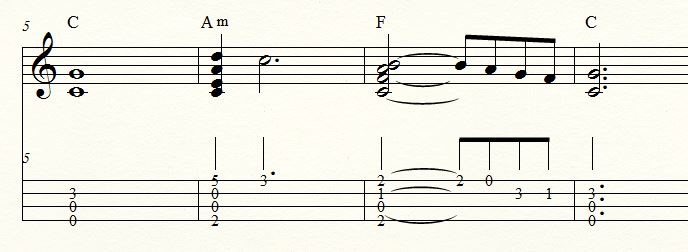
Take note . . . . I arranged this piece as a chord/melody arrangement. That means the melody is embedded into the chords that are fingered by the left hand. This makes it fairly easy to play as all you need do is acquire the fingering for each chord and most of the notes are already in place to play. If you are new to playing instrumental ukulele it can be a bit of adjustment from doing standard rhythmic strumming patterns for accompanying singing. in this case, we are actually playing entire melodies along with chordal accompaniment. At times the melody is found on the 1st string. At other times the 2nd or 3rd string. In cases where the melody is on a lower string then you need to pay special attention to how many strings you actually strum. So, in looking at the clip above you will notice the melody note in the first measure is found on the third fret of the second string so strum down with the thumb but don’t go beyond the 2nd string. In the second measure the first melody note is on the 5th fret of the first string. This one is easy as you will be strumming down all 4 strings. So you can see that through the piece you will be playing only 2 or 3 strings and not all 4. This is a concept you need to understand very early in playing instrumental pieces on the ukulele. It’s a real different mind set from casually strumming all 4 strings throughout the piece. By the way, I use my right hand thumb on all the notes in this arrangement. I prefer the warm tone and consistency of the thumb rather than alternated with fingers and fingernails. I tend to play up on the neck as well for the best tone.
Full sheet music including standard treble clef and tablature notation is available for purchase $5.39 and can be purchased thru the paypal donate button on the Ukulele Mike website: http://www.ukulelemikelynch.com
Remember, only YOU can prevent forest fires – “SMOKEY THE BEAR SONG” – ukulele tutorial by Ukulele Mike Lynch

Below is the ukulele tutorial of this song as seen on my VIMEO channel:
According to Wikipedia Smokey Bear (often called Smokey the Bear or Smokey) is a mascot of the United States Forest Service created to educate the public about the dangers of forest fires. An advertising campaign featuring Smokey was created in 1944 with the slogan, “Smokey Says – Care Will Prevent 9 out of 10 Forest Fires”. Smokey Bear’s later slogan, “Remember… Only YOU Can Prevent Forest Fires”, was created in 1947 by the Ad Council. In April 2001, the message was updated to “Only You Can Prevent Wildfires”. According to the Ad Council, Smokey Bear and his message are recognized by 95% of adults and 77% of children in the U.S.
Smokey’s correct name is Smokey Bear. In 1952, the songwriters Steve Nelson and Jack Rollins had a successful song named “Smokey the Bear”. The pair said that “the” was added to Smokey’s name to keep the song’s rhythm. During the 1950s, that variant of the name became widespread both in popular speech and in print, including at least one standard encyclopedia. A 1955 book in the Little Golden Books series was called Smokey the Bear and Smokey calls himself by this name in the book. From the beginning, Smokey’s name was intentionally spelled differently from the adjective smoky.
The fictional character Smokey Bear, created by the art critic Harold Rosenberg, is administered by three entities: the United States Forest Service, the National Association of State Foresters, and the Ad Council. Smokey Bear’s name and image are protected by U.S. federal law, the Smokey Bear Act of 1952 (16 U.S.C. 580 (p-2); 18 U.S.C. 711).
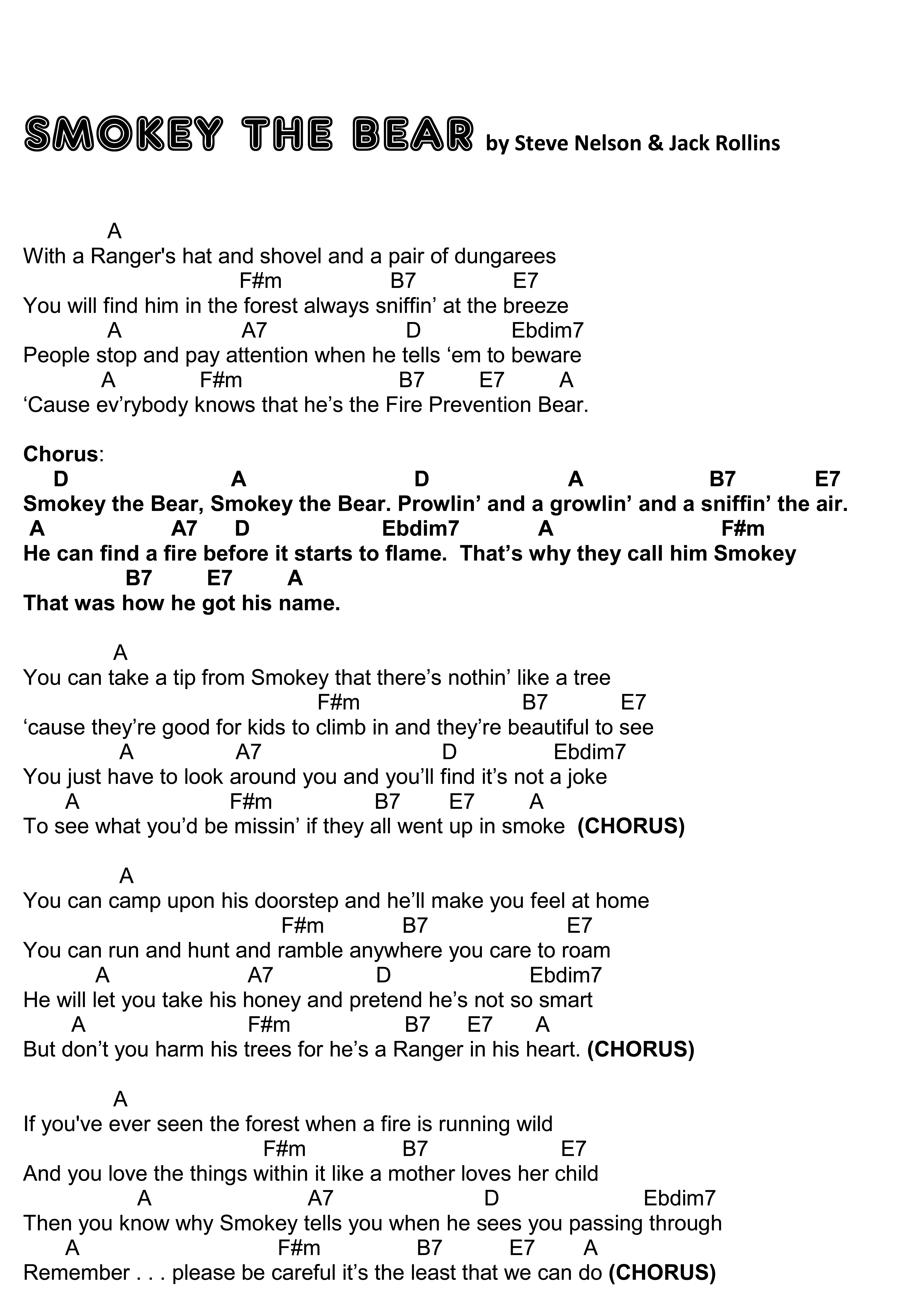
Growing up, Smokey The Bear was a big part of my childhood. I was an official Smokey The Bear Junior Forest Ranger and had a certificate and badge to prove it. I proudly wore that badge and sang the Smokey song. . . I had the record, Golden Book and a bunch of coloring books and comic books. This is a fun song to do and great for campfires. But remember to follow Smokey’s rules about fires in the forest. Remember only YOU can prevent wildfires. . . which is the latest Smokey slogan. The song is in 4/4 time and I’m using a simple syncopated Down Up Down Up Down Up Down Up strum pattern. See the tutorial video for further explanation of chord fingerings.
Below is a Lyric/Chord sheet for Smokey The Bear song:
A VINTAGE SMOKEY BEAR TV AD:
CURRENT SMOKEY BEAR TV AD
Jazz icon Erroll Garner’s “MISTY” – arranged for solo ukulele by Ukulele Mike Lynch

Erroll Louis Garner (June 15, 1923 – January 2, 1977) was an American jazz pianist and composer known for his swing playing and ballads. His best-known composition, the ballad “Misty”, has become a jazz standard. Scott Yanow of Allmusic calls him “one of the most distinctive of all pianists” and a “brilliant virtuoso”.
Notice the short excerpt from my arrangement of MISTY shown below

A stylistic element used in this arrangement is the use of slurs. A slur occurs where you play one note and move up or down to the next note without plucking it again with the right hand. It can be done either as a slide S or a hammer on H.
These terms were first used the the celebrated folk singer, songwriter and author Pete Seeger.
MISTY is included in the newly released 52 song CHORD/MELODY eBook from Ukulele Mike Lynch. It sells for just $20.00 and can be purchased by paying through the paypal donate button on the Ukulele Mike website: http://www.ukulelemikelynch.com Once purchased, it will emailed to you within the day.


Each of the Chord/Melody eBooks can be purchased separately for just $20.00 or all together at a new combo “TRILOGY” discount of just $50.00


For information regarding any ukulele product please email:TheUkuleleMan2012@hotmail.com
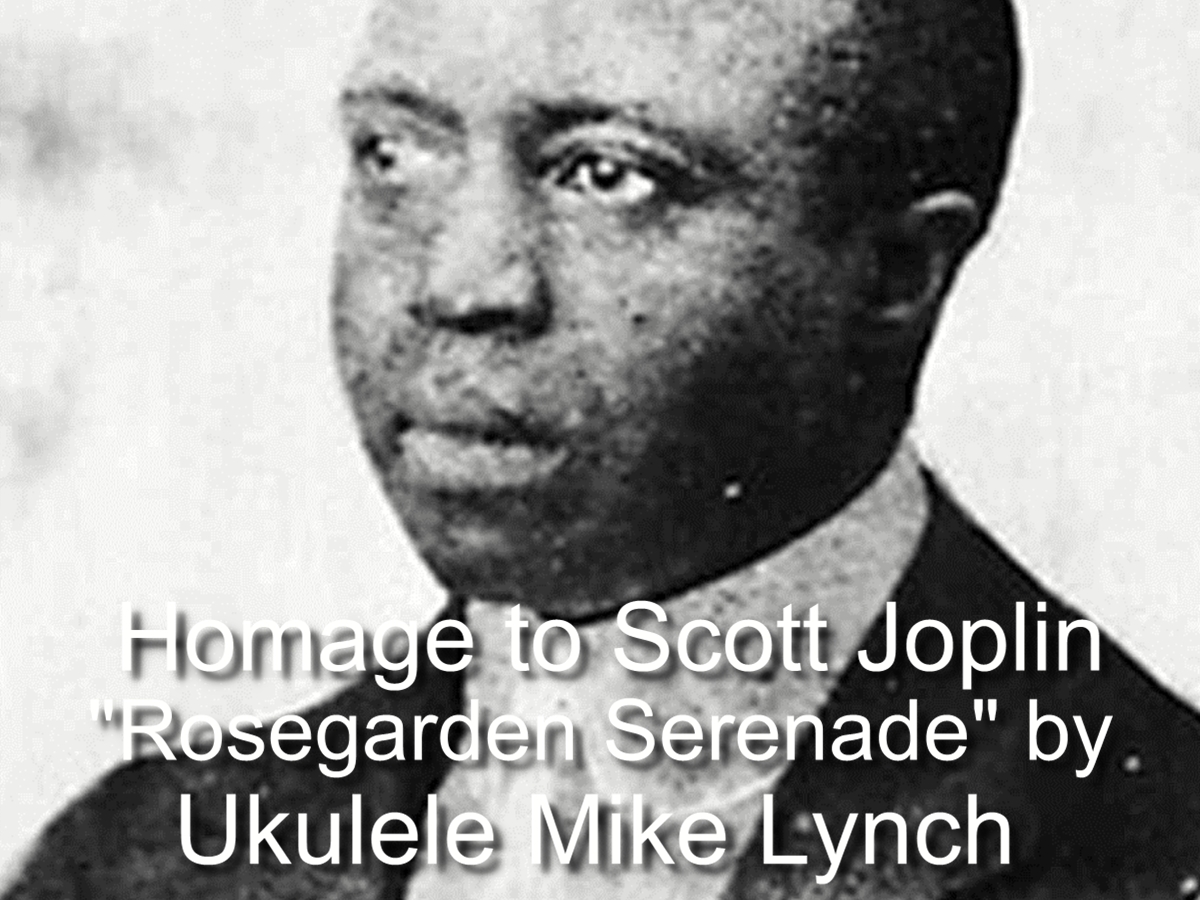
When I was quite young I have distinct memories of visiting my grandma who lived in Oregon and in her home where she lived from about 1915 was this very cool player piano. I would spend hours pushing on those pedals and watching the magic of the keys going down to produce that delicious old player piano sound. Many of the rolls I enjoyed the most were performances of ragtime pieces composed by the KING of ragtime: Scott Joplin.
Later in life as a young college student I would regain my interest in Joplin and acquired his complete works. I recall my mom being in the living room sitting down crocheting and listening to me play and would as me to play another and another. I thumbed through the book and fell upon this piece called The Heliotrope Bouquet and almost as soon as I began playing it my mom called out. . “That was one of the rolls that grandma had”! I said, I thought it sounded familiar. . . and sure enough Scott Joplin was writing these classic rags around that very same time that grandma moved into her farm house down along the McKenzie River in Oregon state USA.
Playing that song brought back memories of that quaint player piano sound and I came to love Joplin’s music even more. One day while improvising on my ukulele I sort of heard that piece in my head and began to compose a similar piece and in a way I was chanelling Joplin. He always admonished players NEVER to play ragtime fast. So my approach to The Rosegarden Serenade became that of a slow rag . . Below is a you tube video performance. Take a few minutes to listen . . . .
The short excerpt from the tablature notated arrangement below will illustrate several important elements found in ragtime music
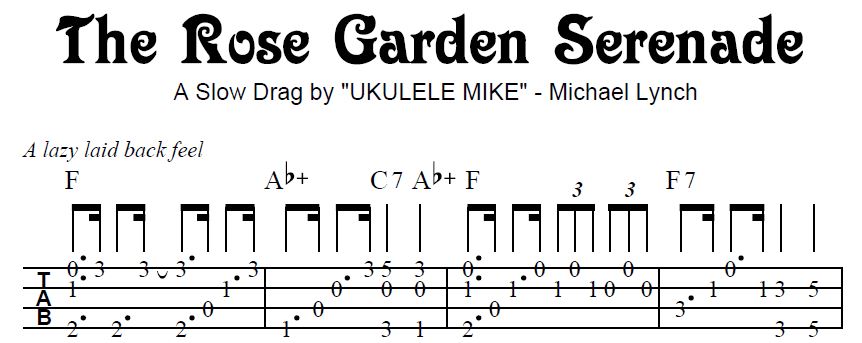
One element that is found in this short clip and truly throughout the piece is the rhythmic figure of a dotted 8th note followed by a 16th note. Long Short Long Short. . . This is identified as a “swing” rhythm and you can find this rhythm in veritually every ragtime composition. I’m playing this piece with the thumb playing the 4th and 3rd strings, the index finger playing the 2nd string and the middle finger playing the 1st string. Another element would be the parallel shifting of chords up and or down such as at the end of the second measure, or in the triplets. I designed this piece on a high G tuned ukulele so a slight modification needs to be made to correct that pitch difference. On the 2nd beat of the first measure notice the 2nd fret on the 4th string is played. . . That works fine with a High G tuning but if you have a Low G you need to alter that note to be 1st string open.
The complete tablature notation of Rosegarden Serenade is contained in my UKULELE SOLO INSTRUMENTAL eBook 2013 Enlarged edition. It can be purchased by paying $28.95 thru the paypal donate button on the Ukulele Mike website: http://www.ukulelemikelynch.com

Table of Contents of the Ukulele Solo Instrumentals Vol 1 enhanced edition:
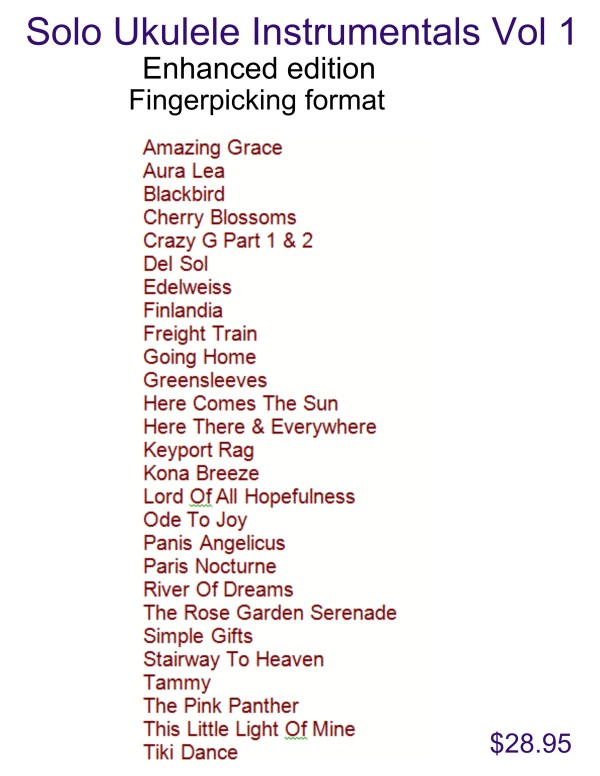
See below a video which more fully describes the contents of this collection . . .
Don’t forget I have an entire Library of Chord/Melody collections. Each eBook can be purchased individually or all together in the Tri Pak at a discount

Inquiries regarding any Ukulele resource, please email: TheUkuleleMan2012@hotmail.com
In the Fingerpicking eBook from Ukulele Mike – – – -Part II of the DREAMSCAPE TRILOGY – “CHERRY BLOSSOMS” – Solo Ukulele composition by Ukulele Mike Lynch

“CHERRY BLOSSOMS” is the second part of my 3 part composition: DREAMSCAPE TRILOGY. First part being Paris Nocturne and the 3rd part being River Of Dreams. All three parts have a similar feel and similar right hand fingering technique. Below is a short clip in Finale format from CHERRY BLOSSOMS.
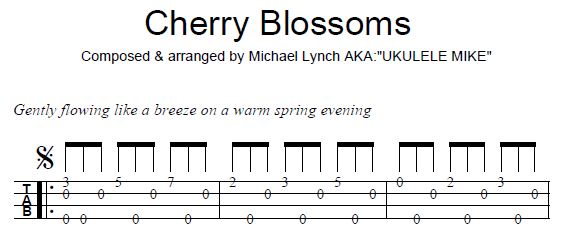
The recurring right hand figure throughout the piece is
m p i m p i m p i m p i
Where: m is Middle finger p is thumb and i is index finger
Middle finger always plays the 1st string.
Index finger always plays the 2nd string.
Thumb plays the 4th and 3rd strings.
Enjoy all of the open strings in this piece. They are the ones with a zero on them. They are played but no left hand fingering applied to them.
“CHERRY BLOSSOMS” needs to be played gently with a smooth flowing triplet feel. . . accenting the first beat.
Below is a You Tube video of “CHERRY BLOSSOMS”
This composition is included in my large Ukulele Solo Instrumentals eBook 2013 Edition by Ukulele Mike Lynch.
It sells for $28.95 and can be purchased by paying through the paypal donate button on my website: http://www.ukulelemikelynch.com
Check out my Word Press blog regarding the Ukulele Solo Instrumentals eBook
I also have a library of Chord Melody eBooks. They can be purchased separately or all together at a discount:
Inquiries regarding any Ukulele Resource, Please email: TheUkuleleMan2012@hotmail.com
The “EVERYMAN” ukulele arranger – Ukulele Mike Lynch

The “Everyman” Ukulele arranger . . . . Ukulele Mike Lynch
In my many years as a music educator, I’ve come to realize that musical skills can be taught to everyone.
But how do we do that as music teachers? Early on I began my journey to discover the answer.
I’ve always had a curious mind about how music works. . . How it functions . . . how it is “made”. I was that child that took things apart to find out how they worked. . . . I would be excited when I found the answer but wasn’t always so successful in getting them put back together again. . . Nevertheless, I have often held the thought that music similarly is a mystery waiting to be “decoded”. I vividly remember in my childhood of sitting by our radio and hearing Patsy Cline sing “CRAZY” and was entranced by not only her voice but by, of all things, the chord progression. Why did that song work the way it did? What seemed to be unique to that song. I would run over to the piano to “figure it out” without the advantage of sheet music. I “decoded” that song and discovered the progression that the composer, Willie Nelson conceived to accompany that melody. I remember taking that progression and composing my own original melody over the top of it and realized that the process of composing or arranging was something I wanted to do for the rest of my life. As a result of many years of composing, arranging, record producing and teaching I’ve developed skills that allow me to tailor an arrangement so it’s just perfect for the performer it’s intended for.
In arranging solo instrumentals for ukulele I continuously take into account the needs of the performers they are intended for . . . YOU!!! . . . . . I’ve spent countless hours pouring over ukulele instrumental collections in my attempt to find suitable pieces for my students, only to discover that they all had things that just didn’t work. Inappropriate keys . . . . excessive barring . . . difficult to awkward fingerings . . . too many notes using complex rhythmic values . . . I take into account that many are done as archiving existing recorded performances by celebrated ukulele performers, and that’s cool, but I submit that the majority of publications of ukulele instrumentals are intended for only a few select players and there is generally no effort to make them accessible to the “Everyman”.
In my many years as a music educator I also found limitations with curriculum materials offered for classroom music teaching so I ended up composing and arranging my own materials. I found ways to make them more accessible to the students while retaining compelling and challenging elements inherent in the pieces. I have always been on the search to “decode” music and find more direct ways of presenting it and helping students grow in their skills.
So now I come to the specific topic of Ukulele instrumentals. It’s my mission to open up the grand possibilities of instrumental playing to EVERYONE . . . to the “Everyman” and “Everywoman” . . .
Granted, going from simple strummed accompaniment ukulele to full blown instrumental ukulele can be a big step for anyone but it’s my goal to make that process easier and fun.
One hurdle one needs to get over is the subject of TABLATURE. What, exactly is TABLATURE? That’s the first question to answer. Let’s get this straight TABLATURE or TABS is NOT a simple lead sheet with lyrics and chords indicated. That’s not even close to being tablature. Nevertheless it’s common to see that on the internet that sites or presenting “TABS” and they are not “TABS” at all. . . They are simply the lyrics with chords placed above the words where the chords occur in the song. TABLATURE is a real, authentic form of notation. It goes back to the middle ages when it was first used in notating composed music for such stringed instruments as Lutes, viols, proto guitars etc . . .
It bypasses the standard Treble clef notation typically used for music. No longer do we have 5 lines and 4 spaces but rather FOUR LINES which indicated the FOUR STRINGS of the ukulele.
The top line represents the 1st string of the ukulele which would be the one nearest your knee. The 4th line represents the 4th string which is the one nearest your chin. Numbers on each string represent where you place your finger to get that note. A zero on a string means the string is played but it’s open.
In my earlier notated instrumentals I show only the TABLATURE staff but now I’m including the corresponding Treble Clef notation as well. Having the standard treble clef notation can be helpful in regards to reading time values since ukulele tablature doesn’d always do the best job so looking up above you can see the exact timing of each note. Note . . You do NOT have to know how to read standard treble clef notation to play ukulele solo instruemental pieces. Often having the tablature in front of you and listening to the You Tube or VIMEO recordings of the piece, one can effectively learn the pieces.
A good portion of my solo ukulele pieces are done as Chord/Melody arrangements. In many cases all you need to do is finger the chord indicated above the line and you have most of your left hand fingers already in place. Where you see a zero, that simply means no finger is place on that string but the string is still played. If there is no number on the string then you don’t play that string. That’s one aspect of instrumental ukulele that can be a bit confusing to people who have been only playing strummed accompaniment for singing, in which case one generally strums all of the strings.
I work hard to choose keys that are “friendly” to the ukulele and for most early level players. . . F, G, C Am and Dm are especially great keys to use. As I play through each key I determine which is best in reference to how many chords will need to be barred or high up on the neck. If at all possible I try to keep a good portion of the melody part of the song on the first or second string.
After playing through the song many times I begin to determine what rhythmic elements I want to introduce into the piece. I try to eliminate confusing note values if at all possible.
As time goes on I will be adding more material and examples to this blog so come back to it on occasion to see what’s new. In lieu of individual private lessons, I am attempting to bring my teaching elements to you in the best ways I know how.
If you’ve never attempted ukulele solo playing, I’d highly suggest downloading SMILE by Charlie Chaplin . . It’s found attached as a pdf file in another blog and is free of charge. I like it for beginning players as it is all pretty much in the first 3 frets and simply uses the thumb to stroke all of the chords and individual melody notes. I also have a VIMEO video uploaded that you can watch and hear for this song.
In the end, when learning to play solo instrumental ukulele we need to have patience . . . lots of patience. It takes a little time to understand and get used to the tablature format, but once there you’ll get many years of enjoyment from it. . . Happy Strumming, Mike Lynch
I forgot to mention my one big collection of tablature notated tunes Ukulele Solo Instrumentals ebook 2013 edition. It sells for $28.95 and can be purchased by paying through the paypal donate button on my website: http://www.ukulelemikelynch.com
Here is a You Tube video explaining the contents of that eBook

Enjoy the video performance and tutorial I made for this song on VIMEO
Source information derived from Wikipedia:
The New Christy Minstrels are an American folk music group founded by Randy Sparks in 1961. They recorded over 20 albums and had several hits, including “Green, Green”, “Saturday Night” and “Everybody Loves Saturday Night” (two different songs), “Today”, “Denver”, and “This Land Is Your Land”. Their 1962 debut album, Presenting The New Christy Minstrels won a Grammy Award and sat in the Billboard charts for two years. The group sold millions of records and were in demand at concerts and on television shows.They also launched the musical careers of several musicians, including Kenny Rogers, Larry Ramos, Gene Clark, Kim Carnes, and Barry McGuire.
Randy Sparks (b. 29 July 1933, Leavenworth, Kansas) is a musician, singer-songwriter and founder of The New Christy Minstrels and The Back Porch Majority. Sparks grew up in Oakland, California and attended the University of California at Berkeley. his first musical engagement was at the Purple Onion in San Francisco. In the late 1950s he had a solo career and released two albums on the Verve label, a self-titled album in 1958 and Walking the Low Road in 1959. The single, “Walkin’ The Low Road”, had previously reached the Cashbox magazine Top 60. In 1960 he formed a trio called “The Randy Sparks Three” and had an album by that same name. He wrote the song “Today” which was a hit for the New Christy Minstrels for their 1964 album of the same title for Columbia Records (CL 2159/CS 8959) and he wrote “Green, Green” with Barry McGuire for the 1963 album Ramblin (CL 2055/CS 8855).
Once again, it’s no surprise that I chose the Key of Fmajor for this Chord/Melody arrangement. The song is in 3/4 or waltz time. Accent the first beat of each measure and if it’s a chord then roll it in a harp like fashion. See the clip below
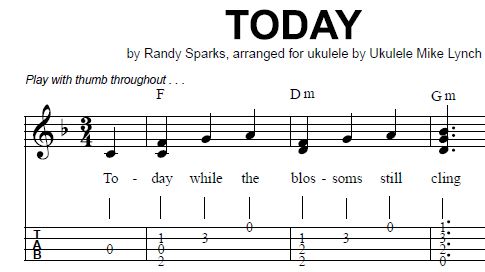
In many chord/melody arrangements simply fingering the chord notated above the music usually sets the fingering for the left hand. Of course, this won’t work if the chord is played up the fingerboard in an upper inversion. We will cover chord inversions in another lesson and video tutorial later.
“TODAY” is included in the newly released 52 song CHORD/MELODY eBook from Ukulele Mike Lynch
It sells for just $20.00 and can be purchased by paying through the paypal donate button on the Ukulele Mike website: http://www.ukulelemikelynch.com Once purchased it will be emailed to you within the day.
Here is a YouTube video detailing the contents of the new 52 song CHORD/MELODY eBook
Note that I have a large collection of ukulele solo arrangements called SOLO UKULELE INSTRUMENTALS eBook 2013 enlarged edition. It also sells for just $20.00
See video below that explains the contents of the SOLO UKULELE INSTRUMENTALS eBook.
For information regarding any ukulele product please email:
TheUkuleleMan2012@Allhotmail.com
The Chord/Melody eBooks can each be purchased separately for just $20.00 or as a combined whole for the new “TRILOGY” discount of just $50.00

Announcing the release of the NEW Chord melody ebook FOUR $25.95


All 4 of the Chord melody ebooks can be purchased at the combo QUARTET price of $70
Questions Regarding any Ukulele resource please email TheUkuleleMan2012@hotmail.com
 UKULELE MIKE LYNCH - All things UKULELE