
TABLE OF CONTENTS
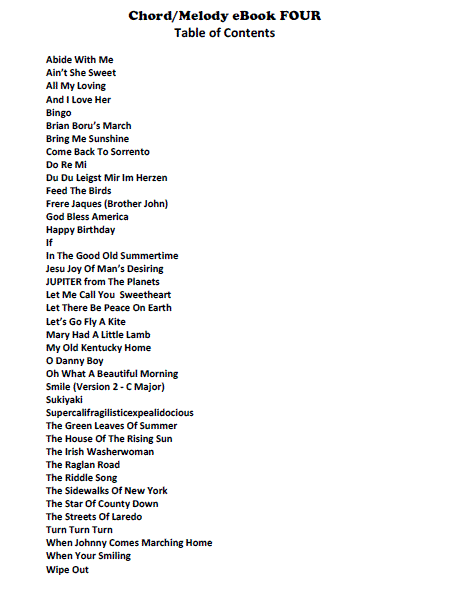
Chord/Melody eBook FOUR can be purchased by making a payment of $25.95 through the paypal button on the Ukulele Mike website: http://www.ukulelemikelynch.com
Once purchased, it will be personally emailed to you within the day . . . Bear in mind these collections are delivered as PDF files . . . LARGE easy to read format.
Also available is the Chord/Melody “TRILOGY”, now reduced to just $50.00


Questions regarding any Ukulele resource, please email: TheUkuleleMan2012@hotmail.com
UKULELE MIKE LYNCH . . . LIVE! on Facebook . . . His very FIRST Live Show! . . . .Wednesday 12 Noon EST / 9am PST . . . See you all there

Welcome to my very FIRST FACEBOOK LIVE show . . . Go to http://www.facebook.com/UKULELEMIKE and post questions in the comment section. I’ll try to answer as many as possible . . .
TheUkuleleMan2012@hotmail.com

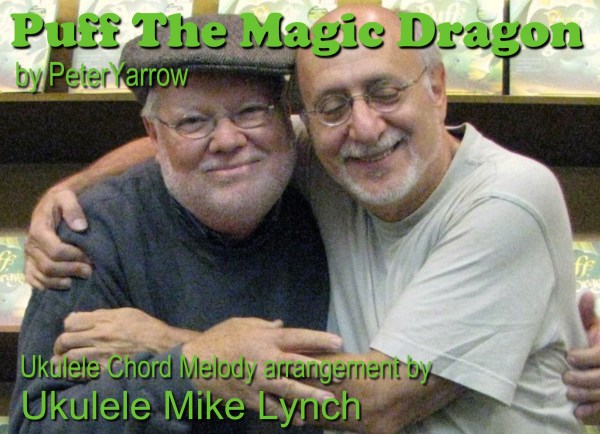 Performance of “Puff The Magic Dragon” by Peter, Paul & Mary
We learn from Wikipedia that “Puff, the Magic Dragon” (or “Puff”) is a song written by Leonard Lipton and Peter Yarrow, and made popular by Yarrow’s group Peter, Paul and Mary in a 1963 recording. The song achieved great popularity.
The lyrics for “Puff, the Magic Dragon” were based on a 1959 poem by Leonard Lipton, a 19-year-old Cornell University student.[1] Lipton was inspired by an Ogden Nash poem titled “Custard the Dragon“, about a “realio, trulio little pet dragon.”
The lyrics tell a story of the ageless dragon Puff and his playmate Jackie Paper, a little boy who grows up and loses interest in the imaginary adventures of childhood and leaves Puff alone and depressed. (Because of the line “A dragon lives forever, but not so little boys”, the lyrics may imply to…
View original post 434 more words
 Wonderful performance of “Jamaica Farewell” by Harry Belafonte
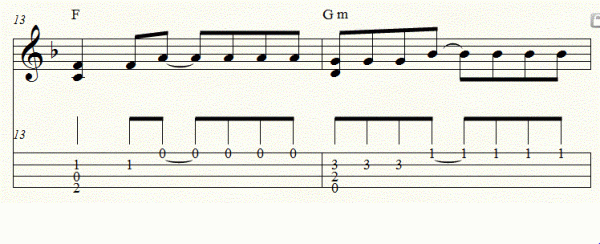
Below is a short clip from the Chord/Melody arrangement of “Jamaica Farewell”
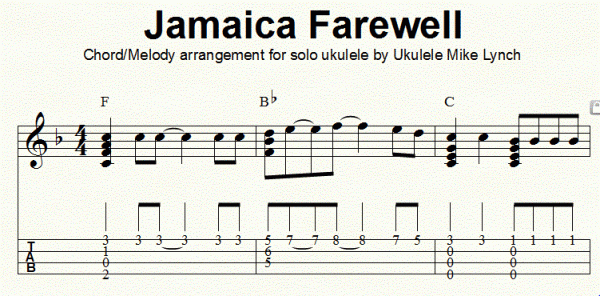 Another short clip . . .
 “Jamaica Farewell” is included in the Chord/Melody eBook TWO. The collection can be purchased by making a payment of just $20.00 through the paypal button on the Ukulele Mike website: http://www.ukulelemikelynch.com Once purchased, it will be personally emailed to you within the day. . .
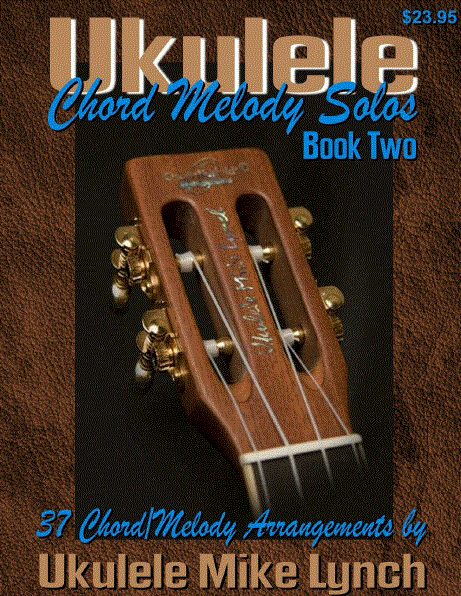 Full Table of Contents. . .
 Each of the Chord/Melody eBooks can be purchased separately for just $20.00 or all together at a new “TRILOGY” combined discount of just $50.00

Questions regarding any Ukulele resources, please email: TheUkuleleMan2012@hotmail.com
 Recorded performance of Can’t Help Falling In Love by Elvis Presley
This song works very well as a Chord/Melody arrangement . . . Below is a short excerpt from the beginning of “I Can’t Help Falling In Love”
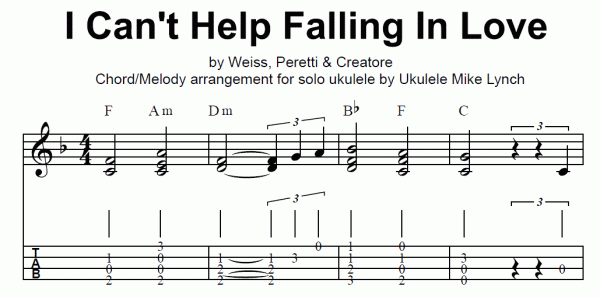 Notice in the above excerpt that the melody begins on the second string then immediately jumps to the first string.. . Then, back to the 2nd . .. . So be very careful not to give into the temptation to play all four strings. . . . This is the chief difference between playing solo instrumental pieces to generally playing all four strings while we strum the chords to accompany singing . . . Notice the Bb chord in the 3rd measure . . . So work on that chord. . . it’s very important to get the Bb chord down. . . . I have a blog specifically dedicated to the challenge…
View original post 167 more words
Ch
“Chariots of Fire” proved to be a perfect fit as a Chord/Melody arrangement . . . Remember, in Chord/Melody style you simply place the fingers on the chord and brush it with just the thumb. . . The melody automatically presents itself . . . Below is a short excerpt from this iconic soundtrack . . .
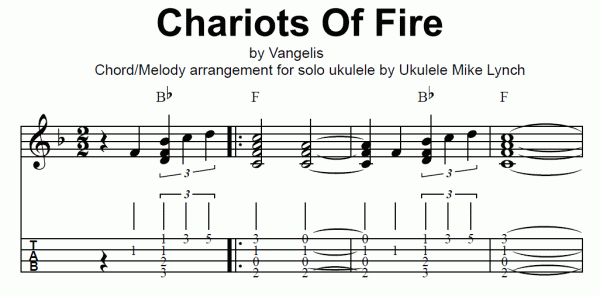 Learning this piece will give us a great “opportunity” to finally learn to play our Bb chord. It’s such an important chord to us as it appears in virtually every song in the Key of F. . . The Key of F is one of the most ideal keys for playing solo instrumentals on the Ukulele.
Below is yet again another short excerpt . . This clip is the beginning of the BRIDGE to the song. . .
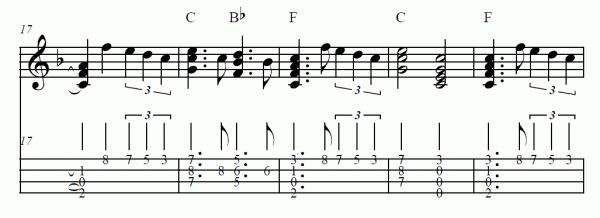 Notice in measure 18, the Bb chord is an entirely different fingering from that found…
View original post 121 more words

Below is a short excerpt from the opening of “I’ll Never Find Another You”.
 Here is yet another short excerpt from I’ll Never Find Another You”
 Note at measure 10 we need to Barre the 10th fret. . . with the ring finger extending up to the 13th fret of the 2nd string. This is probably the most difficult element in this arrangement . . . So be patient with yourself . . . You are definitely up in the higher stratosphere of the fingerboard.
“I’ll Never Find Another You” is contained in the Chord/Melody eBook THREE. . . It can be purchased by making a payment of just $20.00 through the paypal button on the Ukulele Mike website: http://www.ukulelemikelynch.com

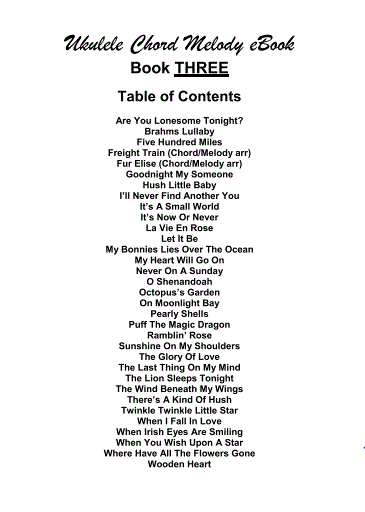 You can purchase each of the Chord/Melody eBooks individually for just $20.00 or all together at a new combo “TRILOGY” discount of just $50.00

Questions regarding any Ukulele resources, please…
View original post 2 more words
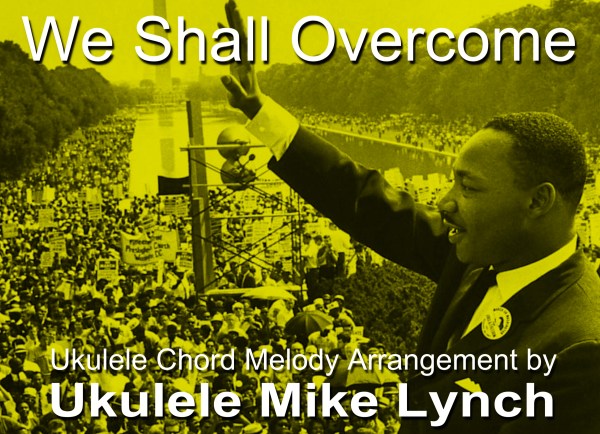 Performance by Joan Baez
HiWe learn from Wikipedia that
The song “We Will Overcome” was published in the September 1948 issue of People’s Songs Bulletin (a publication of People’s Songs, an organization of which Pete Seeger was the director and guiding spirit). It appeared in the bulletin as a contribution of and with an introduction by Zilphia Horton, then music director of the Highlander Folk School of Monteagle, Tennessee, an adult education school that trained union organizers. In it, she claims no ownership of the song and in fact wrote that she had learned the song from members of the CIO Food and Tobacco Workers Union: “It was first sung in Charleston, S.C. … Its strong emotional appeal and simple dignity never fails to hit people. It sort of stops them cold silent.” It was her favorite song and she taught it to countless others, including…
View original post 272 more words
 Peter, Paul & Mary performing Where Have All The Flowers Gone”
We learn from Wikipedia that “Where Have All the Flowers Gone?” is a modern folk-style song. The melody and the first three verses were written by Pete Seeger in 1955 and published in Sing Out! magazine. Additional verses were added by Joe Hickerson in May 1960, who turned it into a circular song. Its rhetorical “where?” and meditation on death place the song in the ubi sunt tradition. In 2010, the New Statesman listed it as one of the “Top 20 Political Songs”.
The 1964 release of the song as a Columbia Records 45 single, 13-33088, by Pete Seeger was inducted into the Grammy Hall of Fame in 2002 in the Folk category.
This is by far one of the easiest of my Chord/Melody pieces. . . It involves no barring so the left hand fingering is quite…
View original post 244 more words
We learn from WIKIPEDIA that “Morning Has Broken” is a popular and well-known Christianhymn first published in 1931. It has words by English author Eleanor Farjeon and is set to a traditional Scottish Gaelic tune known as “Bunessan” (it shares this tune with the 19th century Christmas Carol “Child in the Manger”). It is often sung in children’s services. English pop musician and folk singerCat Stevens (known as Yusuf Islam since 1978 after becoming a Muslim in 1977) included a version on his 1971 album Teaser and the Firecat. The song became identified with Stevens when it reached number six on the U.S. Billboard Hot 100 and number one on the U.S. easy listening chart in 1972.
“Morning Has Broken” is definitely one of the most easily accessible pieces contained in the Chord Melody eBook TWO. . . As in all Chord Melody arrangements…
View original post 340 more words
 UKULELE MIKE LYNCH - All things UKULELE