
Performance by Joan Baez
HiWe learn from Wikipedia that
The song “We Will Overcome” was published in the September 1948 issue of People’s Songs Bulletin (a publication of People’s Songs, an organization of which Pete Seeger was the director and guiding spirit). It appeared in the bulletin as a contribution of and with an introduction by Zilphia Horton, then music director of the Highlander Folk School of Monteagle, Tennessee, an adult education school that trained union organizers. In it, she claims no ownership of the song and in fact wrote that she had learned the song from members of the CIO Food and Tobacco Workers Union: “It was first sung in Charleston, S.C. … Its strong emotional appeal and simple dignity never fails to hit people. It sort of stops them cold silent.” It was her favorite song and she taught it to countless others, including Pete Seeger, who included it in his repertoire, as did many other activist singers, such as Frank Hamilton and Joe Glazer, who recorded it in 1950.
According to the late Pete Seeger, the song is thought to have become associated with the Civil Rights Movement from 1959, when Guy Carawan stepped in as song leader at Highlander, which was then focused on nonviolent civil rights activism. Seeger states the song quickly became the movement’s unofficial anthem. Pete Seeger and other famous folksingers in the early 1960s, such as Joan Baez, sang the song at rallies, folk festivals, and concerts in the North and helped make it widely known. Since its rise to prominence, the song, and songs based on it, have been used in a variety of protests worldwide.
My Chord/Melody arrangement of “We Shall Overcome” is without a doubt one of the easiest arrangements in all of my Solo Ukulele collections. . . As in all Chord/Melody we use no fingerpicking. . . Merely strumming the thumb to acquire simultaneously the chord as well as the melody. . . . Try is short excerpt from the opening measures of the song.
“We Shall Overcome” is contained in the Chord/Melody eBook TWO. It can be purchased by making a payment of just $20.00 through the paypal button on my website: http://www.ukulelemikelynch.com Once purchased, it wll be personally emailed to you within the the day. . .
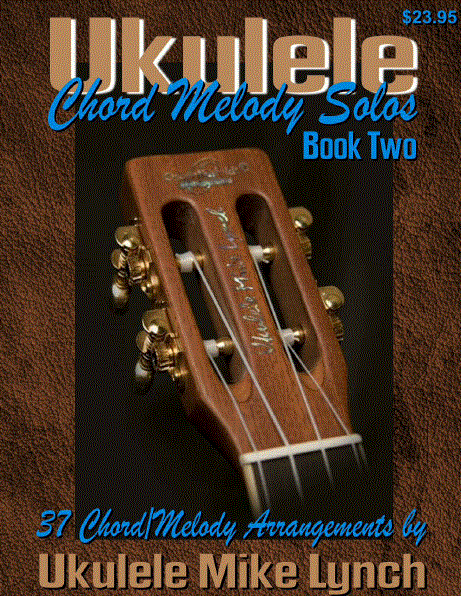
Table of Contents

Each of the Chord/Melody collections can be purchased separately for just $20AA.00 or all together at a combined discount of just $50.00 . . .

Announcing the release of the NEW Chord melody ebook FOUR $25.95


All 4 of the Chord melody ebooks can be purchased at a combo QUARTET discount of $70

Questions regarding any Ukulele resource, please email: TheUkuleleMan2012@hotmail.com

 “Bridge Over Troubled Water” as sung by Simon & Garfunkel
We learn from WIKIPEDIA that “Bridge over Troubled Water” is a song by American music duo Simon & Garfunkel from their fifth studio album, Bridge over Troubled Water (1970). Produced by the duo themselves and Roy Halee, the song was released as the follow-up single to “The Boxer” on January 26, 1970. Composed by singer-songwriter Paul Simon, the song is performed on piano and carries the influence of gospel music. The original studio recording employs elements of Phil Spector‘s “Wall of Sound” technique using L.A. session musicians from the Wrecking Crew.
It was the last song recorded for their fifth and final album, but the first fully completed. The song’s instrumentation was recorded in California while the duo’s vocals were cut in New York. Simon felt his partner, Art…
View original post 1,147 more words
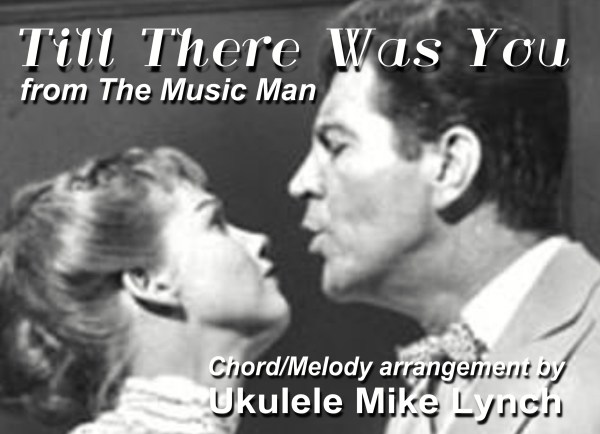
Performance of “Till There Was You”
We learn from Wikipedia that “Til There Was You” is a song written by Meredith Willson for his 1957 musical play The Music Man, and which also appeared in the 1962 movie version. The song is sung by librarian Marian Paroo (Barbara Cook on Broadway, Shirley Jones in the film) to Professor Harold Hill (portrayed by Robert Preston) toward the end of Act Two. It became a hit for Anita Bryant in 1959 and was later covered by the English rock band the Beatles in 1963
THE BEATLES VERSION . . .
“Till There Was You” was included on the Beatles albums With the Beatles (UK release, 1963) and Meet the Beatles! (US release, 1964), the song was the only Broadway tune that the English rock group ever recorded.
Paul McCartney was introduced to Peggy Lee‘s cover of the song by his older cousin, Bett Robbins, who would occasionally baby-sit the two McCartney brothers. McCartney said: “I had no idea until much later that it was from The Music Man.” “‘Til There Was You” was part of the Beatles’ repertoire in 1962 and performed at the Star Club in Hamburg. It became illustrative of the Beatles’ versatility, proving they could appeal to all sections of an audience, moving easily from softer ballads to harder rock and roll, as in their appearance on November 4, 1963 at the Royal Variety Performance when they followed this song with “Twist and Shout“.
The band had previously performed “‘Til There Was You” as part of their failed audition for Decca Records in London on January 1, 1962, and it was the second of five the group sang during their first appearance on The Ed Sullivan Show on February 9, 1964.
Live versions of the song were released on Live at the BBC (1994) and Anthology 1 (1995). The latter version was recorded when the Beatles played at the Royal Variety Performance; because the album was cut so that live numbers began with the actual song, John Lennon‘s famous request that those in the royal box “rattle your jewelry” to “Twist and Shout” is in fact included on the “‘Til There Was You” track. When introducing this song (likewise placed on “She Loves You” for Anthology), McCartney commented that the song “had also been recorded by our favourite American group, Sophie Tucker“. This tongue-in-cheek comment by McCartney unwittingly began an urban legend that “‘Til There Was You” was an old Sophie Tucker song, when in fact, there is no record of her ever performing the tune. A live performance of “‘Til There was You” by Paul McCartney appears on his DVD The Space Within US.
In 2016, the BBC announced that a “holy grail” Beatles record would be auctioned in March of that year. A private pressing; it features two songs, “Hello Little Girl” and “Til There Was You” and was valued at over £10,000. The disc eventually sold for well over its estimated value – £77,500.
MY CHORD/MELODY ARRANGEMENT
I originally did this as a FINGERPICKING, arpeggio arrangement a few years ago. . . It worked quite well in that format, but then I wondered how it mght work as a Chord/Melody arrangement. I discovered that it gave it a kind of gentler, softer approach and it worked very well . . . It has very delicious chords (Jazz chords) and plenty of them to keep the left hand busy. . . See below the first few measures of the piece.
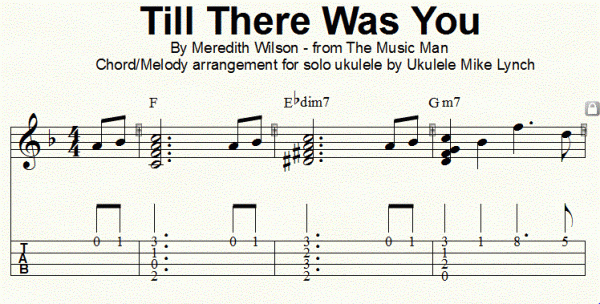
You gotta just love those diminished 7th and minor 7th chords . . . .
The BRIDGE . . .
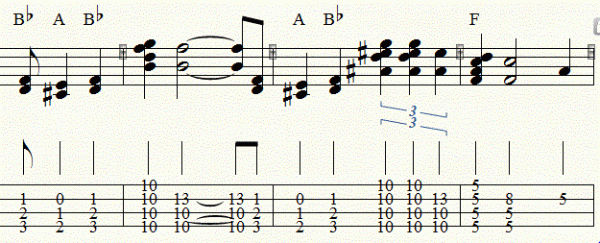
Notice how the melody and therefore the chord inversion takes us clear up to the 10th fret. . . Then we swiftly descend to the 5th fret barre chord on the last measure to play and upper inversion F chord. Admittedly, this will take some degree of practice and lots of patience to get. . . but it’s well worth it as I always say.
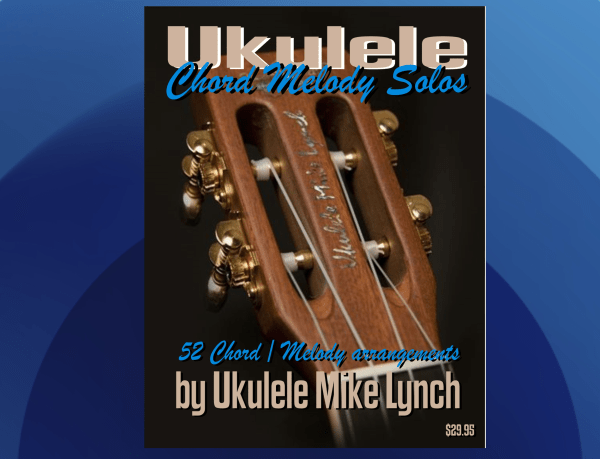
Till There Was You” is contained in the Chord/Melody eBook ONE and can be purchased by making a payment of just $20.00 through the paypal button on the Ukulele Mike website: http://www.ukulelemikelynch.com Once purchased, it will be personally emailed to you within the day. By he way, this is a massively large collection . . . 52 songs in all!
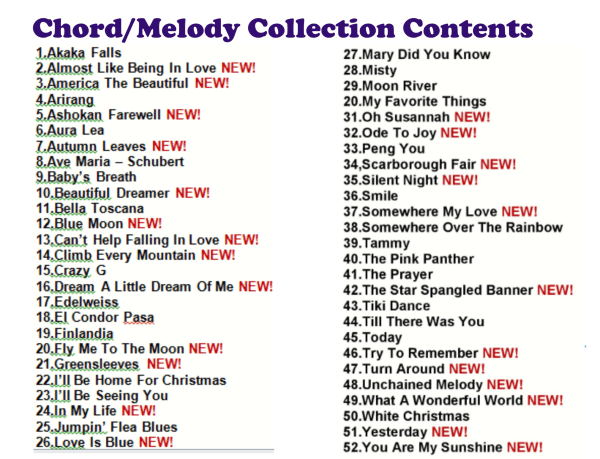
Full table of contents:
Each of the Chord/Melody eBooks can be purchased separately for just $20.00 or all together at a combined discount of just $50.00 . . .

Announcing the NEW Chord melody ebook FOUR $25.95


All 4 of the Chord melody ebooks can be purchased at a combo discount of $70
Questions regarding any Ukulele resource, please email: TheUkuleleMan2012@hotmail.com
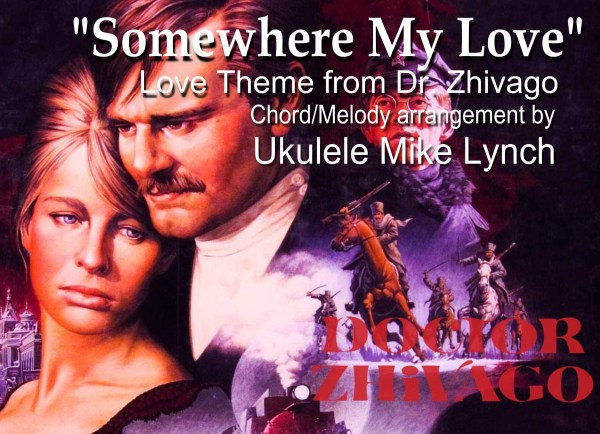
This Chord/Melody arrangement utilizes lots of “Chromatic” shifts. . . Compositionally, they are what give it that distinctive “Russian” sound.
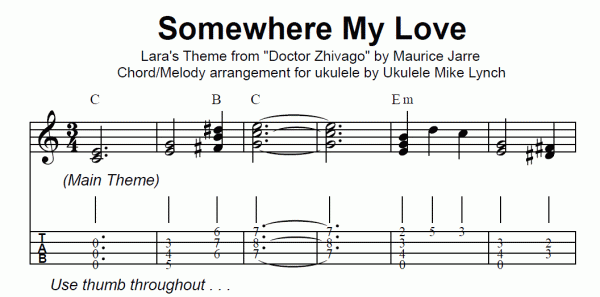 Chromatic merely means moving up or down by half steps . . . We encounter the very first upward Chromatic shift in the 2nd measure at the opening of the piece. . . Its the B chord shifting to the C chord between the second and third measures. Nothing too terribly difficult here . . . just let those shifting notes ring out to fill the air with a hint of cold, winter Russian folk melodies . .
Here is yet another excerpt from later in the piece . . .
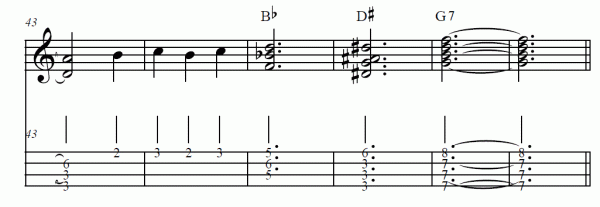 Note the Barre chords on measures 46 and 47. At 46 we Barre the 3rd fret with our index finger while the little finger plays the 6th fret on the first string. Then, it shifts up by 2 frets so that…
View original post 121 more words

“La Vie En Rose” works beautifully as a Chord/Melody arrangement . . . Below is a short excerpt from the opening measure of the piece . . .
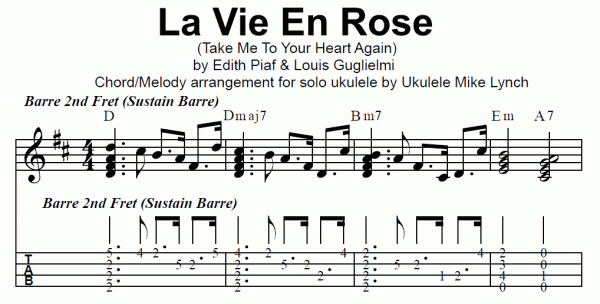 The elegant chords in this piece use a descending pattern based on the continuity of barring the second fret with the index finger while the melody descends on the first string. The first barre chord at the beginning of the first measure should be played with the index finger placed on the 5th fret. Then, you can choose to either slide that down to the 4th fret or place your ring finger on the 4th fret. . . It’s up to you as to which is more comfortable . . . Then at the third measure simply place the index finger across all 4 strings at the 2nd fret.
Here is another short clip . . .
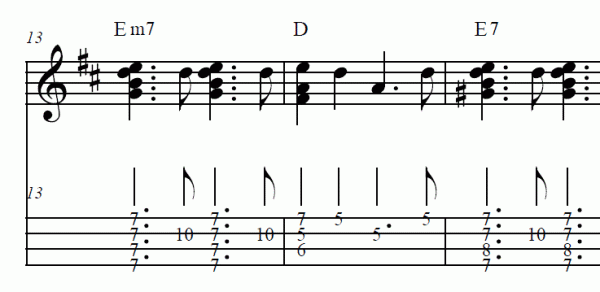 At measure 13 we need…
View original post 127 more words
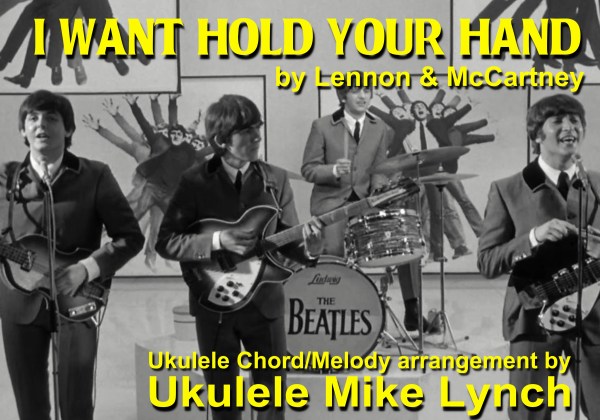
Live performance on the Ed Sullivan Show
Below is a short excerpt from the opening measure of “I Want To Hold Your Hand”

Note, the melody begins on the first string but by the 2nd full measure it drops to the 2nd, 3rd then 4th strings. . . This is a rare occasion where I have brought the melody to the 4th string. It just happens to occur in the midst of a short riff . . . . Using a low G that 4th fret note on the 4th string is perfect. . . On a standard tuning it works, but sounds just a bit different. . .
Here are the beginning measure of the BRIDGE

And here are the final measures of “I Want To Hold Your Hand”
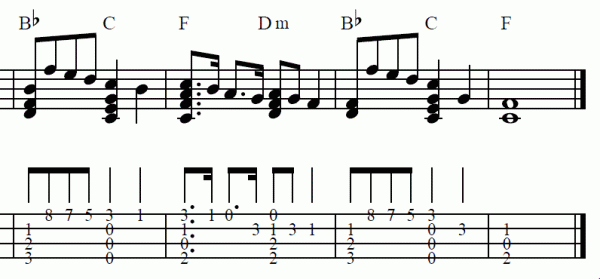
“I Want To Hold Your Hand” is contained in the Chord/Melody eBook TWO. It can be purchased by making a payment of just $20.00 through the paypal button on the Ukulele Mike website: http://www.ukulelemikelynch.com Once purchased, it will be personally emailed to you within the day.
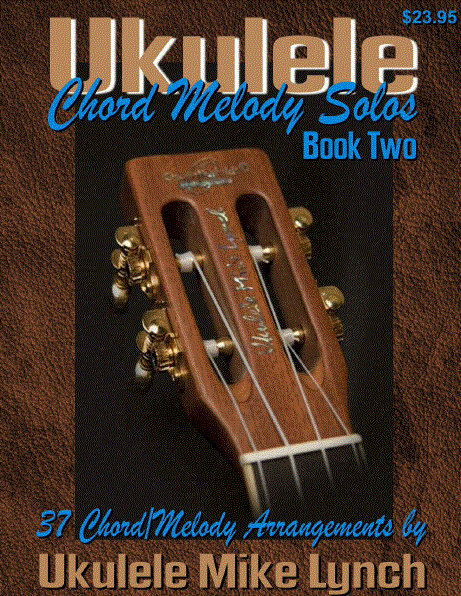
Full table of contents

Each of the current Chord/Melody eBooks can be purchased separately for just $20.00 or all together at a new “TRILOGY” combined discount of just $50.00

Announcing the release of the NEW Chord melody ebook FOUR $25.95
All 4 of the Chord melody ebooks can be purchased at a combo discount of $70
Questions regarding any Ukulele resource, please email: TheUkuleleMan2012@hotmail.com

Performance of “Puff The Magic Dragon” by Peter, Paul & Mary
We learn from Wikipedia that “Puff, the Magic Dragon” (or “Puff”) is a song written by Leonard Lipton and Peter Yarrow, and made popular by Yarrow’s group Peter, Paul and Mary in a 1963 recording. The song achieved great popularity.
The lyrics for “Puff, the Magic Dragon” were based on a 1959 poem by Leonard Lipton, a 19-year-old Cornell University student.[1] Lipton was inspired by an Ogden Nash poem titled “Custard the Dragon“, about a “realio, trulio little pet dragon.”
The lyrics tell a story of the ageless dragon Puff and his playmate Jackie Paper, a little boy who grows up and loses interest in the imaginary adventures of childhood and leaves Puff alone and depressed. (Because of the line “A dragon lives forever, but not so little boys”, the lyrics may imply to some that Jackie Paper dies. Most interpreters believe that he just grew up.) The story of the song takes place “by the sea” in the fictional land of Honalee (the spelling used by author Lenny Lipton, though non-authoritative variations abound.
Lipton was friends with Peter Yarrow’s housemate when they were all students at Cornell. He used Yarrow’s typewriter to get the poem out of his head. He then forgot about it until years later, when a friend called and told him Yarrow was looking for him, to give him credit for the lyrics. On making contact Yarrow gave Lipton half the songwriting credit, and he still gets royalties from the song.
In an effort to be gender-neutral, Yarrow now sings the line “A dragon lives forever, but not so little boys” as “A dragon lives forever, but not so girls and boys.” The original poem also had a verse that did not make it into the song. In it, Puff found another child and played with him after returning. Neither Yarrow nor Lipton remembers the verse in any detail, and the paper that was left in Yarrow’s typewriter in 1958 has since been lost.
In 1961, Yarrow joined Paul Stookey and Mary Travers to form Peter, Paul and Mary. The group incorporated the song into their live performances before recording it in 1962; their 1962 recording of “Puff” reached number two on the Billboard Hot 100 chart and spent two weeks atop the Billboard easy listening chart in early 1963.[4] It also reached number ten on Billboard’s R&B chart.
This is, yet, another of my Chord/Melody arrangements that is quite accessible even for beginning instrumental solo players. . . It’s short, simple, to the point and has fairly easy fingering. . . Below is an excerpt showing both the standard notation as well as the ukulele tablature notation for the opening measures of the song . . .
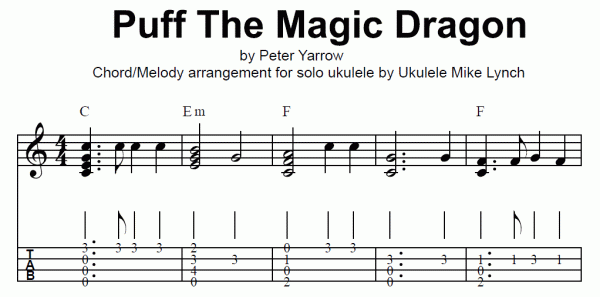
Make note that the melody shifts between the first string and the second string in these four measures . . . no barring necessary in this section . . .
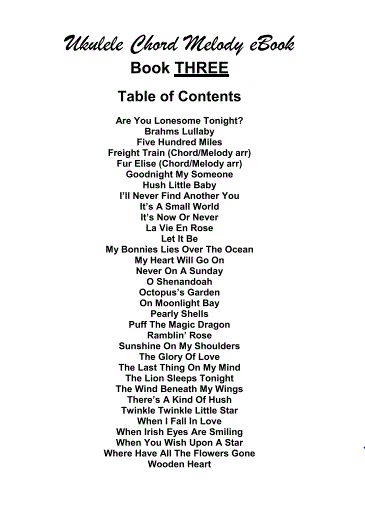
“Puff The Magic Dragon” is contained in the Chord/Melody eBook THREE. It can be purchased by making a payment of just $20.00 through the paypal button on the Ukulele Mike website: http://www.ukulelemikelynch.com Once purchased, it will be personally emailed to you within the day. . .
![chord-melody-3-cover[2]](https://allthingsukulele.com/wp-content/uploads/2016/05/chord-melody-3-cover22.gif?w=600)
Full table of contents:
Announcing the brand new 40 song Chord/Melody eBook FOUR

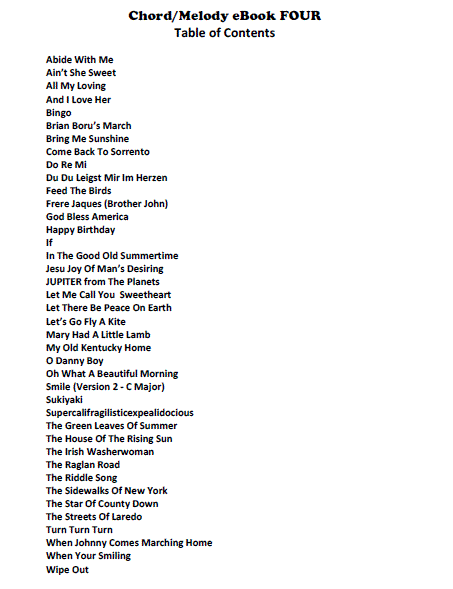
Each of the 3 Chord/Melody eBooks constituting the “TRILOGY” can be purchased individually for just $20.00 or all together at a combined discount of just $50.00

The entire QUARTET of Chord melody ebooks can be purchased for a discount of just $70

Questions regarding any Ukulele resource, please email: TheUkuleleMan2012@hotmail.com

Live performance of Pokarekare ana by Hayley Westenra
We learn from Wikipedia that Pokarekare Ana” is a traditional New Zealand love song, probably communally composed about the time World War I began in 1914. The song is written in Māori and has been translated into English. It enjoys widespread popularity in New Zealand as well as some popularity in other countries. East Coast Māori song-writer Paraire Tomoana, who polished up the song in 1917 and published the words in 1921, wrote that “it emanated from the North of Auckland” and was popularised by Māori soldiers who were training near Auckland before embarking for the war in Europe.
There have been numerous claims and counterclaims regarding authorship over the years. Although the matter has never been definitively settled, guardianship of the words and music is held by the family (descendants) of Paraire Tomoana.
The Māori words have remained virtually unaltered over the decades, with only the waters in the first line being localized. For example, some versions refer to Rotorua, a lake in the North Island. It is then associated with the story of Hinemoa swimming across the lake to her forbidden lover, Tūtānekai, on Mokoia Island. However, there have been many different English translations
I had already arranged this piece some years ago as a purely fingerpicking arpeggio piece. Then I thought, why not do it as a Chord/Melody piece too. . . So here we have a short excerpt from the opening of my Chord/Melody arranagement of “Pokarekare ana”
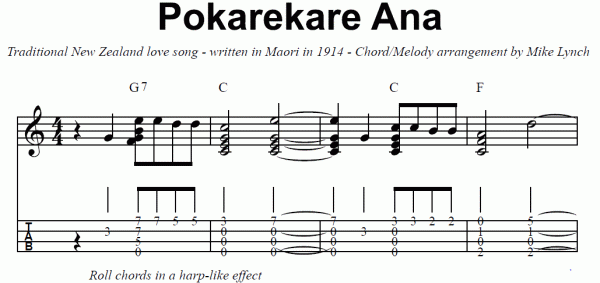
Look at that G7 chord in the first measure . . . It doesn’t look anything like what we might think a G7 chord should be. . . That’s because in Chord/Melody solo performance we routinely play upper fret Chord inversions. . . That’s to accommodate the melody. Solo performance is quite unlike conventional strumming to accompany singing, but it’s well worth the effort and time spent to develop solo playing skills. In Chord/Melody playing only the thumb is used. . . No fingerpicking involved.
Below is the opening of the BRIDGE
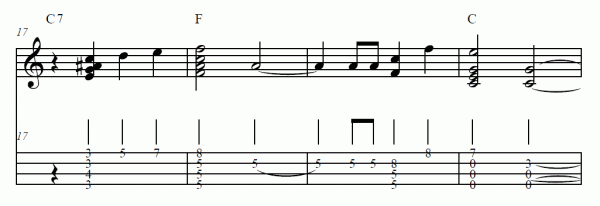
Note in Measure 18 we need to BARRE the 5th fret with the index finger then place the little finger on the 8th fret of the first string. . . . Measure 20 is a cinch . . . just place the little finger on the 7th fret and brush all 4 strings to play the upper inversion of the C chord.
“Pokarekare Ana” is contained in the Chord/Melody eBook TWO. It can be purchased by making a payment of just $20.00 through the paypal button on the Ukulele Mike website: http://www.ukulelemikelynch.com Once purchased, it will be personally emailed to you within the day.
Full table of contents:
Each of the 3 current chord/melody eBooks can be purchased separately for just $20.00 or all together at a combined discount of just $50.00 . . .
All 4 of the Chord melody ebooks can be purchased at a combo discount price 0f &70.

Questions regarding any Ukulele resource, please email: TheUkuleleMan2012@hotmail.com
 A recorded performance by John Denver
We learn from Wikipedia that “Leaving on a Jet Plane” is a song written by John Denver in 1966 and most famously recorded by Peter, Paul and Mary. The original title of the song was “Babe, I Hate to Go” but Denver’s then producer Milt Okun convinced him to change the title.
The song was initially recorded in 1966 by John Denver with the title “Babe, I Hate to Go.” That same year, Denver chose this song along with fifteen others and, with his own money, had 250 copies pressed onto vinyl. He distributed the copies to friends and family. Peter, Paul and Mary were so impressed with the song that they chose to record it themselves and released it on their 1967 Album 1700. However, it didn’t become a hit for them until they released it as a single in 1969.
View original post 344 more words

Louis Armstrong performing “What A Wonderful World”
We learn from Wikipedia that “What a Wonderful World” is a song written by Bob Thiele (as “George Douglas”) and George David Weiss. It was first recorded by Louis Armstrong and released in 1967 as a single, which topped the pop charts in the United Kingdom. Thiele and Weiss were both prominent in the music world (Thiele as a producer and Weiss as a composer/performer). Armstrong’s recording was inducted in the Grammy Hall of Fame in 1999. The publishing for this song is controlled by Memory Lane Music Group, Carlin Music Corp. and BMG Rights Management.
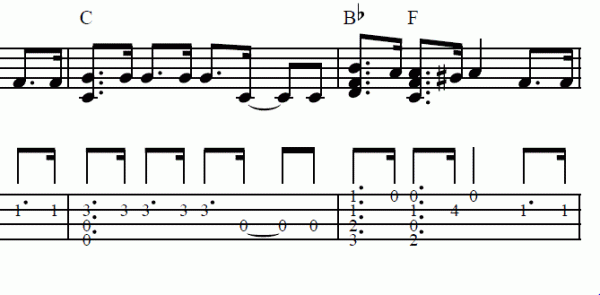
About 5 years ago I did a Ukulele arrangement of this song in a fingerpicking arpeggio format. . . When I first embarked on doing a series of Chord/Melody eBooks, this was among the first I tackled. . . I just felt it could have a new fresh life as a Chord/Melody arrangement and I feel I succeeded in that task. . . Below is a short excerpt from the opening measures . . . It is formatted in both standard notation as well as Ukulele TABLATURE.
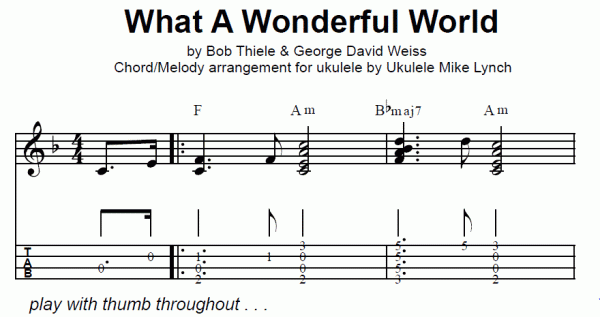
As in all Chord/Melody playing, we simply place the fingers on the notated chords and roll the thumb across the strings. . . The melody presents itself as the top note. of the chord.
Below is the opening of the BRIDGE
“What A Wonderful World” is contained in the Chord/Melody eBook ONE. It is a very large compendium of Chord/Melody arrangements. . . 52 Songs in all . . . It can be purchased by making a payment of just $20.00 through the paypal button on the Ukulele Mike website: http://www.ukulelemikelynch.com Once purchased, it will be personally emailed to you within the day.
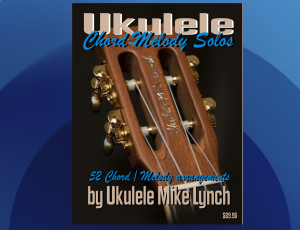
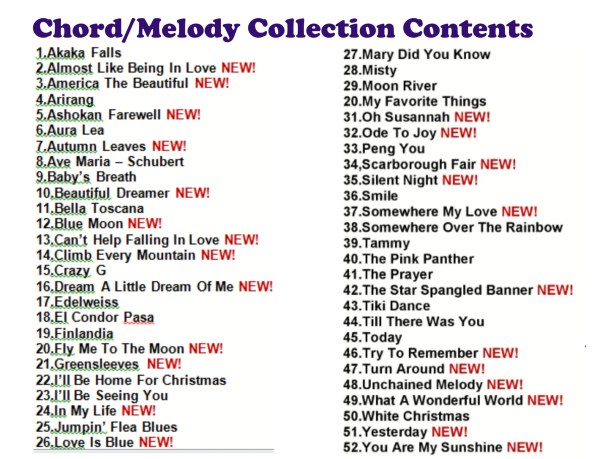
Table of Contents
Each of the currently 3 Chord Melody ebooks can be purchased separately for just $20.00 or all together at a combined discount of just $50
Announcing the release of the NEW Chord melody ebook FOUR $25.95

Questions regarding any Ukulele resource, please email: TheUkuleleMan2012@hotmail.com
 UKULELE MIKE LYNCH - All things UKULELE