
Live performance of Bob Dylan performing “Blowing In The Wind” 1963
Peter, Paul & Mary performing “Blowing In The Wind”
“Blowin’ in the Wind” is a song written by Bob Dylan in 1962 and released on his album The Freewheelin’ Bob Dylan in 1963. Although it has been described as a protest song, it poses a series of rhetorical questions about peace, war and freedom. The refrain “The answer, my friend, is blowin’ in the wind” has been described[by whom?] as “impenetrably ambiguous: either the answer is so obvious it is right in your face, or the answer is as intangible as the wind”. In 1999, the song was inducted into the Grammy Hall of Fame. In 2004, it was ranked #14 on Rolling Stone magazine’s list of the “500 Greatest Songs of All Time”.
Below are the opening measures of “Blowing In The Wind” showing both standard notation as well as Ukulele TABLATURE. . . The 4 lines represent the 4 strings of the Ukulele . . . The top line is the First string . . . that’s the string which is closest to the floor when you hold the Ukulele to play. . . The fingering in this piece is moderately difficult . . .not too much barring but a little is needed to reach the upper fret melody.

Make note that the melody starts on the first string but jumps over to the 2nd string for just one beat at the beginning of the 4th measure . . Em chord. . .
Another short excerpt from later in the piece . . .

“Blowing In The Wind” is contained in the Chord/Melody eBook TWO and can be purchased by making a payment of just $20.00 through the paypal button on the Ukulele Mike website: http://www.ukulelemikelynch.com Once purchased, it will be personally emailed to you within the day.
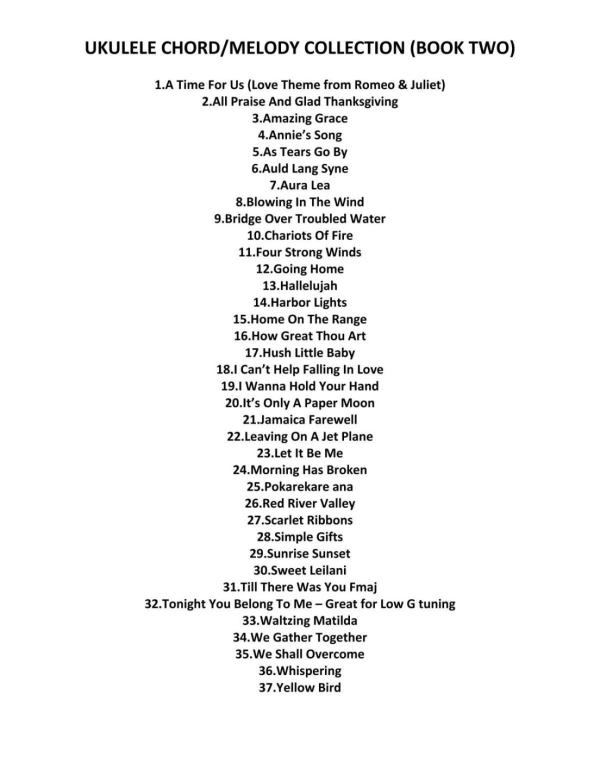
Full table of contents:
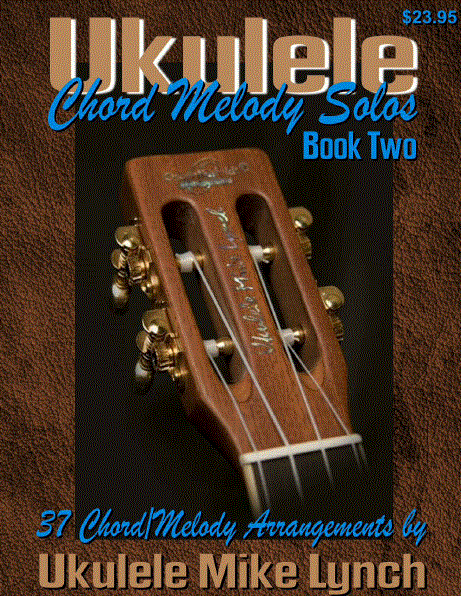
 Each of the 3 Chord/Melody eBooks can be purchased separately for just $20.00 or all together at a combined discount of just $50.00

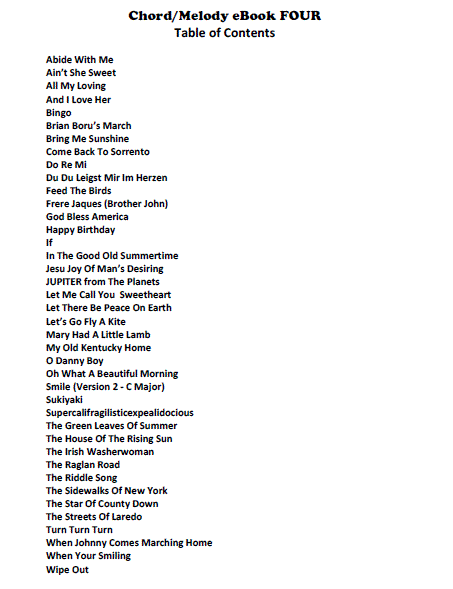
Now available the NEW Chord/Melody eBook FOUR – $25.95


Questions regarding any Ukulele resource, Please email: TheUkuleleMan2012@hotmail.com
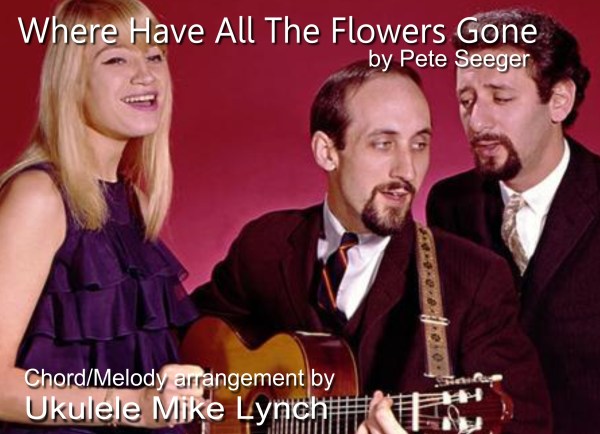
Peter, Paul & Mary performing Where Have All The Flowers Gone”
We learn from Wikipedia that “Where Have All the Flowers Gone?” is a modern folk-style song. The melody and the first three verses were written by Pete Seeger in 1955 and published in Sing Out! magazine. Additional verses were added by Joe Hickerson in May 1960, who turned it into a circular song. Its rhetorical “where?” and meditation on death place the song in the ubi sunt tradition. In 2010, the New Statesman listed it as one of the “Top 20 Political Songs”.
The 1964 release of the song as a Columbia Records 45 single, 13-33088, by Pete Seeger was inducted into the Grammy Hall of Fame in 2002 in the Folk category.
This is by far one of the easiest of my Chord/Melody pieces. . . It involves no barring so the left hand fingering is quite accessible. . . Remember, in Chord/Melody style we do no fingerpicking. . . We merely place the left hand fingers down on the chord and gently roll the thumb across the strings. . . The melody automatically presents itself . . . Be careful not to play in strings not notated . . . Many times the melody jumps from first string to second and to third. . . This style of playing is quite different from conventional strumming accompaniment for singing. . . It does require patience but the time spent on it is totally worth it . . . Chord/Melody style opens up a whole new world of solo instrumental performance.
Here is a short excerpt from the opening of the song:
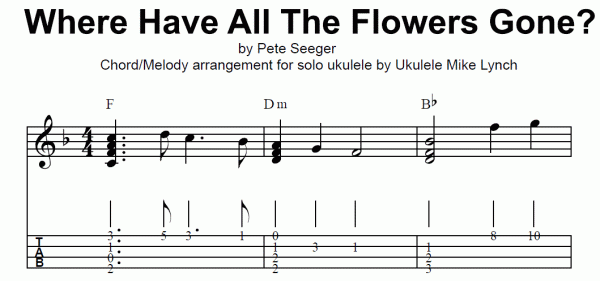
Make note that the melody begins on the first string then in the second measure, it jumps to the 2nd string . . . Then, back to the first again on the 3rd beat of the 3rd measure.
“Where Have All The Flowers Gone” is contained in the Chord/Melody eBook THREE. The eBook can be purchased by making a payment of just $20.00 through the paypal button on the Ukulele Mike website: http://www.ukulelemikelynch.com Once purchased, it will be personally emailed to you within the day.

Full table of contents:

All 3 Chord/Melody books can be purchased individually $20.00 for just or all together at a new combined discount of just $50.00

Questions regarding any Ukulele resource, please email: TheUkuleleMan2012@hotmail.com

We learn from Wikipedia that “When Irish Eyes Are Smiling” is a lighthearted song in tribute to Ireland. Its lyrics were written by Chauncey Olcott and George Graff, Jr., set to music composed by Ernest Ball, for Olcott’s production of The Isle O’ Dreams, and Olcott sang the song in the show. It was first published in 1912, at a time when songs in tribute to a romanticized Ireland were very numerous and popular both in Britain and the United States. During the First World War the famous tenor John McCormack recorded the song.
The song continued to be a familiar standard for generations. Decades later it was used as the opening song on the radio show Duffy’s Tavern. The song has been recorded on over 200 singles and albums and by many famous singers, including Bing Crosby, Connie Francis, and Roger Whittaker
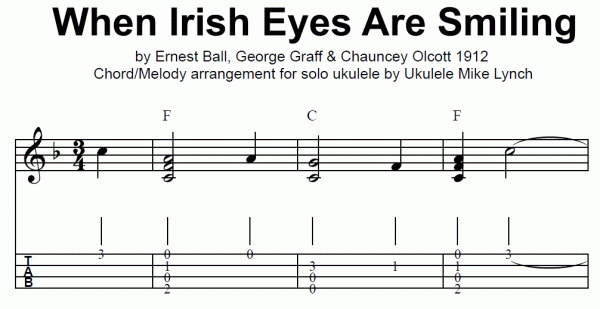
This is one of the more accessible of my chord/melody arrangements . . . . at least in the first section. . . Below is a short excerpt from the opening measure of “When Irish Eyes Are Smiling”
When it goes to the upper fretboard, it gets a bit more challenging . . .
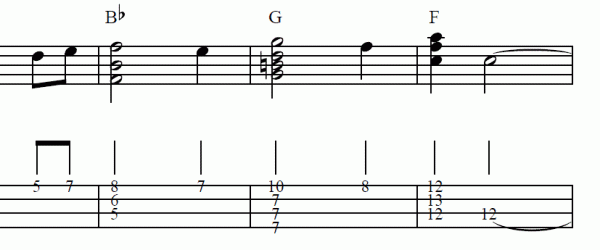
Notice in the third measure that we need to barre the 7th fret with our index finger then place the little finger up on the 10th fret.
This arrangement of “When Irish Eyes Are Smiling” is found in the Chord/Melody eBook THREE.. . It can be purchased by making a payment of just $20.00 through the paypal button on the Ukulele Mike website: http://www.ukulelemikelynch.com Once purchased, it will be personally emailed to you within the day.
Full table of contents:
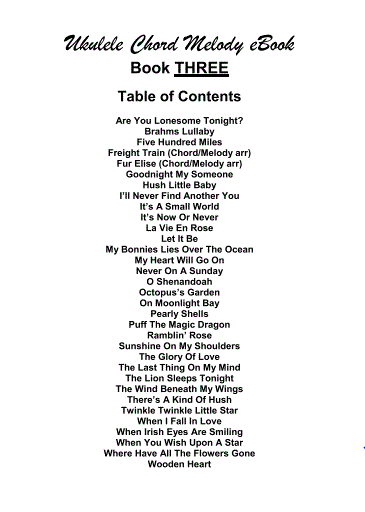
Each of the 3 Chord/Melody eBooks can be purchased separately for just $20.00 or all together at a new combined discount of just $50.00

Announcing the release of the NEW Chord melody ebook FOUR $25.95


All 4 of the Chord melody ebooks can be purchased at a combo discount of $70
Questions regarding any Ukulele resource, please email: TheUkuleleMan2012@hotmail.com

 Here is what we find from Wikipedia . . .
“Wind Beneath My Wings” (sometimes titled “The Wind Beneath My Wings” and “Hero”) is a song written in 1982 by Jeff Silbar and Larry Henley.
The highest-charting version of the song to date was recorded in 1988 by singer and actress Bette Midler for the soundtrack to the film Beaches. This version was released as a single in early 1989, spent one week at No. 1 on the Billboard Hot 100 singles chart in June 1989, and won Grammy Awards for both Record of the Year and Song of the Year in February 1990. On October 24, 1991, Midler’s single was also certified Platinum by the Recording Industry Association of America for shipment of one million copies in the United States. In 2004 Midler’s version finished at No. 44 in AFI’s 100 Years…100 Songs survey of top tunes…
View original post 679 more words
 Each of the THREE current collections in the Chord/Melody series have pieces ranging from easy to more challenging. . “As Tears Go By” is a perfect piece for beginning tablature and Chord/Melody players. As in all Chord/Melody pieces it requires only the thumb to do the strumming. . . No fingerpicking is involved. . . This piece, however, has no barre chords. . . So, even the left hand fingering is quite easy. Below is a short excerpt from the beginning of the song . . .
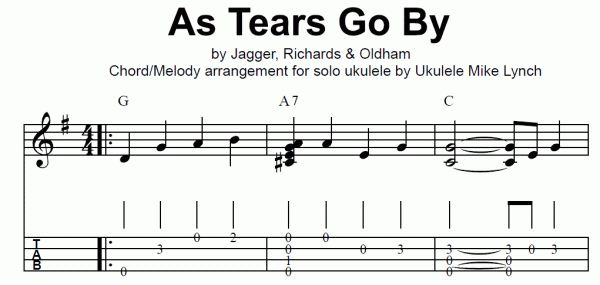 Note that the melody actually begins on the 2nd beat of the first measure. The open 4th string on the first beat is primarily just a “placer” note to establish the rhythm. Don’t let that note throw you off from the melody. As in many many chord melody pieces, you will often only be playing single note melodies interspersed with Chords. . . This…
View original post 85 more words
 The Lion Sleeps Tonight”, also known as “Wimoweh”, “Wimba Way” or “Awimbawe”, is a song written and recorded originally by Solomon Linda with the Evening Birds[1] for the South African Gallo Record Company in 1939, under the title “Mbube”. Composed in Zulu, it was adapted and covered internationally by many 1950s pop and folk revival artists, including the Weavers, Jimmy Dorsey, Yma Sumac, Miriam Makeba and the Kingston Trio. In 1961, it became a number one hit in the United States as adapted in English with the best-known version by the doo-wop group the Tokens. It went on to earn at least US$15 million in royalties from cover versions and film licensing.
The Lion Sleeps Tonight is an ideal song for a Chord/Melody formatted ukulele arrangement. Chord/Melody format is played quite simply by just brushing the thumb over the strings and the melody…
View original post 136 more words

A recorded performance by John Denver
We learn from Wikipedia that “Leaving on a Jet Plane” is a song written by John Denver in 1966 and most famously recorded by Peter, Paul and Mary. The original title of the song was “Babe, I Hate to Go” but Denver’s then producer Milt Okun convinced him to change the title.
The song was initially recorded in 1966 by John Denver with the title “Babe, I Hate to Go.” That same year, Denver chose this song along with fifteen others and, with his own money, had 250 copies pressed onto vinyl. He distributed the copies to friends and family. Peter, Paul and Mary were so impressed with the song that they chose to record it themselves and released it on their 1967 Album 1700. However, it didn’t become a hit for them until they released it as a single in 1969.
The song was also recorded in 1967 by the Chad Mitchell Trio and then later that same year by Spanky and Our Gang. It was performed for the very first time live at The Cellar Door in Washington, D.C. in 1966 by the Chad Mitchell Trio, with John Denver substituting for Chad Mitchell.
John Denver recorded his own version of the song for his debut solo album, Rhymes & Reasons, and re-recorded it in 1973 for John Denver’s Greatest Hits. His version was featured in the end credits of The Guard.
It turned out to be Peter, Paul & Mary’s biggest (and final) hit, becoming their only #1 on the Billboard Hot 100 chart in the United States.[1] It was the penultimate #1 single of the 1960s. The song also spent three weeks atop the easy listening chart[2] and was used in commercials for United Airlines in the late 1970s.
The song also reached #2 in the UK Singles Chart in February 1970.
In 1998, Canadian singer Chantal Kreviazuk recorded a cover of the song, which was featured on the soundtrack of the film Armageddon.
My Ukulele solo arrangement was done in the Chord/Melody format. . . Below is a short excerpt from the beginning of the song . . .

Note that the melody begins on the 2nd string then jumps to the 1st string then back to the 2nd string. . . Be careful to play only those strings designated for each chord. This is the prime difference between playing solo instrumentals from conventional strumming to accompany singing . . .
“Leaving On A Jet Plane” is contained in the Solo Chord/Melody eBook TWO. It can be purchased by making a payment of $20.00 through the paypal button on the Ukulele Mike website: http://www.ukulelemikelynch.com Once purchased, it will be emailed to you within the day.

Full Table of Contents
Each of the 3 current Chord/Melody eBooks may be purchased individually or all together at a new “TRILOGY” combined discount of just $50.00

Proud to announce my brand NEW Chord melody ebook FOUR $25.95


Questions regarding any Ukulele resource, please email: TheUkuleleMan2012@hotmail.com

Accepting a generous invitation of dear friends a number of years ago, my wife and I spent a relaxing week on Liberty Bay in the tiny town of Keyport, Washington. While there I was inspired to compose this lazy little ragtime tune and it became a constant soundtrack to my musings on the porch of the bay side cottage we were living in. Taking walks around the town, I had the melody of this little tune running through my head and I would frequently head back to the cottage to pick up my ukulele and try out new ideas that would pop into my brain. KEYPORT RAG is largely played in a swinging, bouncy, travis picking style and below is a small example of the tablature arrangement of this song.

To perform this piece, a fair amount of previous travis technique is required. It does take a bit of time and patience to get this solid. . . I remember spending countless hours in my college dorm room perfecting the technique of travis picking on my guitar. . . Once I got it though, I never forgot it. . . never lost it . . . Learn it and you’ll love it . . . It will be an essential part of your fingerpicking arsenal. . .
Here is another short excerpt for you to try . . .

Here are a couple of YouTube videos showing online ukulele players performing “The Keyport Rag”
The “Keyport Rag” is contained in the Ukulele Solo Instrumentals eBook (Fingerpicking) Volume 1 enhanced edition. It can be purchased by making a payment of just $20.00 through the paypal button on the Ukulele Mike website: http://www.ukulelemikelynch.com Once purchased it will be personally emailed to you within the day.


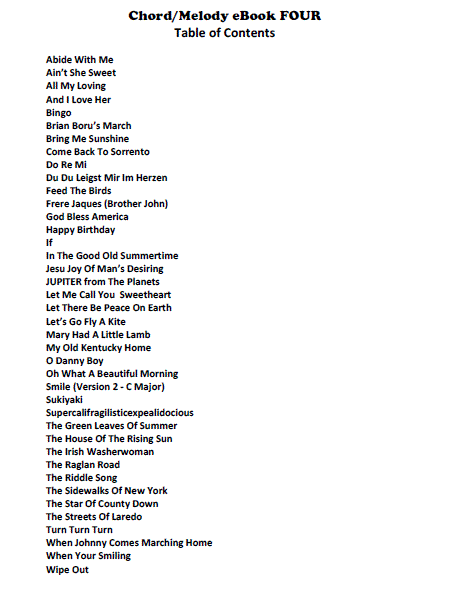
I also have a Chord/Melody series . . . Each of the three collections can be purchased individually for just $20.00 or all together at a combined discount of just $50.00
Now happy to announce the NEW Chord Melody ebook FOUR $24.95

Questions regarding any Ukulele resource, please email: TheUkuleleMan2012@hotmail.com

Recorded performance of “Sweet Leilani” by Bing Crosby in a very high falsetto
We read in Wikipedia that “Sweet Leilani” is a song featured in the 1937 film, Waikiki Wedding. It won the Academy Award for Best Original Song,[2] and Bing Crosby‘s record became one of the biggest hits of 1937.
Harry Owens wrote the song on October 20, 1934 for his daughter Leilani, who was born the previous day. Leilani is a popular Hawaiian name, meaning “heavenly garland of flowers” (not “heavenly flower”). It also has a figurative meaning: Small Hawaiian children were carried on their parents’ shoulders like a lei (garland), so the name took on the meaning “heavenly child.”]
Prior to Waikiki Wedding, the song had been recorded by Sol Hoʻopiʻi under the title “Leilani” as the B-side of “Hawaiian Honeymoon” (Brunswick Records 55085).
Harry Owens and his Royal Hawaiians performed “Sweet Leilani” in the 1938 film Cocoanut Grove starring Fred MacMurray.
Here are the opening few measures in my Chord/Melody arrangement of “Sweet Leilani”

Make note that the melody in these opening bars is quite low . . . residing on the 3rd string. . Be very careful not to play the 3rd or 4th strings during this passage. Below is yet again another short excerpt from “Sweet Leilani”

Chromatic (half step) shifts are extremely common in Hawaiian songs. In the opening of the Bridge of this song we instantly have chromatic shifts going from the 3rd fret to the 2nd fret and then to the 1st fret. Then, in the second measure we have a shift from the Bb chord to the F chord. I had originally thought I might make those Chromatic shifts in the first measure of the Bridge as chordal shifts but decided against it to allow this arrangement to be more accessible to most players. If you are adventuresome, see if you can figure out what those chords might be. . .
“Sweet Leilani” is contained in the Chord/Melody eBook TWO and can be purchased by making a payment of just $20.00 through the paypal button on my website: http://www.ukulelemikelynch.com Once the payment is made, it will be personally emailed to you within the day.

Table of Contents of Chord/Melody eBook TWO
All three of the current Chord/Melody series collections can be purchased individualAnnouncing for just $20.00 or all together at a new “TRILOGY” combined discount of just $50.00

Announcing the release of the NEW Chord melody ebook FOUR $25.95
o
All 4 Chord Melody ebooks can be purchased at a combo QUARTET discount of $70
Questions regarding any Ukulele resource, please email: TheUkuleleMan2012@hotmail.com

We learn from Wikipedia that “Simple Gifts” is a Shaker song written and composed in 1848 by Elder Joseph Brackett.
It has endured many inaccurate descriptions. Though often classified as an anonymous Shaker hymn or as a work song, it is better classified as a dance song.
The tune was written by Joseph Brackett (1797–1882) in 1848.[2] Brackett, a lifelong resident of Maine, first joined the Shakers at Gorham, Maine, when his father’s farm helped to form the nucleus of a new Shaker settlement. The song was largely unknown outside Shaker communities until Aaron Copland used its melody for the score of Martha Graham‘s ballet Appalachian Spring, first performed in 1944. Copland used “Simple Gifts” a second time in 1950 in his first set of Old American Songs for voice and piano, which was later orchestrated. Many people thought that the tune of “Simple Gifts” was a traditional Celtic one but both the music and original lyrics are actually the compositions of Brackett. “Simple Gifts” has been adapted or arranged many times since by folksingers and composers.
Below is a performance of the Ukulele Mike fingerpicking arrangement as seen on You Tube
The simplicity of this piece so elegantly mirrors the simplicity of the Ukulele . . . They are simply meant to be together. . . I designed this arrangement as a fingerpicking arrangement and below you will see a short excerpt from the opinion measures. . . Keep in mind that in fingerpicking the thumb plays the 4th and 3rd strings while the 2nd string is played by the Index finger while the 1st string is played with the middle finger. . .
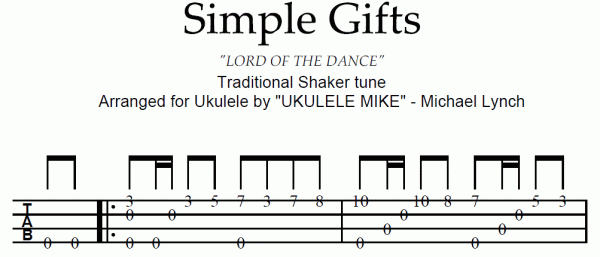
Note that this arrangement was done to suit a standard form of tuning in that the 4th string is tuned to a High G. Therefore, if you happen to be playing with a Low G tuning, those opening 2 notes should be played on the 3rd fret of the 2nd string. . .
Below are the opening measure of the Bridge:
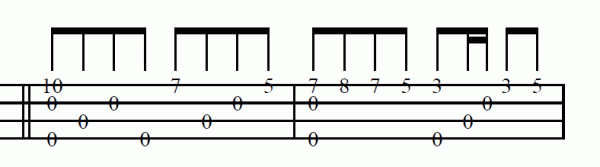
We go up high on the fretboard to play this melody but luckily all of the other strings are played open so no fingerings involved on the rest of the strings
“Simple Gifts” is contained in the Solo Ukulele Instrumentals eBook Volume 1 enhanced edition (Fingerpicking style). It can be purchased by making a payment of just $20.00 (recently reduced) through the paypal button on the Ukulele Mike website: http://www.ukulelemikelynch.com Once purchased it will be personally emailed to you within the day
Here is the Table of Contents of the Solo Instrumentals eBook

Also available the Chord/Melody “TRILOGY” now reduced to $50.00 . . . separately $20.00

New . . . Chord/Melody eBook FOUR $25.95
Questions regarding any Ukulele resources, please email: TheUkuleleMan2012@hotmail.com
 UKULELE MIKE LYNCH - All things UKULELE