“MY HEART WILL GO ON” – the mega-hit by Celine Dion from the movie TITANIC is a hit as a Chord/Melody Solo arrangement on the ukulele


Here is a full performance and full tutorial as seen on VIMEO:
The backstory of this song is really quite interesting and here it is via Wikipedia:
“My Heart Will Go On”, also called the “Love Theme from Titanic”, is the main theme song to the 1997 blockbuster film Titanic. Its music was composed by James Horner, its lyrics were written by Will Jennings, and it was produced by James Horner and Walter Afanasieff; Celine Dion recorded and released it.
Originally released in 1997 on the Titanic soundtrack album and Dion’s album Let’s Talk About Love, the romantic song went to number 1 all over the world, including the United States, Canada, Ireland, United Kingdom and Australia. “My Heart Will Go On” was released in Australia and Germany on December 8, 1997, and in the rest of the world in January and February 1998.
The song became Dion’s biggest hit…
View original post 756 more words
“WHEN I FALL IN LOVE” – An old classic standard takes on a new life as a Ukulele Chord/Melody arrangement by Ukulele Mike Lynch

Full Ukulele performance and tutorial of “WHEN I FALL IN LOVE” by Ukulele Mike Lynch as seen and heard on VIMEO
According to Wikipedia: “When I Fall in Love” is a popular song, written by Victor Young (music) and Edward Heyman (lyrics). It was introduced in the film One Minute to Zero. Jeri Southern sang on the first recording released in April 1952 with the song’s composer, Victor Young, handling the arranging and conducting duties. The song has become a standard, with many artists recording it, though the first hit version was sung by Doris Day released in July 1952. Probably the most notable recording was that done by
Nat King Cole,
Doris Day’s recording was made on June 5, 1952. It was released by Columbia Records as catalog number 39786 and issued with the flip side “Take Me in Your Arms”. The song reached number 20 on the Billboard…
View original post 211 more words

Full Ukulele performance and tutorial of “WHEN I FALL IN LOVE” by Ukulele Mike Lynch as seen and heard on VIMEO
According to Wikipedia: “When I Fall in Love” is a popular song, written by Victor Young (music) and Edward Heyman (lyrics). It was introduced in the film One Minute to Zero. Jeri Southern sang on the first recording released in April 1952 with the song’s composer, Victor Young, handling the arranging and conducting duties. The song has become a standard, with many artists recording it, though the first hit version was sung by Doris Day released in July 1952. Probably the most notable recording was that done by
Nat King Cole,
Doris Day’s recording was made on June 5, 1952. It was released by Columbia Records as catalog number 39786 and issued with the flip side “Take Me in Your Arms”. The song reached number 20 on the Billboard chart.
This arrangement has been done as a Chord/Melody style. With Chord/Melody style there is no fingerpicking involved. Simply strum the strings with the thumb and the melody sings out on top. Below is a short clip of the opening bars of WHEN I FALL IN LOVE. . .

Notice the dim7, m6, m7 and maj7 chords. These are the “bread and butter” chords for all jazz arrangements. Working through this piece will give you a good exposure to these essential Jazz Chords.
WHEN I FALL IN LOVE is contained in the Chord Melody eBook THREE which can be purchased for just $20.00 and can be purchased through the paypal donate button on the Ukulele Mike website: http://www.ukulelemikelynch.com
Note that the eBooks are delivered to you via email as pdf files for download. We do not have hard copy paper versions of these books. Once the payment is made, PayPal will give you the opportunity to add more instructions such as the name of the collection etc It will then
be emailed to you within the day. Please, be sure that the email account attached to your PayPal account is current.

Each of the Chord/Melody collections can be purchased separately for just $20.00 or all together at a new Combo “TRILOGY” discount of just $50.00

All 4 of the Chord melody ebooks can be purchased separately or at a combined discount price of $70.

UKULELE MIKE SAYS CHORD MELODY ARRANGEMENTS ARE THE BEST WAY TO GET INTO SOLO UKULELE INSTRUMENTALS

Questions regarding any Ukulele Resource, please email: TheUkuleleMan2012@hotmail.com

Here is a full performance and full tutorial as seen on VIMEO:
The backstory of this song is really quite interesting and here it is via Wikipedia:
“My Heart Will Go On”, also called the “Love Theme from Titanic”, is the main theme song to the 1997 blockbuster film Titanic. Its music was composed by James Horner, its lyrics were written by Will Jennings, and it was produced by James Horner and Walter Afanasieff; Celine Dion recorded and released it.
Originally released in 1997 on the Titanic soundtrack album and Dion’s album Let’s Talk About Love, the romantic song went to number 1 all over the world, including the United States, Canada, Ireland, United Kingdom and Australia. “My Heart Will Go On” was released in Australia and Germany on December 8, 1997, and in the rest of the world in January and February 1998.
The song became Dion’s biggest hit, and one of the best-selling singles of all time, and was the world’s best-selling single of 1998. The music video was directed by Bille Woodruff and released at the end of 1997.
Due to the song’s widespread popularity when it was released, it is considered to be Dion’s signature song. Today, along with two other songs from film soundtracks, Whitney Houston’s “I Will Always Love You” from The Bodyguard and Bryan Adams’s “(Everything I Do) I Do It for You” from Robin Hood: Prince of Thieves, it is considered one of the biggest love ballads of the 1990s.
James Horner had originally composed the music for the song as an instrumental motif which he used in several scenes during Titanic. He then wanted to prepare a full vocal version of it, for use in the end credits of the film. Director James Cameron did not want such a song, but Will Jennings went ahead anyway and wrote the lyrics. When Dion originally heard the song, she did not want to record it. Horner showed the piano sketch to Simon Franglen, who was working with him on electronic textures and synthesizers for the film score. Franglen, who had, himself, worked with Dion for several years on many of her major hits to date, programmed and arranged an extensive demo to take to Dion.
In Tommy Mottola’s book, Hit Maker – The Man and his Music, he claims that Dion recorded the song in one take, and that demo is what was released. Mottola states that since so much money was on the line for Cameron’s film that Cameron felt obligated to include a theme song to promote the movie.
Dion’s manager and husband René Angélil convinced her to sing on this demo version, which she had not done for many years. Horner waited until Cameron was in an appropriate mood before presenting him with the song. After playing it several times, Cameron declared his approval, even though he worried that he might be criticized for “going commercial at the end of the movie”. Cameron also wanted to appease anxious studio executives and “saw that a hit song from his movie could only be a positive factor in guaranteeing its completion.”
I continue to be strongly convinced that the Chord/Melody format for arrangement is THE way to go with solo ukulele arrangements. No fingerpicking is involved which means no need to make decisions as to which fingers play which strings. In Chord/Melody format everything is simply played with the thumb. Strumming the chords as indicated in the tablature also allows you to play the melody right along with them. The melody always rides on top. As I’ve mentioned many times before, often times that melody note may be placed on the second or third strings which means that one must only strum two or three strings. Be sure to watch the tablature closely to see that you do not exceed the strings needed, otherwise the melody will be lost. I chose the key of G for this arrangement as indicated by the one single F# indicated in the Key Signature. Below is a short clip of the opening few measures of “My Heart Will Go On” Note the interesting chord progression. . .

So, notice how in the first three measures the melody is on the second string. We do not play the first string throughout the measures. At the end of the line it does go up to the first string and now we end up playing all four strings. Make every effort to keep the fingers firmly pressed on the frets to allow maximum sustain of the notes. The ukulele, by its very nature, is not a long sustaining instrument so we need to do as much as possible to enhance the sustain. This will lend a smoother, not so choppy, sound to our playing.
“MY HEART WILL GO ON” is contained in my Chord Melody eBook THREE $20.00 and can be purchased by making a payment through the paypal donate button on the Ukulele Mike website: http://www.ukulelemikelynch.com
If you have any questions regarding how to purchase my materials please inquire by email:
TheUkuleleman2012@hotmail.com

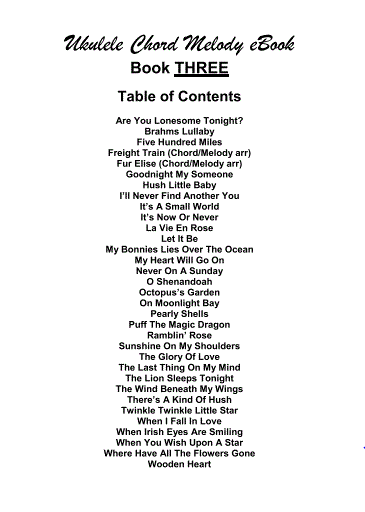
Complete table of contents of the Chord/Melody eBook THREE:

Currently I have THREE other Chord/Melody eBooks in the Chord/Melody series. . . Not including my Christmas Chord Melody eBook. Bear in mind, these are not delivered as hard copy books but rather in the PDF format to be downloaded. The THREE Chord Melody series can be purchased separately for just $20.00 or all together at a combined discount of just $50.00

Announcing the release of the NEW Chord melody ebook FOUR $25.95
 o
o

All 4 of the Chord melodUy ebooks can be purchased at a combo discount of $70

UKULELE MIKE SAYS CHORD MELODY ARRANGEMENTS ARE THE BEST WAY TO GET INTO SOLO UKULELE INSTRUMENTALS
Any questions regarding Ukulele resources such as eBooks, DVDs, etc. Email TheUkuleleMan2012@hotmail.com

Performance of YELLOW BIRD on YouTube
From WIKIPEDIA we find: Choucoune (Haitian Creole: Choukoun) is a 19th-century Haitian song composed by Michel Mauleart Monton with lyrics from a poem by Oswald Durand. It was rewritten with English lyrics in the 20th century as Yellow Bird. One of Oswald Durand’s most famous works, the 1883 Choucoune is a lyrical poem that praises the beauty of a Haitian woman of that nickname. Michel Mauleart Monton, an American-born pianist with a Haitian father and American mother composed music for the poem in 1893, appropriating some French and Caribbean fragments to create his tune. The song Choucoune was first performed in Port-au-Prince on 14 May 14, 1893. It became a popular slow méringue (mereng) in Haiti, and was played prominently during the bicentennial celebrations in Port-au-Prince in 1949. Chououne was first recorded in Haiti by Emy de Pradines for her “Voodoo – Authentic Music of Haiti” album (Remington R-199-151) released in the USA in 1953.
The song also appeared in the 1957 Calypso-exploitation film Calypso Heat Wave, performed by The Tarriers, sung by the group’s lead singer, Alan Arkin.
The English rendering of Choucoune: Yellow Bird, first appeared on the album Calypso Holiday, a 1957 release by the Norman Luboff Choir, Norman Luboff having arranged the song in the calypso style that become popular in the English-speaking world in the mid-1950s. The lyrics for Yellow Bird, by Alan and Marilyn Bergman, have no connection with the narrative of the Durand poem—other than the poem features the words “ti zwazo” (little birds) in its refrain, and so the original Haitian song is sometimes called Ti Zwazo or Ti Zwezo. The song became a minor hit at #70 on the Billboard Hot 100 for the Mills Brothers in 1959. Its most successful incarnation came in the summer of 1961 when the Arthur Lyman Group reached #4 on the Hot 100 and #2 on the newly formed Easy Listening chart with their Hawaiian flavored instrumental version,[1] which bested a rival instrumental single release by Lawrence Welk (#61).
Several versions of Yellow Bird were recorded and released in Jamaica around the late 1950s/1960s. Jamaican mento/calypso singers renditions include Lord Jellicoe (Hilary ILP-1040), Keith Stewart (WIRL 1031), Count Frank (WIRL 1058), Roy Fuller (Tiger 002/Dynamic 3312), Archie Lewis (Federal 213) and The Joy Makers (Somb, 1976).
Yellow Bird has also been recorded by Keely Smith, Roger Whitaker, Davy Graham, Roger Williams, Johnny Tillotson, The Brothers Four, Gary Crosby, and Paul Clayton. The song continues to be popularly associated with calypso and the Caribbean, and is often performed by steelpan bands—but some versions, such as Chris Isaak’s from Baja Sessions, show a Hawaiian flavor.
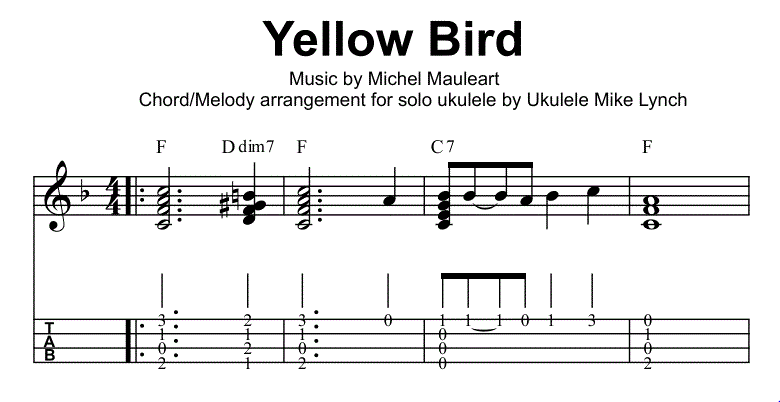
I chose to do this current arrangement in a chord melody style. It’s become increasingly clear to me that solo ukulele performance is most easily achieved through this format. There is absolutely no fingerpicking involved. No decision as to which finger plays which string etc. . . Merely stroke the strings with the thumb to get both the chord and melody combined. Note that although many times the melody is on the first string, other times it is found on the second or third string, so in those cases avoid playing the higher strings. You will notice this in the short
excerpt shown below.
YELLOW BIRD is contained in the CHORD/MELODY eBook TWO now reduced to just $20.00
It can be purchased by making a payment through the paypal donate
button on the Ukulele Mike website: http://www.ukulelemikelynch.com
Once the payment is made, PayPal gives you the option to add more information
such as the name of the collection etc. . .
It will then be personally emailed to you within the day.


Each Chord/Melody collection can be purchased separately for just $20.00 or all together at the new Combo “TRILOGY” discount of just $50.00

Announcing the release of the NEW Chord melody ebook FOUR $25.95
All 4 of the Chord melody ebooks can be purchased at a combo discount of $70
For information regarding any ukulele product please email:TheUkuleleMan2012@hotmail.com
BRIAN BORU’S MARCH – A chord/melody arrangement explained with free downloadable tablature in PDF format
YOU TUBE PERFORMANCE OF BRIAN BORU’S MARCH
Brian Boru’s March is a traditional Irish tune.
Brian Boru was a High King of Ireland who founded the O’Brien dynasty.[1]
In 1969, the song was recorded by The Chieftains. Horslips used it in 1976, as the intro and basis for “Trouble (With a Capital T)” from the album The Book of Invasions
This a tune of great antiquity belonging to the class of tunes known as “clan
marches”, i.e. pieces that are the “property” of a particular family and are closely
associated with that family (the musical analogue to the Scots highland tartan
designs).
There is an excellent Wikipedia article on Brian Boru which makes it unnecessary
for me to go into great detail about him here. Born into a family of local chieftains
around 941, he was the “High King” of Ireland at the time of his defeat of the
“Danes” at the Battle of Clontarf in 1014. Prior to his death in that battle, he
established the O’Brien dynasty as successors to the O’Neills. He is sometimes
referred to as “the Emperor of the Irish” from the fact that by the year 1011, all the
regional rulers of Ireland acknowledged Brian’s authority – a situation that might
have had a profound effect on subsequent Irish history if it had lasted.
There are no records actually relating this piece of music to Brian Boru or his any
of his exploits – as “Chief” Francis O’Neill points out, the style of the tune suggests
an origin much later than the 11th Century. That it is clearly in the clan march
tradition, however, cannot be disputed, even if the actual origins of the tune are
lost in the mists of time.
In his Irish Minstrels and Musicians, O’Neill quotes as follows from the journal of
a German traveller named Kohl, who heard Brian Boru’s March performed on the
pipes in County Louth in the mid 1800’s:
“The music of this march is wildly powerful and at the same time melancholy. It is
at once the music of victory and of mourning.”
O’Neill also quotes the poet Thomas Davis, who writes in regards to the music of
the clan marches:
“No enemy speaks slightlingly of Irish music and no friend need fear to boast of it.
Its antique war-tunes … stream and crash upon the ear like the warriors of a
hundred glens meeting, and you are borne with them to battle …
Brian Boru’s March Tablature CLICK HERE TO DOWNLOAD FREE PDF
Check out all of the resources in the Ukulele Mike Chord/Melody series. Now all THREE ebooks
available at a combined discount. They can be purchased through the paypal donate button on
the Ukulele Mike website: http://www.ukulelemikelynch.com

For information regarding any ukulele resource, please email: TheUkuleleMan2012@hotmail..com

How often have we started to play a song and then notice there is a barre chord and we turn
the page to the next song? Or, more often, we just glance over that chord and move on?
This is a typical scenario with plenty of stringed instrument players but needen’t be once
we become comfortable with the technique. Once we can confidently play barre chords a whole
world of music will open up for us. This I can promise you.
More often than not barre chords only happen occasionally within a song. . . . We could be playing along just fine for 16 measures then in comes an Fminor or perhaps a Bbminor chord. . .
Then we move on to more easily played fingerings. The mere fact that those chords only come a few times in any given song points out that we don’t really get good quality practice time to
strengthen our barre chord technique. I am a strong advocate of designing a portion of our practice time to focused quality practice. . . . Take that F minor, for example, and single it out. Play it . . . listen critically to it. . . playing each string individually to ensure that each string is being held down securely and properly against the fret. Once we think it sounds good we congratulate ourselves then release the fingers and do it again. . . Repeatedly, over and over and over again. . . Then go back a few measures in the song and play up to and include that F minor chord. . . Does it sound better? Most likely it will. . . then after time and fatigue it may sound a little on the sloppy side again, but the point is taken . You have done quality focused practicing. . . Getting your fingers accustomed to the shape of the chord. . . Getting your fingers accustomed to how much pressure is needed. . . Getting your fingers accustomed to making the proper shift from the preceding chord to the F minor . . All of this is acquired by repeated looping of the chord and those on either side of it. . . Don’t just play straight through the song. . . That doesn’t really improve things. . . Take the time and patience to surgically select those sections of a song that are problematic and most of they may be barre chords. . . over time . . and many hours of “REAL FOCUSED PRACTICE” we will improve and we will finally get that barre chord technique down. . . As we practice and our hands may get tired or achey . . . time to stop. . . shake your hand out. . .stretch the fingers. . . relax your hand . . go on to something a bit more comfortable then come back to the barre chord again. It is only by consistent DAILY practice that will ever get to that point of barre chord perfection that we long for. I’ve known so many students who say they worked on their barre chords Monday evening and then again Saturday and that was it. Progress will rarely be achieved in that fashion. It takes daily diligent hard work but believe me, it’s worth it . . . . Happy Strumming, Ukulele Mike Lynch
Apart from Barre chords. . . I would like to remind everyone that I now have THREE Chord/Melody eBooks and they can be purchased as a combination pak at a discount.
Click on this link for more information
https://allthingsukulele.com/2015/02/03/the-ukulele-mike-chordmelody-series-ebooks-one-two-three-now-available-as-a-combo-package-at-a-discount/


For information regarding any ukulele product please email:
TheUkuleleMan2012@hotmail.com
One of the most iconic American folksongs “500 Miles” now arranged in a chord/melody format and included in the “Chord/Melody eBook THREE” from Ukulele Mike Lynch

Watch and listen to the arrangement as performed on VIMEO
Hedy West (April 6, 1938 – July 3, 2005) was an American folksinger and songwriter.
West was of the same generation as Joan Baez, Judy Collins, and others of the American folk music revival. Her most famous song “500 Miles” is one of America’s best loved and best known folk songs. She was described by the English folk musician AL Lloyd as “far and away the best of American girl singers in the [folk] revival.”
Hedy West played the guitar and the banjo. She played both clawhammer style and a unique type of three finger picking that wasn’t quite bluegrass, and wasn’t quite old-time, exhibiting influences from blues and jazz.
Hedy West will be remembered for a long time as the composer of the beloved American folk song “500 Miles” This song has been covered by nearly every folk from the 60’s until now. Everybody from Judy Collins, Peter Paul & Mary, Joan Baez and even Justin Timberlake have
Recorded “500 Miles” I chose to apply the tried and true Chord/Melody style to this piece and I feel it worked quite well. Below is a short clip from the music showing how it looks in a tablature format.

“500 Miles” is included in the new “CHORD/MELODY” eBook THREE” from Ukulele Mike Lynch.

HERE IS THE ENTIRE CONTENTS OF “CHORD/MELODY eBook THREE”

The entire collection can be purchased for $20 by making a payment through the paypal donate
button on the Ukulele Mike website: http://www.ukulelemikelynch.com
Once the payment is made, paypal gives you an option to add more information such as the name of the piece etc. . . It will then be emailed to you within the day. It will arrive as a pdf file for you to download and print.

Listen and watch the brief tutorial below on YouTube
From Wikipedia, we learn:
Bagatelle No. 25 in A minor for solo piano, commonly known as “Für Elise” or “Fuer Elise” (German: [fyːʁ eːˈliːzə], English: “For Elise”, commonly written without German diacritical marks as “Fur Elise”), is one of Ludwig van Beethoven’s most popular compositions. It is usually classified as a bagatelle, but it is also sometimes referred to as an Albumblatt.
The score was not published until 1867, 40 years after the composer’s death in 1827. The discoverer of the piece, Ludwig Nohl, affirmed that the original autographed manuscript, now lost, was dated 27 April 1810.[4]
It’s become very clear to me that Chord/Melody format is the way to go for making solo ukulele pieces truly accessible to more people. I did a fingerpicking arrangement of FUR ELISE some time ago, but in the process of compiling this new collection, I wondered if perhaps a new fresh look at the piece might be a good idea. So, sitting down with ukulele in hand I began to approach FUR ELISE in a chord melody style and discovered to my delight that it worked very very well. It still retained the elegant melody as well as the flowing aspect of the phrasing of this piece.
Here is a little snippet off the piece so you can see how it’s laid out in Tablature format.

FUR ELISE is included in the new “CHORD/MELODY eBook THREE” which is available for $24.95.
To purchase, just make a payment through the paypal donate button on the Ukulele Mike website: http://www.ukulelemikelynch.com Once the payment is made, paypal will allow you to add more information such as the name of the collection etc. It will then be emailed to you within the day.
This 3rd in the series can be purchased separately or you can purchase all 3 at a discount.
See below . . .
CHORD/MELODY eBook THREE

Currently there are THREE books in the Chord/Melody Series:

They can be purchased individually or all together at a discount.
For information regarding any ukulele product please email:
TheUkuleleMan2012@hotmail.com
The UKULELE MIKE “CHORD/MELODY SERIES” – eBooks ONE, TWO & THREE now available as a combo package at a discount
These eBooks can be purchased separately as well

Now all THREE of the Chord/Melody collections available as a combo package at discount. . .
Below are the table of contents of each of the collections . . .
BOOK ONE $29.95
BOOK TWO $23.95
BOOK THREE $24.95
The combined package can be purchased by making a payment of $70.00 through the paypal donate
button on the UKULELE MIKE website: http://www.ukulelemikelynch.com . . . Once the payment is made, paypal will give you an opportunity to add more information such as the name of the eBook or collection. It will then be emailed to you within the day. . .
The Chord/Melody collections are a perfect way to get into solo instrumental playing. No fingerpicking is involved. . . Just the simple use of the thumb is all that’s needed.
These arrangements work equally well with High G or Low G tuning and all sound excellent on the baritone…
View original post 12 more words
 UKULELE MIKE LYNCH - All things UKULELE