
“Scarborough Fair” is a traditional ballad of Great Britain about the Yorkshire town of Scarborough.
The song relates the tale of a young man who instructs the listener to tell his former love to perform for him a series of impossible tasks, such as making him a shirt without a seam and then washing it in a dry well, adding that if she completes these tasks he will take her back. Often the song is sung as a duet, with the woman then giving her lover a series of equally impossible tasks, promising to give him his seamless shirt once he has finished.
As the versions of the ballad known under the title “Scarborough Fair” are usually limited to the exchange of these impossible tasks, many suggestions concerning the plot have been proposed, including the hypothesis that it is about the Great Plague of the late Middle Ages. The lyrics of “Scarborough Fair” appear to have something in common with an obscure Scottish ballad, The Elfin Knight (Child Ballad #2), which has been traced at least as far back as 1670 and may well be earlier. In this ballad, an elf threatens to abduct a young woman to be his lover unless she can perform an impossible task (“For thou must shape a sark to me / Without any cut or heme, quoth he”); she responds with a list of tasks that he must first perform (“I have an aiker of good ley-land / Which lyeth low by yon sea-strand”).
The melody is very typical of the middle English period.
As the song spread, it was adapted, modified, and rewritten to the point that dozens of versions existed by the end of the 18th century, although only a few are typically sung nowadays. The references to the traditional English fair, “Scarborough Fair” and the refrain “parsley, sage, rosemary, and thyme” date to 19th century versions, and the refrain may have been borrowed from the ballad Riddles Wisely Expounded, (Child Ballad #1), which has a similar plot. A number of older versions refer to locations other than Scarborough Fair, including Wittingham Fair, Cape Ann, “twixt Berwik and Lyne”, etc. Many versions do not mention a place-name, and are often generically titled (“The Lovers’ Tasks”, “My Father Gave Me an Acre of Land”, etc.).
SCARBOROUGH FAIR is another piece that I would have traditionally done as a flowing 3/4 waltz time arpeggio style. Fingerpicking is the most common way to achieve that style, but I was determined to make this more accesislbe to more people by arranging it as a more simpler Chord/Melody style. No fingers involved whatsoever. On the thumb is used in more straightforward way. Strum a chord then play a melody line then play the thumb again etc etc
BELOW IS A MUSICAL EXERPT SHOWING THE SIMPLE CHORD MELODY NOTATION . . .

SCARBOROUGH FAIR is included in the newly released massive 52 song Chord/Melody eBook.
It sells for just $20.00 and can be purchased by paying through the paypal donate button on the Ukulele Mike website: http://www.ukulelemikelynch.com Once purchased, it will be personally emailed to you within the day.


Each of the Chord/Melody eBooks can be purchased separately for just $20.00 or all together at a new combo “TRILOGY” discount of just $50.00



All 4 of the Chord melody ebooks can be purchased at a combo discount price of $70.

Questions regarding any Ukulele resource please email: TheUkuleleMan2012@hotmail.com
ANNOUNCING! ODE TO JOY by Ludwig van Beethoven now in a Chord/Melody format . . . perfect for entry level soloists

What do we know about “Ode To Joy”? . . . Here’s what we learn from Wikipedia:
Ode to Joy” (German: “An die Freude”, first line: “Freude, schöner Götterfunken”) is an ode written in the summer of 1785 by German poet, playwright and historian Friedrich Schiller and published the following year in Thalia. A slightly revised version appeared in 1808, changing two lines of the first and omitting the last stanza.
It is best known for its use by Ludwig van Beethoven in the final movement of his Ninth Symphony, which does not set the entire poem and reorders some sections (Beethoven’s text is given in that article). Beethoven’s tune[1] (but not Schiller’s words) was adopted as the Anthem of Europe by the Council of Europe in 1972, and subsequently the European Union.
In arranging this piece, I originally did it as a fingerpicking arrangement with flowing 8th note arpeggios. This has always been so popular with young students and entry level instrumentalists that I decided to go back and devise a simply Chord/Melody arrangement. I selected the key of G and it works so nicely on
the ukulele . Here is a small excerpt from my arrangement . Notice the top staff is standard treble clef notation. The bottom staff is in tablature format.
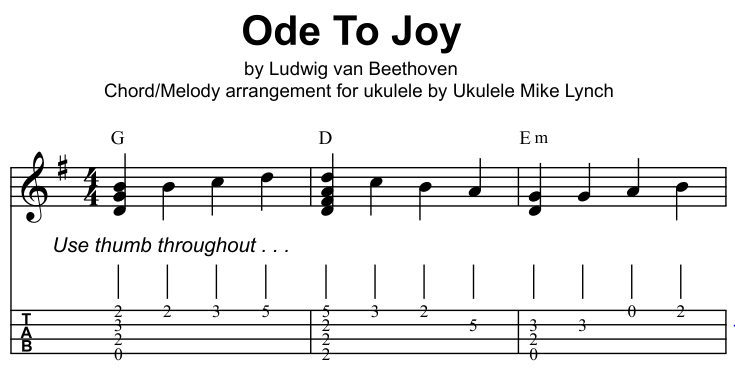
Listen and watch my YouTube performance of this Chord/Melody arrangement of ODE TO JOY
While watching this video, notice that I am constantly trying to hold down the chord as long
as possible while the melody line plays. By its very nature, the ukulele tends to have a very fast decay of sound so we need to help it sustain as much as we can. If we play a chord then
even slightly let up pressure from the strings that will mute the string making our playing choppy. This requires attention to detail. . .It pays off though, as our playing becomes smoother and more elegant.
This is a “classic” chord/melody arrangement which basically established the chord on the first beat of the measure then plays a short melody line then goes to the next chord etc. etc. Once again I can’t overemphasize the need to be patient and learn a measure at a time. Memorize that measure then add another and so forth. This may seem a bit tedious at first but over time we WILL
get to the place where we can “sight read” a line and play it outright. But the keyword is patience oh and daily repetitive practice . .. I once had a piano instructor who told mas a young boy he had the opportunity to meet the composer Bela Bartok. He asked Mr. Bartok for advice and Bartok said PRACTICE, PRACTICE, PRACTICE. May our PRACTICE time be fun. . . may it always be a joy. . . Happy Strumming . . .
ODE TO JOY is included in my brand new CHORD/MELODY eBook.
Here is a link detailing the contents of this collection:


When purchased together, the combo price is $48.90
Payable through the paypal button on the Ukulele Mike website
http://www.ukulelemikelynch.com
For information regarding any ukulele product please email:
TheUkuleleMan2012@hotmail.com

Listen to the full performance and watch the highly detailed VIMEO video tutorial here . . .
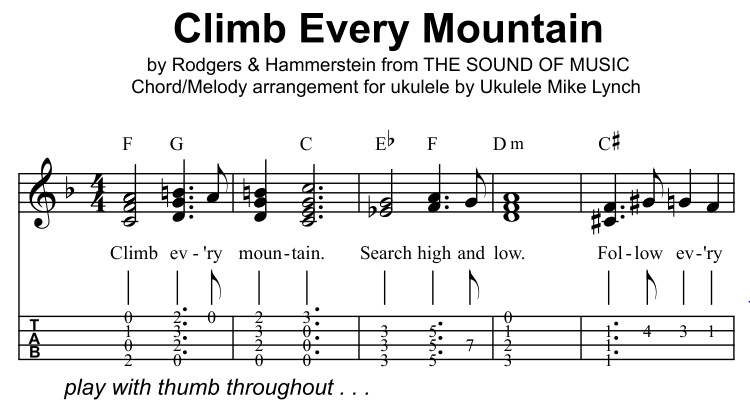
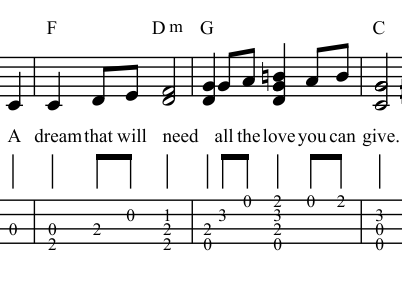
Here are some excerpts that illustrate the notation format of this piece and all of the pieces
contained in the new CHORD/MELODY eBook. The top line is standard treble clef notation while the
bottom line is formatted as Ukulele Tablature
Example 1.
Example 2.
Example 3.
This is part of the dramatic ending of Climb Every Mountain . . . Try it out
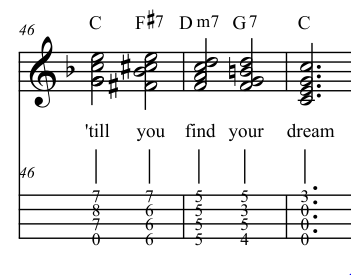
CLIMB EVERY MOUNTAIN is included in my brand new 52 Song CHORD/MELODY eBook – now reduced to just $20.00
It can be purchased by paying through the paypal button on the Ukulele Mike website: http://www.ukulelemikelynch.com Once purchased it will be personally emailed to you within the day . . .
Each of the Chord/Melody eBooks can be purchased separately for just $20.00 or all together at a new Combo “Trilogy” discount of just $50.00
All 4 of the Chord melody ebooks can be purchased at a combo discount price of $70.

Information regarding any ukulele product please email:TheUkuleleMan2012@hotmail.com

YESTERDAY – Chord/Melody arrangement by Ukulele Mike Lynch
YESTERDAY is included in the brand new CHORD/MELODY eBook from Ukulele Mike Lynch.
It sells for just $20.00 and can be purchased by paying through the paypal donate button
on the Ukulele Mike website: http://www.ukulelemikelynch.com
Once purchased, it will be personally emailed to you within the day as a pdf eBook.
Here is a blog detailing the entire contents of the new CHORD/MELODY eBook
https://allthingsukulele.com/2014/08/21/huge-chordmelody-collection-from-ukulele-mike-lynch-available-now/

Each Chord/Melody eBook can be purchased separately for just $20.00 or all together at a new combo “Trilogy” discount of just $50.00
For information regarding any ukulele product please email:
TheUkuleleMan2012@hotmail.com


From the Wikipedia site we learn that Finlandia, Op. 26 is a symphonic poem by the Finnish composer Jean Sibelius. The first version was written in 1899, and it was revised in 1900. The piece was composed for the Press Celebrations of 1899, a covert protest against increasing censorship from the Russian Empire, as the last of seven pieces, each performed as an accompaniment to a tableau depicting episodes from Finnish history.
The premiere was on 2 July 1900 in Helsinki with the Helsinki Philharmonic Society conducted by Robert Kajanus. A typical performance takes anywhere from 7½ to 9 minutes.
A recurrent joke within Finland at this time was the renaming of Finlandia at various musical concerts so as to avoid Russian censorship. Titles under which the piece masqueraded were numerous, a famously flippant example being Happy Feelings at the awakening of Finnish Spring
I was first exposed to FINLANDIA…
View original post 513 more words
THE DAY I TOOK MY UKE TO LUNCH – a true story by “UKULELE MIKE”
PLEASE NOTE: My “UKULELE BASICS” DVD is currently available for purchase. . . For more information email me at mike@ukulelemikelynch.com
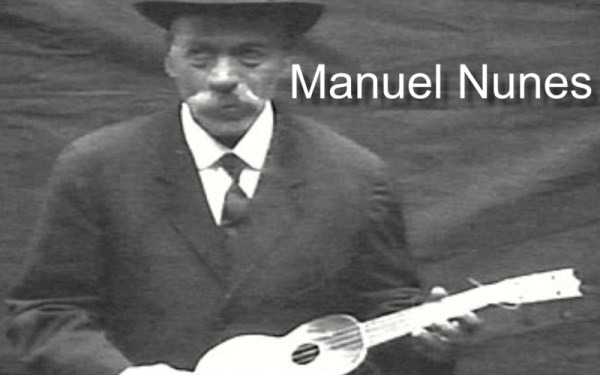
One day many years ago, upon leaving my music room and heading for the faculty lunchroom I met up with my principal in the school hall. I had in my hand my ever present uke. . . She said rather off handedly “Mike, did you know my grandfather invented the ukulele?” I stood there in silence for what seemed forever. . . In my mind I guess I always thought the ukulele just existed . . . not something that was invented and on top of that this lady was of portuguese desent not obviously Hawaiian. . . By the way her name was Mildred Nunes. . . So I responded. . . “Seriously? your grandfather invented the uke?” Yep, then she followed up with “do you know that I’m of…
View original post 351 more words
“Für Elise” by Ludwig van Beethoven – Solo ukulele arrangement by Ukulele Mike Lynch
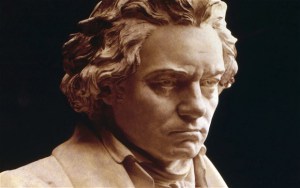
According to Wikipedia we find that Fur Elise (For Elise) is one of Ludwig van Beethoven’s most popular compositions. The score was not published until 1867, 40 years after the composer’s death in 1827. The discoverer of the piece, Ludwig Nohl, affirmed that the original autographed manuscript, now lost, was dated 27 April 1810. It is not certain who “Elise” was. It has been suggested that Ludwig Nohl may have transcribed the title incorrectly and the original work may have been named “Für Therese” a reference to Therese Malfatti von Rohrenbach zu Dezza (1792–1851). She was a friend and student of Beethoven’s to whom he proposed in 1810, though she turned him down to marry the Austrian nobleman and state official Wilhelm von Droßdik in 1816.
Here is a YouTube video of my arrangement of this piece for solo ukulele:
“Fur Elise” is a full out fingerpicking arrangement. As in…
View original post 224 more words

I’ve had hundreds of requests for more and more Chord/Melody ukulele solo arrangements.
For so many people they have proven to be an immediate success. They are so much easierto learn then complicated fingerpicking, arpeggio style arrangements. Although those do have their place and can be of great elegance and beauty, these chord/melody arrangements are more readily accessible to most players.
Chord/Melody arrangements are by far the best introduction to instrumental soloplaying. One can play convincing instrumentals with much more ease thanusually experienced with fingerpicking solo playing. Only the thumb is used inthis stye of playing. No other fingers are involved. This acts to simplify the process so one can concentrate on the distinctive melody of the piece.
In many cases the melody will be found to exist on either the first or second strings. One needs to merely hold down the main chord while the melody is played above. I’ve taken such elaborate pieces as the Schubert Ave Maria and brought it down to its most important chordal structures. No more awkward finger picking arppegios in these pieces. Simply play the chord and the melody will sing out on the top. A fine way to begin playing solo instrumentals and yet many professionals use this arrangement technique throughout their playing careers. Be patient with yourself as you learn to play these compositions. Try to set reasonable goals for each day’s practice session. Learn a few measures at at a time and before you know it you’ll be playing whole arrangements. You’ll surprise yourself at how beautiful your playing will become. And as always . . . .
Happy Strumming!!
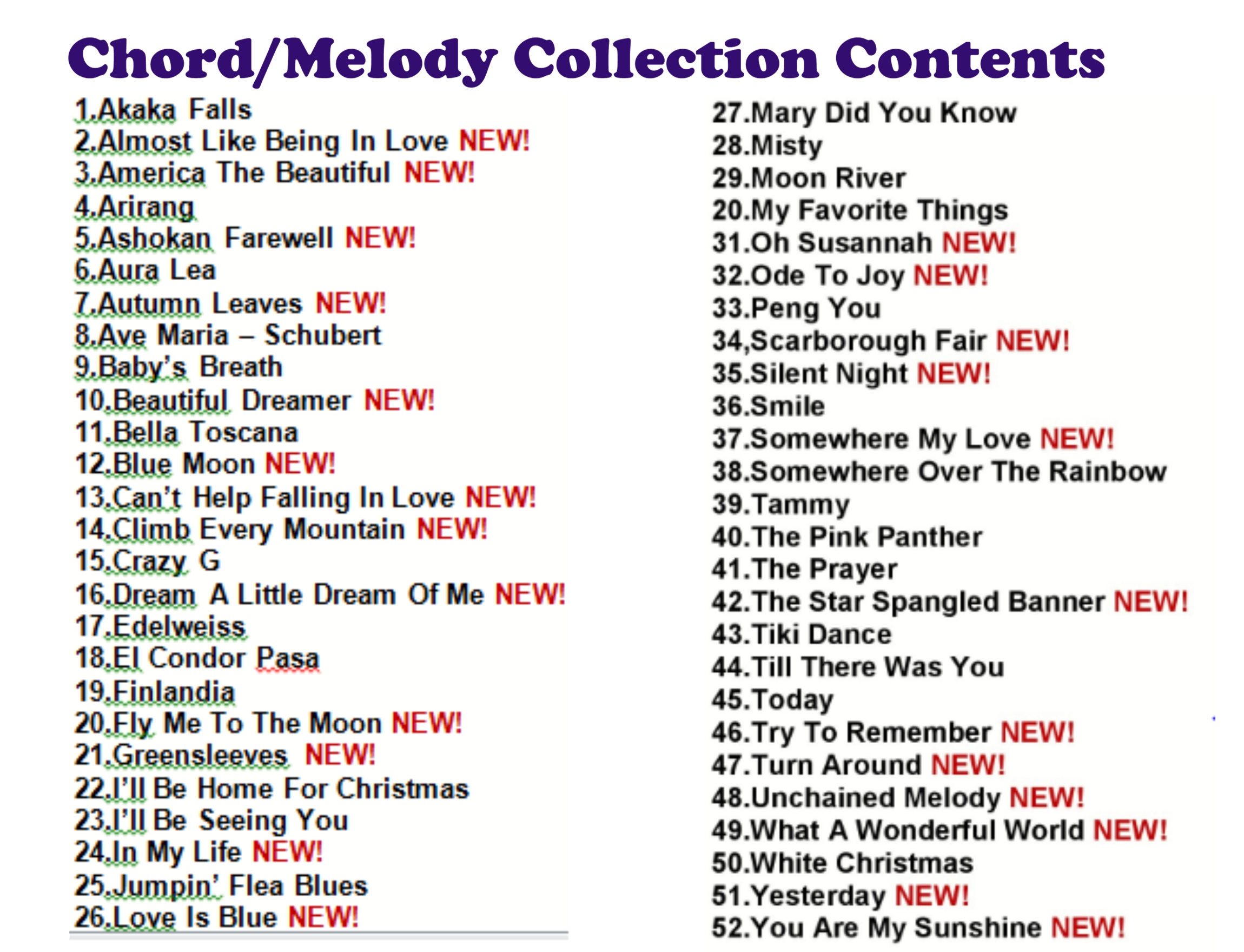
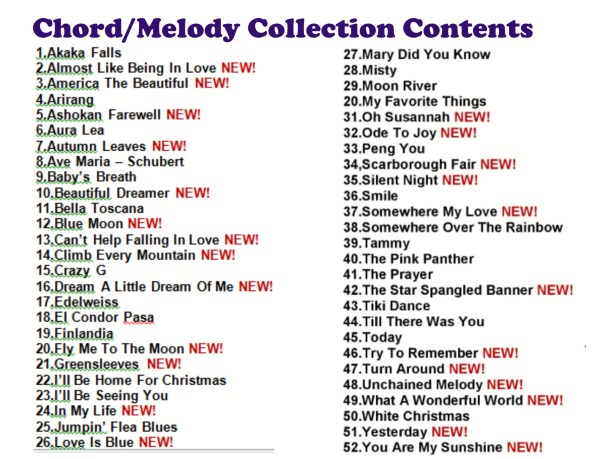
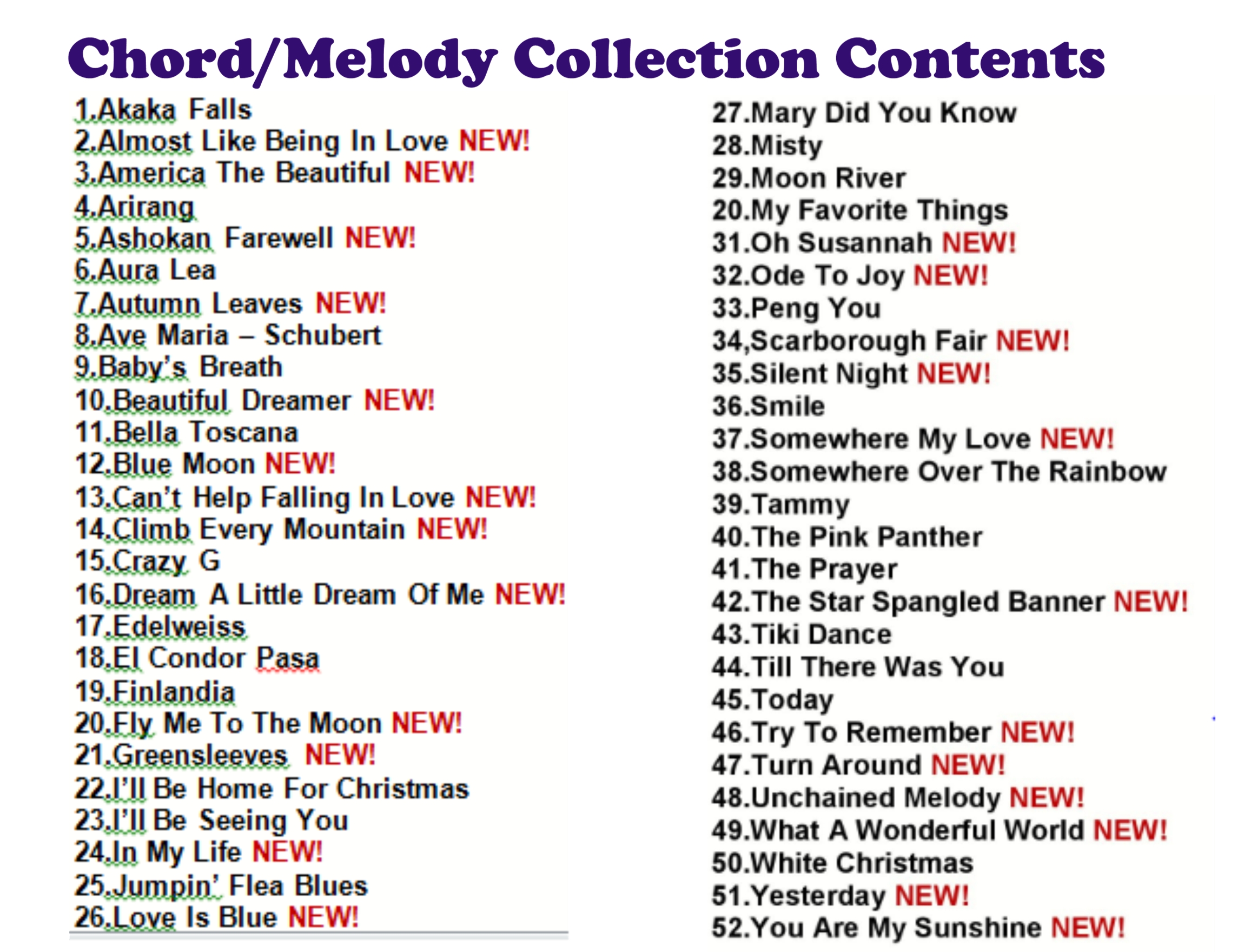
Below is the entire contents of this collection. I have pulled various chord/melody pieces
from earlier releases and added 25 brand new arrangements to the mix. In some cases I’ve
taken former fingerpicking arrangements and rendered them into Chord/Melody such as Silent Night, What A Wonderful World and Greensleeves.
Watch the You Tube video below . . .
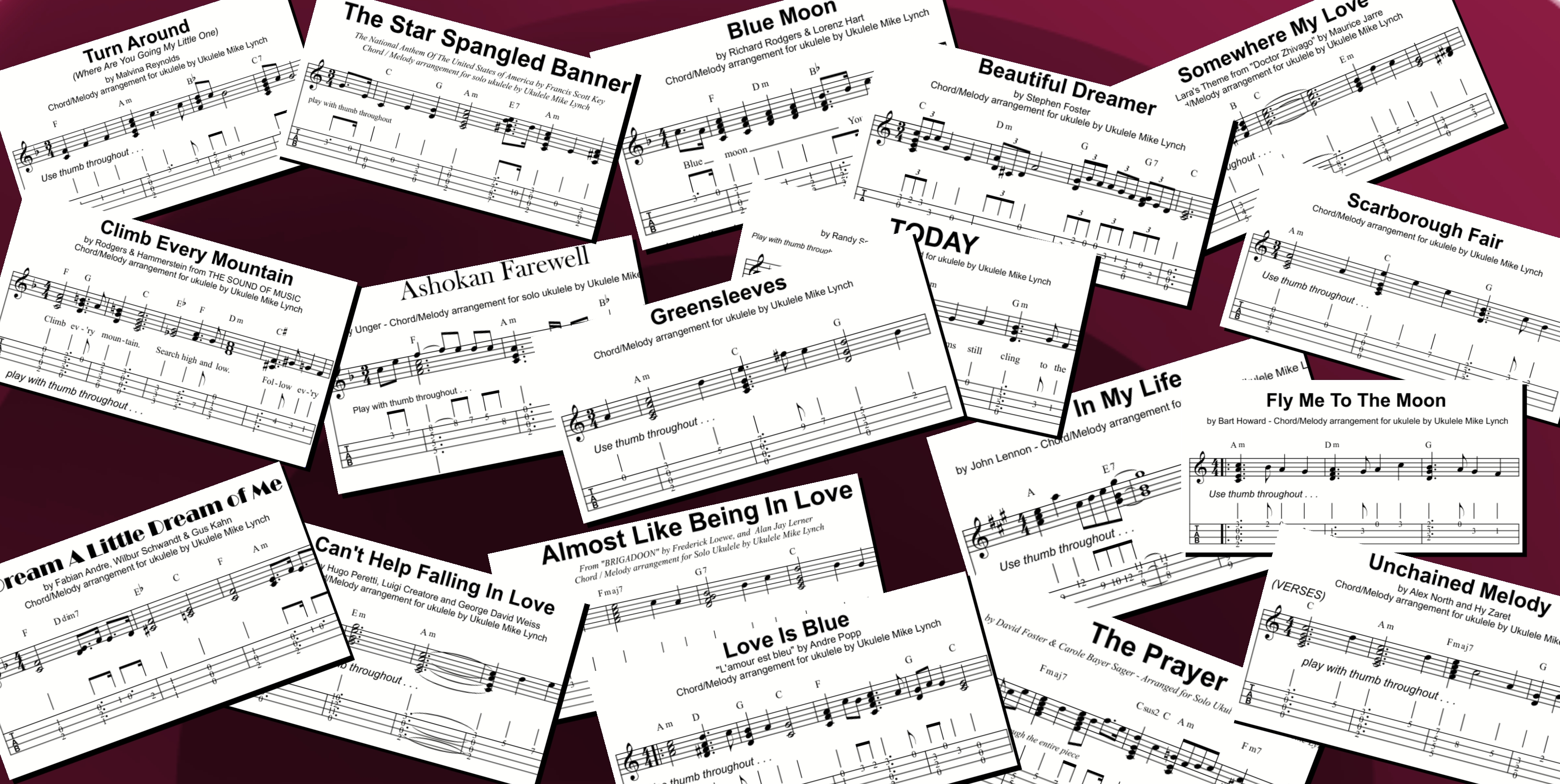
Here is a collage showing the notation layout of the songs in this collection . . .
By clicking on this image you will make it measurably larger and much easier to read
52 Songs in all . . . Now for only $20.00
There are songs here for those who are new to solo ukulele playing on up to more advanced.
I’ve included standard treble clef notation along with the tablature for each song.
Tablature doesn’t do a great job in establishing length of notes but the treble clef right above
will let you know if its a quarter note, half note, eighth note etc. . .
The Chord/Melody eBook can be purchased by making a payment of $29.95 through the paypal
donate button on the Ukulele Mike website: http://www.ukulelemikelynch.com
Once purchased, the eBook will be emailed to you within the day.
Once you do make the payment, PayPal will allow you to add additional information such
as the name of the resource you wish to purchase.
VERY IMPORTANT NOTE!!
Both of these collections will arrive in your inbox as pdf eBooks.
They are not hard copy books. Many will choose to just print out those
individual pieces as they work on them. Many will load it onto their computer or
even better their ipad or Tablet and work with the music in that fashion.
Some, of course, will print it out to be used in a more traditional way.
Each Chord/Melody eABook can be purchased separately for just $20.00 or all together as a combo for a new “TRILOGY” discount of just $50.00
All 4 of the Chord melody ebooks can be purchased at a combo discount price of $70.
For information regarding any ukulele product please email:TheUkuleleMan2012@hotmail.com
“THE SOUND OF SILENCE” by Simon & Garfunkel – Complete video tutorial for the ukulele by Ukulele Mike Lynch

In researching the song THE SOUND OF SILENCE, I found this Wikipedia article and found it interesting enough to quote it wholesale. I learned a tremendous amount about this song that I never knew before.
“The Sound of Silence” is a song by singer-songwriter duo Simon & Garfunkel. Written in February 1964 by Paul Simon in the aftermath of the 1963 assassination of John F. Kennedy, the song propelled the group to mainstream popularity. An initial version preferred by the band was remixed and sweetened, and has become known as “the quintessential folk rock release”. In the U.S., it was the duo’s second most popular hit after “Bridge Over Troubled Water”.
The song features Simon on acoustic guitar and both singing. It was originally recorded as an acoustic piece for their first album Wednesday Morning, 3 A.M. in 1964 but on the initiative of the record company’s producer, Tom Wilson, it was later overdubbed with drums, electric bass and electric guitar, all without the knowledge or participation of Simon & Garfunkel and rereleased as a single in September 1965.[3][4] The single reached number one on New Year’s Day 1966 and was included in the 1966 album Sounds of Silence.
“The Sound of Silence” was originally called “The Sounds of Silence” and is titled that way on the early albums in which it appeared and on the first single release; only on later compilations was it retitled “The Sound of Silence”. Both the singular and the plural appear in the lyrics. In his book Lyrics 1964–2008, Simon has the title in the singular.
In an interview with Terry Gross of National Public Radio (NPR), Paul Simon said that the concept of the song “wasn’t something that I was experiencing at some deep, profound level—nobody’s listening to me, nobody’s listening to anyone—it was a post-adolescent angst, but it had some level of truth to it and it resonated with millions of people.”
Paul Simon began working on the song some time after the Kennedy assassination. He had made progress on the music but had yet to write the lyrics. On February 19, 1964, the lyrics coalesced, as Simon recalled: “The main thing about playing the guitar, though, was that I was able to sit by myself and play and dream. And I was always happy doing that. I used to go off in the bathroom, because the bathroom had tiles, so it was a slight echo chamber. I’d turn on the faucet so that water would run (I like that sound, it’s very soothing to me) and I’d play. In the dark. ‘Hello darkness, my old friend / I’ve come to talk with you again’.”
Simon showed the new composition to Art Garfunkel the same day, and shortly afterward, the duo began to perform it at folk clubs in New York. In the liner notes of their debut album, Wednesday Morning, 3 A.M., Garfunkel claims: “‘The Sound of Silence’ is a major work. We were looking for a song on a larger scale, but this is more than either of us expected.” The duo recorded it for the first time on March 10, and included the track on Wednesday Morning, 3 A.M., which was released that October. The album flopped upon its release, and the duo split up, with Simon going to England for much of 1965, partnering up with singer-songwriter Bruce Woodley of The Seekers. There, he often performed the song solo in folk clubs and recorded it for a second time on his solo LP, The Paul Simon Songbook, in May 1965. In the meantime, Simon and Garfunkel’s producer at Columbia Records, Tom Wilson, had learned that the song had begun to receive airplay on radio stations in Boston, Massachusetts, and around Gainesville and Cocoa Beach, Florida.
On June 15, 1965, immediately after the recording session of Bob Dylan’s “Like a Rolling Stone”, Wilson took the original acoustically instrumented track of Simon & Garfunkel’s 1964 version, and overdubbed the recording with electric guitar (played by Al Gorgoni and Vinnie Bell), electric bass (Joe Mack), and drums (Buddy Salzman), and released it as a single without consulting Simon or Garfunkel. The lack of consultation with Simon and Garfunkel on Wilson’s remix was because, although still contracted to Columbia Records at the time, the musical duo at that time was no longer a “working entity”. Roy Halee was the recording engineer, who, in spirit with the success of The Byrds and their success formula in folk rock, introduced an echo chamber effect into the song.[3] Al Gorgoni later would reflect that this echo effect worked well on the finished recording, but would dislike the electric guitar work they superimposed onto the original acoustic piece.
For the B-side, Wilson used an unreleased track he cut with the duo a few months earlier, on which they had tried out a more “contemporary” sound. The record single “Sounds of Silence”/”We’ve Got a Groovey Thing Going” entered the U.S. pop charts in September 1965 and slowly began its ascent. In the first issue of Crawdaddy! magazine, January 30, 1966, Paul Williams, in reviewing the later album, wrote that he liked this B-side song which he found pure “rock and roll”, “catchy”, with a “fascinating beat and melody” and great harmony.
Simon learned that it had entered the charts minutes before he went on stage to perform at a club in Copenhagen, and in the later fall of 1965 he returned to the U.S. By the end of 1965 and the first few weeks of 1966, the song reached number one on the U.S. charts. Simon and Garfunkel then reunited as a musical act, and included the song as the title track of their next album, Sounds of Silence, hastily recorded in December 1965 and released in January 1966 to capitalize on their success. The song propelled them to stardom and, together with two other top-five (in the U.S.) hits in the summer of 1966, “I Am a Rock” and “Homeward Bound,” ensured the duo’s fame. In 1999, BMI named “The Sound of Silence” as the 18th-most performed song of the 20th century. In 2004, it was ranked #156 on Rolling Stone’s list of the 500 Greatest Songs of All Time, one of the duo’s three songs on the list.
When director Mike Nichols and Sam O’Steen were editing the film The Graduate, they initially timed some scenes to this song with the intention of substituting original music for the scenes. However, they eventually concluded that the song could not be adequately substituted and decided to purchase the rights for the song for the soundtrack. This was an unusual decision for the time, as the song had charted over a year earlier and recycling established music for film was not commonly done. However, the film’s executive producer, Joseph E. Levine, approved of the creative decision. Nichols commissioned Simon and Garfunkel to compose additional original music for the film. With the practice of using well known songs for films becoming commonplace, “The Sound of Silence” has since been used for other films, such as Kingpin in 1996, Old School in 2003, and Watchmen in 2009. It appeared on the fourth season of the television series Arrested Development in 2013. On March 21, 2013, the song was added to the National Recording Registry in the Library of Congress for long-term preservation.
MY Vimeo video tutorial for THE SOUND OF SILENCE
I chose a fingerpicking pattern and a strumming pattern for this song.
The fingerpicking pattern is a standard 4/4 time arpeggio. THUMB MIDDLE THUMB INDEX
THUMB plays the 4th and 3rd strings
Index plays the 2nd string
Middle plays the 1st string.
The Strumming pattern is down up DOWN up down up DOWN up
notice the accented DOWN strokes. That emphasized DOWN stroke adds
energy and interest to the pattern. You will clearly hear it in the video.
I played the entire video on the newly released Ukulele Mike “Signature” tenor from Oscar Schmidt. I’m using a Low G tuning but it sounds equally well on a standard High G.
 UKULELE MIKE LYNCH - All things UKULELE