BREAKING NEWS!! – STILL ’tis the season – Music of the Christmas season goes on WAY past Christmas day

I can’t remember the last time I ventured out the day following Christmas but today I did just that.
Typically, being a teacher and school being out of session, I would be home reading a new book I received on Christmas day while sipping on a warm cup of hot chocolate. . . Nat King Cole softly singing “The Christmas Song” from the stereo. . . Stereo??? What’s that?? Oh my, am I giving away my age?
But this weekend we are going as a family to the little village of Leavenworth, Washington nestled up in the foothills of the Cascade mountains. Bedecked in its twinkling Christmas lights, the Bavarian styled village draws us every year as a family to spend 4 delicious nights of relaxation. I needed to get to a local retail shop to exchange some soft furry slippers I had purchased for my wife and daughters. I wanted them to have them for the trip. Imagine my surprise when I entered the shop only to see literally hundreds of consumers frantically ripping Christmas ornaments and wrapping from the shelves for the yearly after Christmas 50% off sale. What was a wonderful little shop just a few days ago festooned with Christmas lights and cheer had become a scene of chaotic activity. No longer were the lights twinking or the holiday music playing. Employees were rapidly taking down the display fixtures and were already in the process of constructing “EASTER” themed displays!!! . . . Little bags of Cadbury eggs were sitting in their little straw nests. . . . Chocolate bunnies were hopping about . . . .and everything pastel was quickly replacing the traditional Red and Green. What had happened?
Sadly, what happened was that for most people Christmas was over. . . sigh . . . . We speak of Christmas time, of the Holiday Season but what, exactly, does that mean. Let’s take a little trip to Wikipedia, the source of all information, to find out just what defines the Christmas season.
According to Wikipedia: The Christmas season, also called the holiday season (especially in the U.S. and Canada),the festive season, or simply the holidays, is an annually-recurring period recognized in many Western and Western-influenced countries that is generally considered to run from late November to early January, defined as incorporating at least Christmas and usually New Year, and sometimes various other holidays and festivals. It incorporates a period of shopping which comprises a peak season for the retail sector (the “Christmas (or holiday) shopping season”), and a period of sales at the end of the season (the “January sales”).
Originally, the term “Christmas season” was considered synonymous with Christmastide, a term itself derived from Yuletide, which runs from December 25 (Christmas Day) to January 6 (Epiphany), popularly known as the 12 Days of Christmas. However, as the economic impact involving the anticipatory lead-up to Christmas Day grew in America and Europe into the 19th and 20th centuries, the term “Christmas season” began to become synonymous instead with the traditional Christian Advent season, the period observed in Western Christianity from the fourth Sunday before Christmas Day until Christmas Day itself. The term “Advent calendar” survives in secular Western parlance as a term referring to a countdown to Christmas Day from the beginning of December.
So there you have it. Christmas season is defined by retail sales . . . arghhhhh . . . . Within our family and our circle of friends we always continue to celebrate the Christmas season up to include Epiphany on January 6. Therefore, the songs don’t just end of Christmas day. . . They carry on . . . We have a local smooth jazz station that plays Christmas music from Thanksgiving day on but come midnight on Christmas day they go back to playing smooth jazz. . . the season is over. Well, for those of us who continue to celebrate lets keep the music alive. Sing those carols and popular holiday songs . . . play the tunes on piano and guitar and ukulele or whatever instrument comes to hand. To assist in that I have compiled an eBook which is actually 2 books in one “A UKULELE CHRISTMAS” The first section contains numerous solo ukulele arrangements of classic and popular Christmas carols and songs. The second book consists of Sing a long songs with ukulele accompaniment. Actually, one could also use the book for Guitar, Mandolin, banjo, Piano etc. . . I’ve given suggested strumming patterns and arranged the songs in uke friendly keys.
Here is a blog detailing the eBook “A UKULELE CHRISTMAS”
“UKULELE CHRISTMAS eBook” Now available from “UKULELE MIKE LYNCH”
An alternative to the hustle and bustle of the holiday season. Time to sit back, relax and just listen. Perfect as a bedtime lullaby CD for children or a night time lullaby CD for the child in each of us.
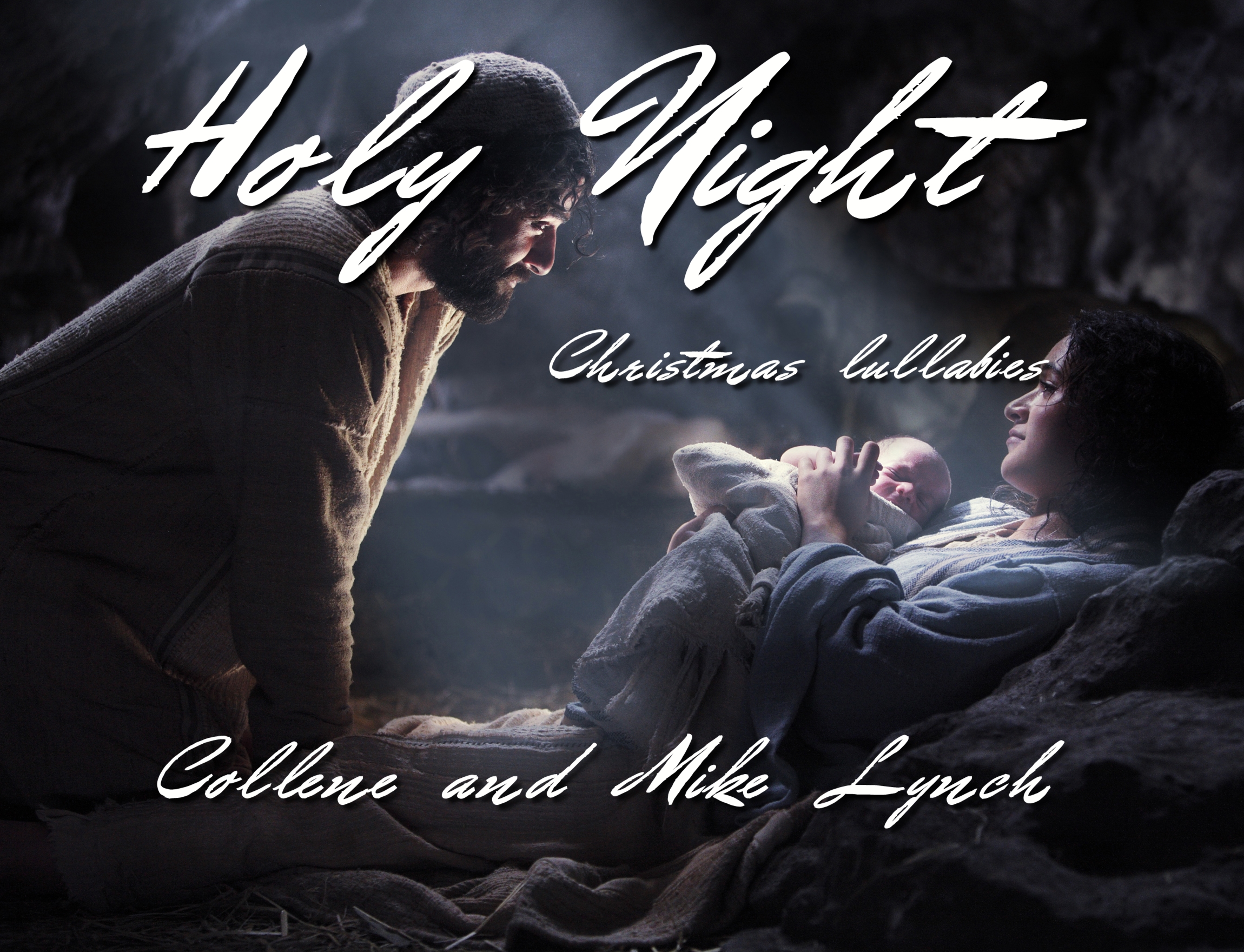
This CD is a blend of traditional and newly composed Christmas songs. All have been selected, arranged and composed to reflect a more tranquil nature of the holiday time. Soothe the nerves and allow yourself to sit back and relax. Let the soft melodies weave their spell and center you in a place that brings peace and relaxation.
Listen to the musical examples featured in the YouTube video below.
The “HOLY NIGHT” Christmas audio CD can be purchased for $13.95 by paying through the paypal donate button on the Ukulele Mike website: http://www.ukulelemikelynch.com
Add $3.00 shipping within the US . . . $7.00 outside the US
THIS IS THE TIME from this CD
“Mary Did You Know?” – by Mark Lowery & Buddy Greene – Solo ukulele arrangement by Ukulele Mike Lynch

Mark Lowry wrote the words in 1984 when his pastor asked him to write the program for the living Christmas tree choir presentation. The music was written by Buddy Greene. Michael English was the first recording artist to record and release ‘Mary, Did You Know?” on his debut album titled Michael English which was released on January 1, 1992. Country music artist Kathy Mattea recorded her version of the song in 1993 for her Christmas album “Good News”, thus giving the song its first widespread exposure to Country radio. Nearly every major pop and country artist in recent years has included this song on their “official” Christmas CD. Sung by school and church choirs worldwide, it has become a beloved classic at Christmas time.
Below is a performance by Ukulele Mike Lynch of his solo ukulele arrangement.
Rockin’ Around The Christmas Tree – by Brenda Lee – Ukulele tutorial by Ukulele Mike Lynch
Despite her mature-sounding voice, Brenda Lee recorded this song when she was only 13 years old. Despite the song’s title, its instrumentation also fits the country music genre, which Brenda Lee more fully embraced as her career evolved. The recording features Hank Garland’s ringing guitar and Boots Randolph’s swinging solo sax break.
An instrumental version of the song appears as background music in the 1964 television special Rudolph the Red-Nosed Reindeer, which exclusively featured music written by Marks. It can be heard in the scene where Rudolph first arrives at the Reindeer Games and meets another reindeer named Fireball. The song was also used in the 1990 film Home Alone during a scene when Kevin McCallister pretends that there is a holiday party taking place in his house, and discourages the burglars from robbing it.
Below is a full video tutorial by Ukulele Mike Lynch of “Rockin’ Around The Christmas Tree”
The “Pachelbel Canon” arranged for solo ukulele by Ukulele Mike Lynch
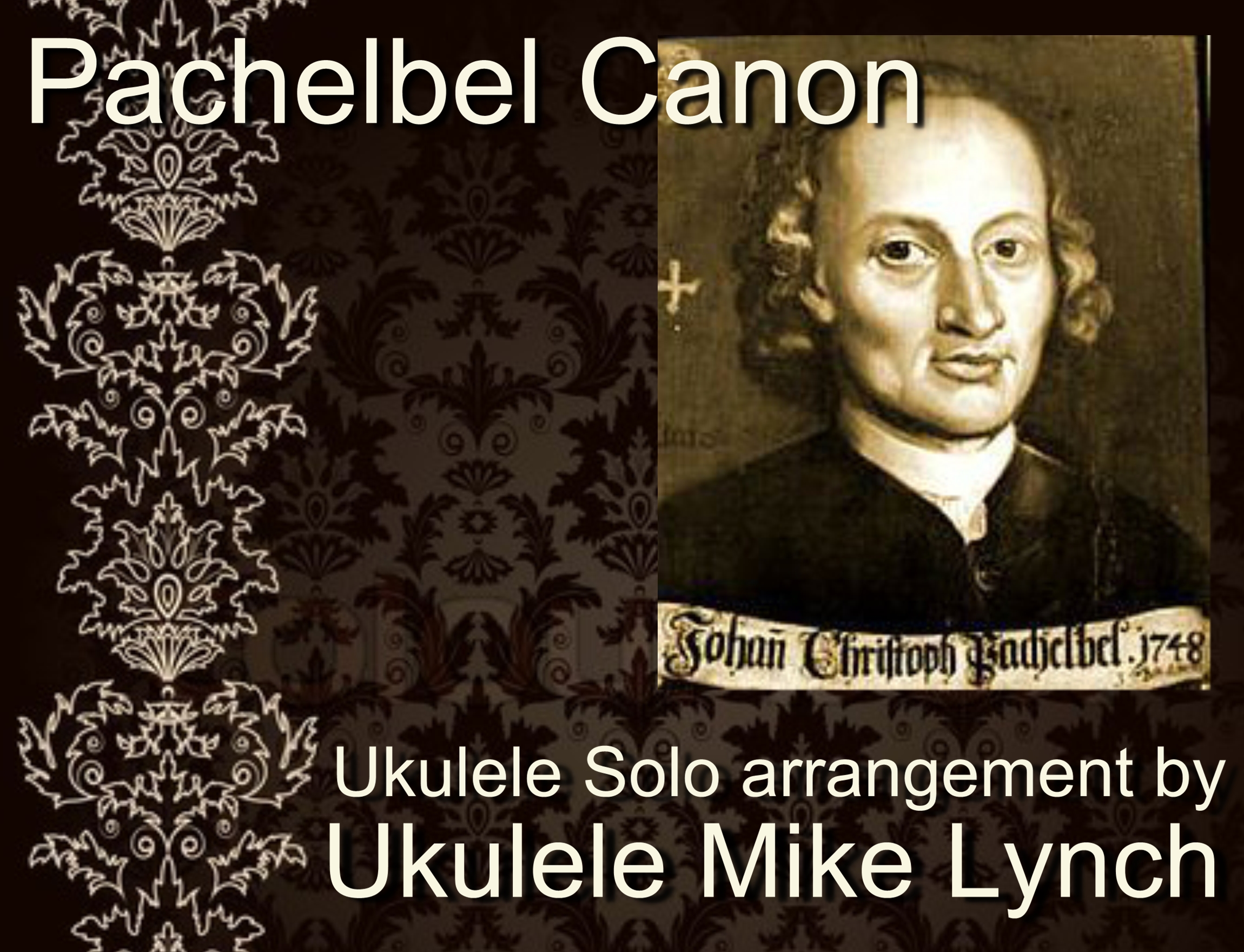
In part we find from WIKIPEDIA that Pachelbel’s Canon is the name commonly given to a canon by the German Baroque composer Johann Pachelbel in his Canon and Gigue for 3 violins and basso continuo (German: Kanon und Gigue für 3 Violinen mit Generalbaß) (PWC 37, T. 337, PC 358). It is his most famous composition. It was originally scored for three violins and basso continuo and paired with a gigue. Both movements are in the key of D major.
Like most other works by Pachelbel and other pre-1700 composers, the Canon remained forgotten for centuries and was rediscovered only in the 20th century. Several decades after it was first published in 1919 the piece became extremely popular. The piece was particularly prevalent in the pop charts of the 1990s, being sampled and appropriated in numerous commercial hits such as Coolio’s “C U When U Get There” and Green Day’s “Basket Case”. It is frequently played at weddings and included on classical music compilations, along with other famous Baroque pieces such as ‘Air on the G String’ by Johann Sebastian Bach.
In his lifetime, Pachelbel was renowned for his chamber works, but most of them were lost. The Canon and Gigue in D major is one such piece. One writer hypothesized that the Canon may have been composed for Johann Christoph Bach’s wedding, on 23 October 1694, which Pachelbel attended. Johann Ambrosius Bach, Pachelbel, and other friends and family provided music for the occasion. Johann Christoph Bach, the oldest brother of Johann Sebastian Bach, was a former pupil of Pachelbel.
The Canon was first published in 1919 by scholar Gustav Beckmann, who included the score in his article on Pachelbel’s chamber music. His research was inspired and supported by renowned early music scholar and editor Max Seiffert, who in 1929 published his arrangement of the Canon and Gigue in his Organum series. However, that edition contained numerous articulation marks and dynamics not in the original score. Furthermore, Seiffert provided tempi he considered right for the piece, but that were not supported by later research. The Canon was first recorded in 1940 by Arthur Fiedler, and a popular recording of the piece was made in 1968 by the Jean-François Paillard chamber orchestra. It has been arranged for numerous instruments including the electronic synthesizer and more recently for solo ukulele by YouTube artist and teacher, Ukulele Mike Lynch.
Tutorial video on YouTube by Ukulele Mike Lynch
This is most definitely a fingerpicking style arrangement. See the short clip below that shows the very simple chord structure that Pachelbel chose for his iconic piece of classical music. The opening chord on the 1st and 3rd beats should be played with the thumb playing the 4th string . . . Index finger playing the 2d string . . . Middle finger playing the 1st string. Roll that chord with a harp like effect. Thumb continues to play the 4th string then the 3rd string.

The Pachelbel Canon is basically made up of merely 2 measures. Those measure with their accompanying chord progression repeat with melodic variations. However, since the melody moves up the fingerboard the chords need to move too. This is where chord inversions come in handy. Most basic chords are made up of 3 notes. The order in which those notes are positioned depends on the melody part. Look at the clip below and notice the G major chord. You need to barre the 7th fret while the pinky plays the 10th fret 1st string to make this chord work in its high inversion.

Simply playing the 10th fret 1st string creates the high inversion Cmajor chord as shown in the clip below.
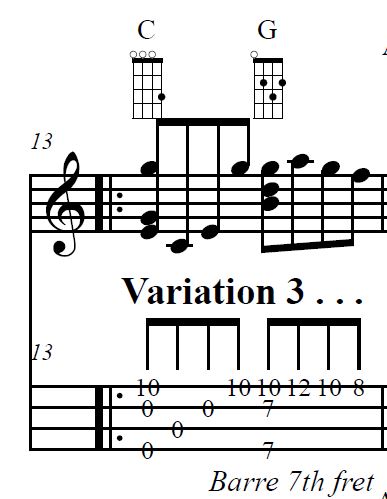
Tablature for “PACHELBEL CANON” is available for purchase by paying $5.39 through the paypal donate button on the Ukulele Mike website: http://www.ukulelemikelynch.com
I have plenty of solo ukulele instrumentals available for playing enjoyment.
Here is a link to a former blog I did detailing my ENTIRE CATALOG of available solo ukulele instrumentals . . .
THE COMPLETE CATALOG OF UKULELE MIKE LYNCH SOLO UKULELE INSTRUMENTALS
This arrangement plus 15 more are heard on the newly released “HEART STRINGS” CD . . It can be purchased for $12.95 through the paypal donate button on the Ukulele Mike website: http://www.ukulelemikelynch.com
$3.00 shipping within the US . . . $7.00 shipping outside the US
“Chestnuts Roasting On An Open Fire” by Mel Torme & Bob Wells – Solo ukulele arrangement by Ukulele Mike Lynch

According to Wikipedia “The Christmas Song” (commonly subtitled “Chestnuts Roasting on an Open Fire” or, as it was originally subtitled, “Merry Christmas to You”) is a classic Christmas song written in 1944 by musician, composer, and vocalist Mel Tormé (aka The Velvet Fog), and Bob Wells. According to Tormé, the song was written during a blistering hot summer. In an effort to “stay cool by thinking cool”, the most-performed (according to BMI) Christmas song was born.
“I saw a spiral pad on his piano with four lines written in pencil”, Tormé recalled. “They started, “Chestnuts roasting…, Jack Frost nipping…, Yuletide carols…, Folks dressed up like Eskimos.’ Bob (Wells, co-writer) didn’t think he was writing a song lyric. He said he thought if he could immerse himself in winter he could cool off. Forty minutes later that song was written. “I wrote all the music and some of the lyrics.”
The Nat King Cole Trio first recorded the song early in 1946. At Cole’s behest – and over the objections of his label, Capitol Records – a second recording was made the same year utilizing a small string section, this version becoming a massive hit on both the pop and R&B charts. Cole again recorded the song in 1953, using the same arrangement with a full orchestra arranged and conducted by Nelson Riddle, and once more in 1961, in a stereophonic version with orchestra conducted by Ralph Carmichael. Nat King Cole’s 1961 version is generally regarded as definitive, and in 2004 was the most loved seasonal song with women aged 30–49, while Cole’s original 1946 recording was inducted into the Grammy Hall of Fame in 1974.
Below is a performance/tutorial of “CHESTNUTS ROASTING ON AN OPEN FIRE” by Mel Torme and arranged for solo ukulele by Ukulele Mike Lynch
I play my arrangement with just the right thumb. No fingerpicking is involved. The opening segment presented below is just a simple vamp with the thumb playing the 4th then the 3rd, 2nd and 1st string for each chord change. Notice the Ebdim7 and Gm7 chords. These are both what we call “jazz” chords. They have a delicious distinctive sound that sets them apart from normal major and minor chords. Adding that 7th to the chord is the secret ingredient. If these chord shapes are foreign to you, it will take no time to get use to them and you’ll treasure them forever in your playing. This song is a great introduction to some of these “jazz” chord voicings.

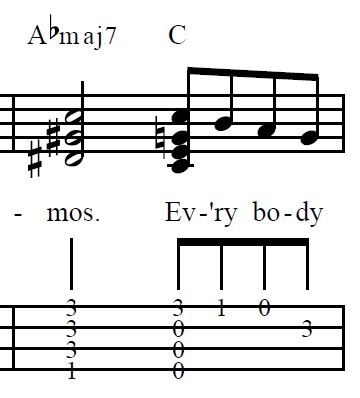
Another “jazz” chord is found in the example below . . . The Abmaj7 . . . I like to play it by barring the 3rd fret with my ring finger while my index finger plays the 1st fret of the 4th string. If you find another fingering that works better for you, go for it.
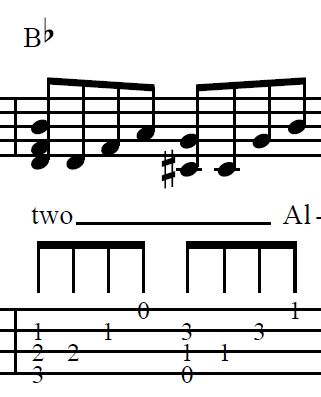
Below notice the first chord is Bb but it’s only played with 3 strings. Therefore, it eliminates the need to barre the first 2 strings as you typically would with a normal Bb chord. Makes it pretty easy.
The tablature notation for CHESTNUTS ROASTING ON AN OPEN FIRE is only available as a single tab. It’s not included in my rather large UKULELE CHRISTMAS eBook. It can be purchased for $5.39 by paying through the paypal donate button on my website: http://www.ukulelemikelynch.com
Once purchased it will be emailed to you within the day.
Below is a link to a recent blog I did detailing my COMPLETE ENTIRE CATALOG of Solo Ukulele instrumentals currently available:
THE COMPLETE CATALOG OF UKULELE MIKE LYNCH SOLO UKULELE INSTRUMENTALS
The Perfect Christmas gift! Ukulele Mike’s Beginners DVD combo pak

“THE WONDERFUL WORLD OF THE UKULELE” Volume 1 DVD
PLUS “UKULELE MIKE’S FAVORITES FOR BEGINNING UKULELE make up
the Beginners combo pak. They can be purchased together or separately.
See the You Tube video below detailing the contents of the DVD
The companion eBook to the beginners DVD is entitled “UKULELE MIKE’S FAVORITES FOR BEGINNING UKULELE”

It is definitely a perfect compliment to the DVD. Singly it sells for $15.00 but purchased as part of a combo pak with the DVD, it is only an additional $10.00.
Below is a link to a former blog detailing the contents of the companion eBook.
PERFECT for Beginning Ukulele Players : UKULELE MIKE’S FAVORITES for Beginning Ukulele Songbook
For information regarding any ukulele product please email:
TheUkuleleMan2012@hotmail.com

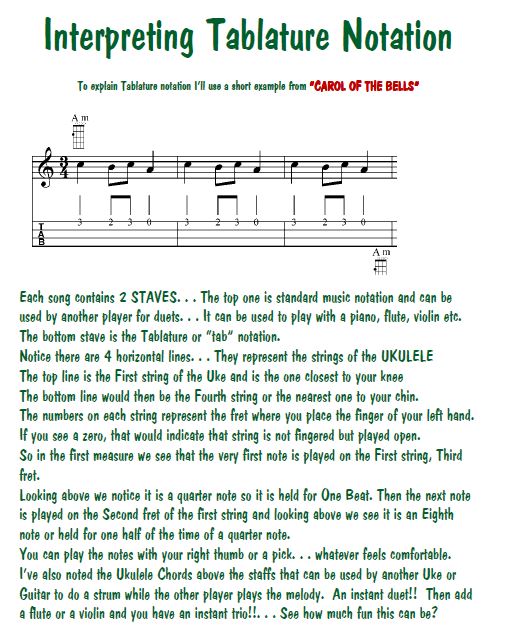
I’ve had so many people showing a great interest in playing solo ukulele instrumentals lately. Sales of my SOLO INSTRUMENTALS eBook plus my CHRISTMAS UKULELE eBook not to speak of all of my individual tabs lets me know how popular solo instrumental playing is becoming among the global ukulele community. And now my massive collection of CHORD/MELODY pieces . . .A couple of years ago I released a collection of Solo Christmas Melodies and below is a page from that collection that attempts to summarize the subject of TABLATURE notation.
What in the world is tablature anyway???
Well, it’s actually a form of notation that has been used since the days of the
Renaissance and Baroque eras when it was developed to notate music for fretted string
Instruments such as the lute, viheula and guitar.
There were also types of tablature for organs, harps and ocarina.
Often the term tablature is misused when referring to simple chord/lyric songsheets. There are numerous online sites claiming to be offering “tabs” for current pop tunes. They are wrong. . . They are misleading . . . and they do nothing but add to the confusion for ukulele players. Even after repeated chiding from me they will not relent. One site even admitted they knew they were using the term “tab” erroneously but blatantly said they will continue to do so since it helps keep their site “popular” argggghhhhhh
As a music educator for over 40 years that just makes me see red.
Nowadays the term tablature is often shortened to “Tab”.
Whereas “standard notation” indicates the notes on a musical staff, tablature indicates the actual physical placement of the fingers on the strings at their appropriate fret positions.
Although tablature does simplify fretted instrument notation, it is, after all, still a form of notation and requires steady practice and patience to understand and interpret.
The tablature lines indicate the strings of the ukulele and one needs to know which strings are which. The top line indicates string number one or the “A” string. One needs to understand that the first string is the string nearest your knee. The bottom line of the tablature is the 4th string known as the “G” string.
For ukulele players who have generally thought of the ukulele as an instrument to accompany singing, it’s often a challenge to see it as an instrumental solo instrument. In other words, full strummed chords are no longer always the case. There are many times when just 2 or 3 strings are plucked or strummed. Sometimes but one string is played to denote a melody line. So now with solo playing one can no longer just apply the fingers of the left hand to the fingerboard for a chord and strum up and down with the right hand. There is much more detail involved here. So, for example in the music clip shown above of CAROL OF THE BELLS. . . The tablature only indicates a melody which is played on the first string (1st line as indicated by the tab) If you want to play a chord along with that melody then you need a 2nd instrument to play the chord listed above the standard notation on the upper staff line. Hope this makes some sense. As I laid out the arrangements in my MELODIES OF CHRISTMAS book, I made it possible for 2 ukuleles or 2 groups of ukuleles can play together and compliment each other with one group playing melody, the other playing chords with standard down up down up strumming patterns.
Typically, tablature notation doesn’t do a really great job in clearly indicating note values. Meaning how long you hold the note. For that reason, in most of my more recent arrangements I’m now including standard treble clef notation on the top which does clearly indicate note values etc.
All of the pieces in my SOLO UKULELE INSTRUMENTALS and UKULELE CHRISTMAS collection are in tablature format. Some are fingerpicked. . . . Others are chord/melody pieces where one brushes the chord and the melody rings out as the prominent note on top. EDELWEISS and TILL THERE WAS YOU are perfect examples of chord/melody pieces.
I’ve made a conscious effort to make these pieces accessible to the majority of ukulele players with moderate skills. It’s been my experience that many publications of solo instrumental pieces are daunting and would cause many to be turned off to getting into the world of solo instrumental ukulele playing.
As a teacher, I’ve found that many people are not comfortable with accompanying themselves while singing so playing instrumentals is a great way to enjoy the capabilities of your ukulele. Many of these pieces are standard classical pieces such as Beethoven’s Pathetique Sontata while many others are my own original compositions such as BELLA TOSCANA, BABY’S BREATH and my “DREAMSCAPE TRILOGY”.
PRACTICE METHOD for TABLATURE playing:I recommend not biting off more than one can chew. Look at the piece and choose one measure or two to learn. Don’t attempt to sit down and plod through and entire piece at a glacial tempo. It’s best to study one measure . . . determine the left hand fingerings . . . determine what fingers are employed in the right hand . . . slowly play through the measure . . . begin to memorize . . . try playing it without looking at the music . . . go back to double check . . . then play again until it’s firmly memorized and played with ease . . . then proceed on to the next measure and repeat that sequence of events. Taking on just one or 2 measures a day will have you playing the entire piece within a week. Trying to play the entire piece from front to end only ends up with frustrations and feeling incompetent. You CAN do this. . . it just take TIME and PATIENCE. You’ll discover after a period of time that your comfort zone with reading tablature will increase a thousand fold. After a time you WILL develop the ability to simply look at the measure and start to SIGHT READ. It’s analogous to learning to read. As a child we read one word at a time slowly and progressively. In time we are reading faster and comprehending. The same goes for reading any form of notation, be it standard treble clef or tablature notation. We learn from one beat to the next. Memorization is essential. Get that chord memorized . . . get that fingering memorized . . . in time the skill of sight reading does happen but only after a period of practice and time.
Final word . . . always have your “playing” time really be “PLAYING”. History tells us that when Mozart was a little child and he spent countless hours playing the keyboard or the violin, he really WAS playing. . . just as a child plays with toys. To Mozart music was joy . . . fun . . . and true playing. Always let your ukulele time be that. Never let it be drudgery. When your fingers get tired or your brain. . . for me, it’s usually my brain ha ha ha. . . Then go to something a bit easier or familiar and come back to the more difficult work later. And always rememember . . . . “HAPPY STRUMMING”
P.S.Let me refer you to a blog I did a few months ago
Here’s the link: https://allthingsukulele.com/2013/09/10/the-everyman-ukulele-arranger-ukulele-mike-lynch/?relatedposts_exclude=1849
Special Addendum . . .
I now have 3 Chord/Melody eBooks . . . They can each be purchased separately for just $20.00 or all together at a new combo “TRILOGY” discount of just $50.00

Just released the New Chord melody ebook FOUR

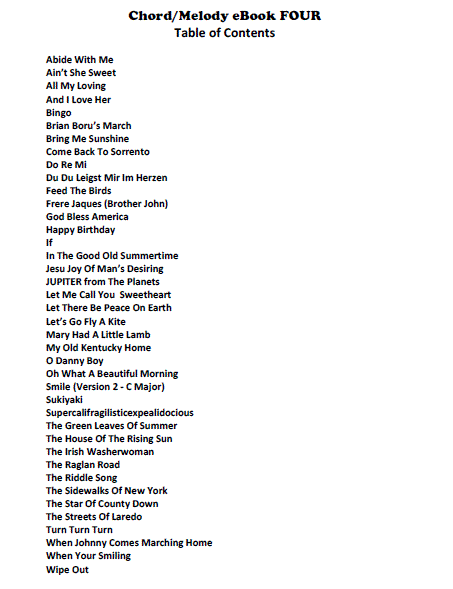

Chord/Melody arrangements are by far the best introduction to instrumental solo playing. One can play convincing instrumentals with much more ease than usually experienced with fingerpicking solo playing. Only the thumb is used in this stye of playing. No other fingers are involved. This acts to simplify the process so one can concentrate on the distinctive melody of the piece. In many cases the melody will be found to exist on either the first or second strings. One needs to merely hold down the main chord while the melody is played above. I’ve taken such elaborate pieces as the Schubert Ave Maria and brought them down to their most important chordal structures. No more awkward finger picking arppegios in these pieces. Simply play the chord and the melody will sing out on the top. A fine way to begin playing solo instrumentals and yet many professionals use this arrangement technique throughout their playing careers.
New Chord/Melody collection
For information regarding any ukulele resource please email: TheUkuleleMan2012@hotmail.com
“I’ll Be Home For Christmas” a beloved World War II Christmas song, dedicated to “The Greatest Generation”
“I’ll Be Home For Christmas” by Kim Gannon, Walter Kent & Buck Ram
“I’ll Be Home for Christmas” is a Christmas song recorded in 1943 by Bing Crosby who scored a top ten hit with the song. “I’ll Be Home for Christmas” has since gone on to become a Christmas standard.
The song is sung from the point of view of an overseas soldier during WWII, writing a letter to his family. In the message, he tells the family that he will be coming home, and to prepare the holiday for him including requests for “snow”, “mistletoe”, and “presents by the tree”. The song ends on a melancholy note, with the soldier saying “I’ll be home for Christmas, if only in my dreams.”
The song was written by the lyricist Kim Gannon and composer Walter Kent. Buck Ram, who previously wrote a poem and song with the same title, was credited as a co-writer of the song following a lawsuit. The original 1943 release of the song by Bing Crosby on Decca Records listed only Walter Kent and Kim Gannon as the songwriters on the record label. Later pressings added the name of Buck Ram to the songwriting credit.
The song touched the hearts of Americans, both soldiers and civilians, who were in the midst of World War II, and it earned Crosby his fifth gold record. “I’ll Be Home for Christmas” became the most requested song at Christmas U.S.O. shows. Yank, the GI magazine, said Crosby “accomplished more for military morale than anyone else of that era”.
This is, once again, a chord/melody solo instrumental. As in most of my chord/melody arrangements I suggest using only the thumb and no finger picking involved whatsoever.
I always stroke the strings up the neck a bit for the warmest, sweetest sound, using only the flesh of the thumb.
Below is a short example of the song showing the intro “vamp”. A “vamp” is a short (usually 4 bar) chord progression that can be repeated freely to introduce the song. Typically during a vamp the artist may even speak over it while introducing the song. At the end of the vamp you will notice a double line. Double lines in musical notation are usually used to indicate the end of a distinct phrase or section of the piece.
In this example you’ll also see the generous use of Jazz chords such as the min7 and dim7. These are terrific chords to add to your chord vocabulary.

The short excerpt below shows notation for a “double slur” that is more thoroughly described in the tutorial video above. Notice the use of the letter “H” for Hammer on and letter “P” for pull off. Achieving each of these skills takes time and patience to develop. Don’t give up on it. I would suggest practicing the part first without the effects then add them in later after your technique has more fully developed. It does take time . . .

Full standard notation and ukulele tablature is available for purchase: $5.39 and can be purchased by paying through the paypal donate button on the Ukulele Mike website: http://www.ukulelemikelynch.com
Once purchased I will email it to you within the day.
Don’t forget I also have a large “2 in 1” UKULELE CHRISTMAS eBook . . .
Here is a blog detailing the contents of that collection:
“UKULELE CHRISTMAS eBook” Now available from “UKULELE MIKE LYNCH”
For information regarding any ukulele product please email:
TheUkuleleMan2012@hotmail.com
“UKULELE CHRISTMAS eBook” Now available from “UKULELE MIKE LYNCH”

UKULELE CHRISTMAS eBook arranged and compiled by UKULELE MIKE LYNCH

It’s actually TWO TWO TWO BOOKS IN ONE!!!! ha ha ha
Truly it is, though. . . The first book “A UKULELE CHRISTMAS” contains my entire catalog of UKULELE SOLO INSTRUMENTALS in Tablature format. It also includes a full page tutorial on how to interpret and play in the tablature format.
Here is the complete list of Solo Christmas Ukulele instrumentals in tablature format:
Angels We Have Heard On High
Away In A Manger
Coventry Carol
Good King Wenceslas
O Come Little Children
O Little Town Of Bethlehem
O Tannenbaum
Pat-A-Pan
Silent Night
Still, Still, Still
Up On The Housetop
We Three Kings
What Child Is This
White Christmas Chord/Melody Version
White Christmas (Fingerpicking vesion)
Winter Wonderland
The second book is the “CHRISTMAS SING-A-LONG COLLECTION”
A comprehensive collection of traditional and popular classic CHristmas standards, perfect for Christmas and Holiday…
View original post 232 more words
 UKULELE MIKE LYNCH - All things UKULELE