THE KEYPORT RAG by Ukulele Mike Lynch

YOU TUBE performance and tutorial for The Keyport Rag

Upon a generous invitation of dear friends several years ago, my wife and I spent a relaxing week on Liberty Bay in the tiny town of Keyport, Washington. While there I was inspired to compose this lazy little ragtime tune and it became a constant soundtrack to our musings on the porch of the bay side cottage we were living in. Taking walks around the town, I had the melody of this little tune running through my head and I would frequently head back to the cottage to pick up my ukulele and try out new ideas that would pop into my brain. KEYPORT RAG is largely played in a swinging, bouncy travis picking style and below is a small example of the tablature arrangement of this song.
EXAMPLE OF KEYPORT RAG #1

Throughout the piece the thumb plays the 4th and 3rd strings. The index finger plays the 2nd string and the middle finger plays the 1st string. The cool thing about travis picking is that the thumb carries a consistent rhythm while the 2 top strings carry the melody. This allows the player to split the uke into 2 parts: The bass or thumb strokes and the melody parts. This is a great way to play solo instrumental pieces.
Among many songs that work well with travis that include melody are BLOWIN’ IN THE WIND, PUFF THE MAGIC DRAGON, THIS LAND IS YOUR LAND and many many more tunes from the 60’s folk era.
Take a look again at the example above and note that in the 3rd measure you will see a letter “H” above the first two notes. The letter “H” stands for the phrase “HAMMER ON” which is a technique that allows you to change the melody with out striking it twice with the right hand. Instead, you strike the first note then let the second note sound by striking it forcefully with the left hand. This technique is prevalent in not only folk music but also in jazz and classical. In fact, concert violinists use it all the time to create SLURS between notes. One can go in the opposite direction and rather then hitting the string but plucking it with the left hand. This is called a “PULL OFF” and indicated with a letter “P”. The first person to use these names was the celebrated folk singer and songwriter Pete Seeger.
EXAMPLE OF KEYPORT RAG #2

In the above example notice the last 2 measures. They are both TRAVIS picking style but one is a “STRAIGHT FEEL” while the second one is a “SWING STYLE”. Yes, TRAVIS can be played both ways and each way is distinctly different. When using travis in a song remember it has to be in 4/4 time and keep that bouncy thumb beat. To determine whether to use the “STRAIGHT FEEL” or “SWING FEEL” comes with practice and experimentation. Use your own ear and sensitivity to determine which one to use. One other thing to keep in mind is to keep a good balance in volume between the bass notes and the melody notes. Don’t let the bass notes overtake the melody or the melody will be lost in the mix so to speak. Practice to make the melody be predominant otherwise it will sound all mushed together and the melody will be hidden. Keep in mind that to get TRAVIS pick to work you need to be slow at first then speed up but don’t get impatient or frustrated. Give it time and you’ll get it. When I was in college and first learned to do TRAVIS on the guitar it took me a good couple of weeks to really get it smooth and sounding like I heard it on recordings. It’s an amazing picking pattern to learn and well worth the time and practice. HAPPY STRUMMING!
THE KEYPORT RAG is contained in my UKULELE SOLO INSTRUMENTAL eBook 2013 Enlarged edition: $28.95 and can be purchased by paying directly through the paypal donate button on the Ukulele Mike website: http://www.ukulelemikelynch.com
Once purchased it will be emailed to you within the day.
Don’t forget, I also have a whole Chord/Melody series Library. Each eBook can be purchased separately or together as a tri pak at a discount

Questions regarding any Ukulele resource, please email TheUkuleleMan2012@hotmail.com

Antonin Leopold Dvorak 1841 – 1904 Read more…

ELIZABETH COTTEN
According to Wikipedia Elizabeth Nevills (Cotten) was born in Carrboro, North Carolina, at the border of Chapel Hill, to a musical family. Her parents were George Nevills and Louise Price Nevills. Elizabeth was the youngest of five children. At age seven, Cotten began to play her older brother’s banjo. By eight years old, she was playing songs. At the age of 11, after scraping together some income as a domestic helper, she bought her own guitar. Although self-taught, she became very good at playing the instrument. By her early teens she was writing her own songs, one of which, “Freight Train”, would go on to be one of her most recognized. Cotten wrote “Freight Train” when she saw a train pass by her house on Lloyd Street in Carrboro, North Carolina.
Around the age of 13, Cotten began working as a maid along with her mother. Soon after the age of 15, she was married to Frank Cotten. The couple had a daughter named Lillie, and soon after young Elizabeth gave up guitar playing for family and church. Elizabeth, Frank and their daughter Lillie moved around the eastern United States for a number of years between North Carolina, New York, and Washington, D.C., finally settling in the D.C. area. When Lillie married, Elizabeth separated from Frank and moved in with her daughter and her family.
Elizabeth Cotten retired from guitar playing and songwriting for decades until she was eventually rediscovered. Cotten had retired from the guitar for 25 years, except for occasional church performances. It wasn’t until she reached her 60s that she began recording and performing publicly. She was discovered by the folk-singing Seeger family while she was working for them as a housekeeper.
While working for a brief stint in a department store, Cotten helped a child wandering through the aisles find her mother. The child was Penny Seeger, and the mother was composer Ruth Crawford Seeger. Soon after this, Elizabeth again began working as a maid, caring for Ruth Crawford Seeger and Charles Seeger’s children, Mike, Peggy, Barbara, and Penny. While working with the Seegers (a voraciously musical family) she remembered her own guitar playing from 40 years prior and picked up the instrument again to relearn almost from scratch.
Now, with her connection with the celebrated Seeger family her music was introduced to numerous folk artists of the era. Her signature song FREIGHT TRAIN has been covered by Bob Dylan, Pete Seeger, Joan Baez, Gerry Garcia, Peter Paul & Mary among others. I have attempted in this ukulele arrangement to faithfully capture the rhythmic feeling she created on her guitar. Using the distinctive fingericking style “TRAVIS PICKING” that bouncy raggy feel is produced. Below is a snippet from my arrangement in tablature form that shows that “TRAVIS” style of picking. Notice the consistent thumb stroke 4 times each bar. That along with the swingy 8th note feel creates that iconic sound that has come to be a hallmark of the Folk Style.
EXAMPLE 1

Take note that the thumb strokes alternate between the 4th and 3rd strings giving it that distinctive bouncy sound. The 2nd finger plays the 1st string and the Index finger plays the 2nd string throughout.
YouTube performance of FREIGHT TRAIN as arranged by UKULELE MIKE LYNCH
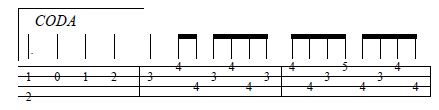
The snippet of music below shows the “CODA” section of FREIGHT TRAIN. The word CODA applies to a section of music that is reserved for the end of the composition. Sometimes we call that a tag ending. It is a piece of music that only happens at the very end of the song. Within the music the word “Go To Coda” instructs us to go directly to the CODA section to finish the piece. The CODA section breaks from the normal TRAVIS pick as a departure that leads us to the end of the piece.
EXAMPLE 2
Full tablature arrangement of FREIGHT TRAIN is included in my SOLO UKULELE INSTRUMENTALS eBook 2013 Enlarged Edition now reduced to just $20.00 and can be purchased by paying through the paypal donate button on the Ukulele Mike website: http://www.ukulelemikelynch.com Once purchased it will be emailed to you within the day.


Questions regarding any Ukulele resource please email TheUkuleleMan2012@hotmail.com
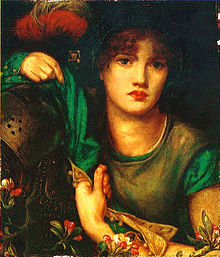
“My Lady Greensleeves” as depicted in an 1864 painting by Dante Gabriel Rossetti
The traditional classic song GREENSLEEVES has a long and celebrated history. As chronicled in Wikipedia: A broadside ballad by this name was listed at the London Stationer’s Company in September 1580, by Richard Jones, as “A Newe Northen Dittye of ye Ladye Greene Sleves”. Six more ballads followed in less than a year, one on the same day, 3 September 1580 (“Ye Ladie Greene Sleeves answere to Donkyn hir frende” by Edward White), then on 15 and 18 September (by Henry Carr and again by White), 14 December (Richard Jones again), 13 February 1581 (Wiliam Elderton), and August 1581 (White’s third contribution, “Greene Sleeves is worne awaie, Yellow Sleeves Comme to decaie, Blacke Sleeves I holde in despite, But White Sleeves is my delighte”). It then appears in the surviving A Handful of Pleasant Delights (1584) as A New Courtly Sonnet of the Lady Green Sleeves. To the new tune of Green Sleeves. Christmas and New Year texts were associated with the tune from as early as 1686, and by the 19th century almost every printed collection of Christmas carols included some version of words and music together, most of them ending with the refrain “On Christmas Day in the morning”. One of the most popular of these is “What Child Is This?”, written in 1865 by William Chatterton Dix.
Over the centuries GREENSLEEVES has been interpreted instrumentally and vocally in hundreds of arrangements but the most enduring instrument that has been associated with this song has been the lute and later the classical guitar and harp. The ukulele with its nylon strings and mellow tone is uniquely adapted to this wonderful melody. In my ukulele arrangement I stress the use of rolled chords to achieve a harp like sound. Here are two examples of my arrangement as notated in tablature format.
EXAMPLE 1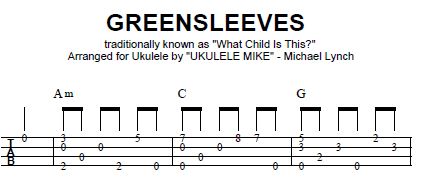
EXAMPLE 2

Here is the YouTube video of my ukulele arrangement of GREENSLEEVES
The tablature arrangement of GREENSLEEVES is included in my SOLO UKULELE INSTRUMENTAL collection 2013 Enlarged edition. It can be purchased $28.95 by paying through the paypal donate button on my website: http://www.ukulelemikelynch.com It contains 96 pages of solo fingerpicking and chord/melody pieces for instrumental ukulele.

All the same great content found in the original UKULELE MIKE’S FAVORITES FOR BEGINNING UKULELE as combined with THE WONDERFUL WORLD OF THE UKULELE DVD as a combo pak. The big difference is that this edition is for the Baritone Ukulele with Baritone chord fingerings, chord grids, chord chart but with all the same strumming and fingerpicking pattern suggestions. Most of the song material on THE WONDERFUL WORLD OF THE UKULELE DVD for beginning ukulele is in this book so NOW as a baritone ukulele player you can play right along with the instructional DVD.
Here is what you’ll find inside the pages of the Baritone edition of UKULELE MIKE’S FAVORITES FOR BEGINNING UKULELE:
Baritone Ukulele Chord Sheet
Amazing Grace
America The Beautiful
An Irish Lullaby
Are You Sleeping?
Auld Lang Syne
Bicycle Built For Two
Five Hundred Miles
Happy Birthday To You
He’s Got The Whole World In His Hands
Home On The Range
I Gave My Love A Cherry (Riddle Song)
In The Good Old Summertime
I’ve Been Workin’ On The Railroad
Jesus Loves Me
Kumbaya
Mele Kalikimaka
Michael Row The Boat Ashore
Morning Has Broken
My Bonnie Lies Over The Ocean
My Old Kentucky Home
My Wild Irish Rose
O Canada
O Danny Boy
Oh My Darling Clementine
Oh Susannah
On Top Of Old Smokey
On Top of Spaghetti
Red River Valley
Sailing, Sailing
She’ll Be Comin’ ‘Round The Mountain
Silent Night
Sloop John B.
Somewhere Over The Rainbow / What A Wonderful World
Stewball
Sweet Betsy From Pike
Take Me Out To The Ballgame
Teddy Bear’s Picnic
The Happy Wanderer
The House Of The Rising Sun
The Lion Sleeps Tonight
This Land Is Your Land
This Little Light of Mine
Waltzing Matilda
When Irish Eyes Are Smiling
When The Saints Go Marching In
You Are My Sunshine
THE WONDERFUL WORLD OF THE UKULELE instructional DVD for beginners can be purchased for $20 plus $3 shipping in the US $7 outside the US. Payable through the PayPal donate button on the Ukulele Mike website: http://www.ukulelemikelynch.com
To help you get started on playing your Baritone ukulele I have made a video on tuning. Keep in mind that I’m using the traditional DGBE tuning for the Baritone Ukulele. There are numerous other tunings but I had to concentrate on just one for practical purposes.
BARITONE UKULELE TUNING VIDEO:
An earlier Baritone Ukulele lesson . . . more to come soon

The song AKAKA FALLS was written by Helen Lindsey Parker in 1934. According to an ancient Hawaiian legend, Akaka fell to his death from the 442 foot falls called AKAKA FALLS. His two lovers, Lehua and Maile could not stop crying and they can be seen in a ravine close by, disguised as two smaller waterfalls.
The song both in instrumental form as well as sung form has become a classic standard in Hawaiian music. Below is a video performance of AKAKA FALLS done recently by Hawaiian ukulele icon Jake Shimabukuro. The song’s simplicity and purity make it an audience favorite.
A few months ago my wife and I saw Jake perform this in a concert at Benaroya Hall here in Seattle. He did it as the final encore and inspite of its simplicity compared to many of his more complex pieces, this piece was a perfect ending to a perfect evening of ukulele music.
I was inspired later that week to come up with my own arrangement of this song. I was strongly influenced by Jake’s arrangement and several others I found online. Below are several clips from my arrangement. Note the harp-like rolls I have notated in the score. Those are intended to give the piece a more flowing feeling and also to fill out the sound. Since the ukulele only has 4 strings, by rolling the chords one can create an illusion of a larger fuller instrument.
EXAMPLE 1.
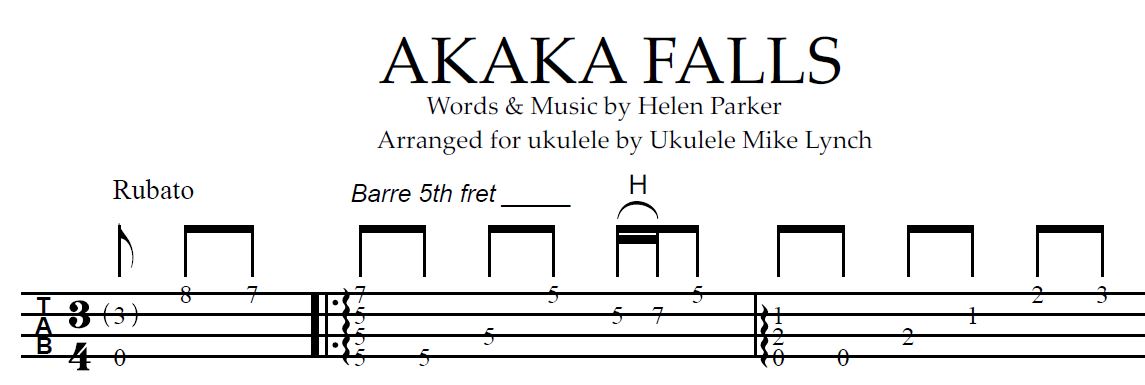
EXAMPLE 2.
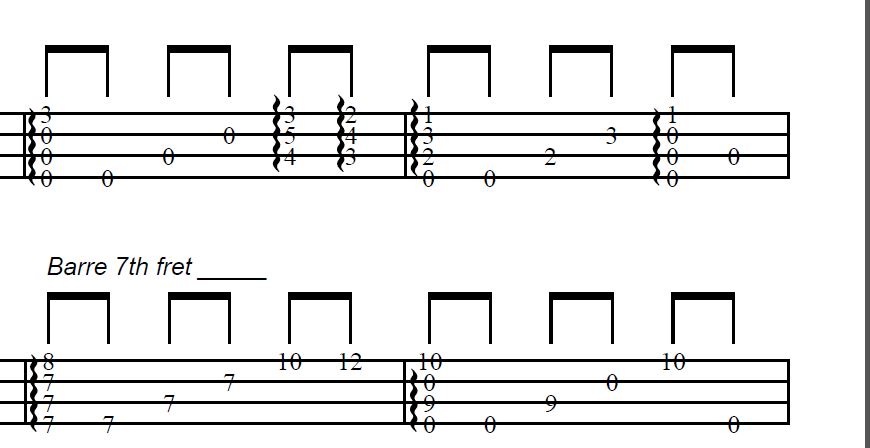
EXAMPLE 3.
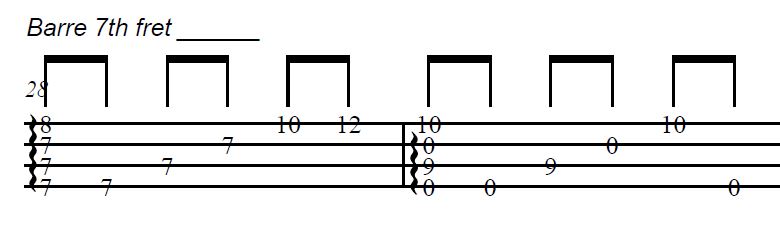
Tablature for this arrangement of AKAKA FALLS is not included in the SOLO UKULELE INSTRUMENTALS eBook, but it is available as a single tablature for $5.39 and can be purchased by paying through the paypal donate button on my website: http://www.ukulelemikelynch.com

From the Wikipedia site we learn that Finlandia, Op. 26 is a symphonic poem by the Finnish composer Jean Sibelius. The first version was written in 1899, and it was revised in 1900. The piece was composed for the Press Celebrations of 1899, a covert protest against increasing censorship from the Russian Empire, as the last of seven pieces, each performed as an accompaniment to a tableau depicting episodes from Finnish history.
The premiere was on 2 July 1900 in Helsinki with the Helsinki Philharmonic Society conducted by Robert Kajanus. A typical performance takes anywhere from 7½ to 9 minutes.
A recurrent joke within Finland at this time was the renaming of Finlandia at various musical concerts so as to avoid Russian censorship. Titles under which the piece masqueraded were numerous, a famously flippant example being Happy Feelings at the awakening of Finnish Spring
I was first exposed to FINLANDIA while studying piano as a young child. I’ve held this melody as a very cherished part of my musical background. It has been so universally accepted that it has been set to lyrics numerous times. Christian hymns (Be Still, My Soul; I Sought the Lord; We Rest on Thee; A Christian Home; This Is My Song; and I Then Shall Live), Gweddi dros Gymru or A Prayer for Wales (a national song of Wales), Ambrosian Oaks (the alma mater of St. Ambrose University in Davenport, Iowa), and Land of the Rising Sun (the national anthem of the short-lived African state of Biafra). It is also the tune for Capital University’s alma mater, “O Capital.”
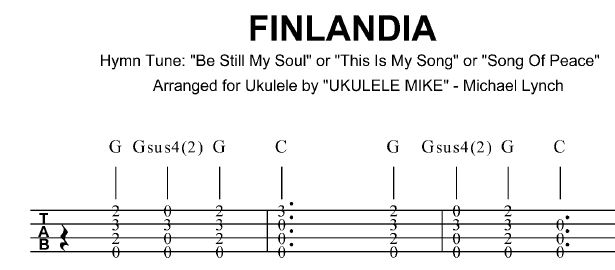
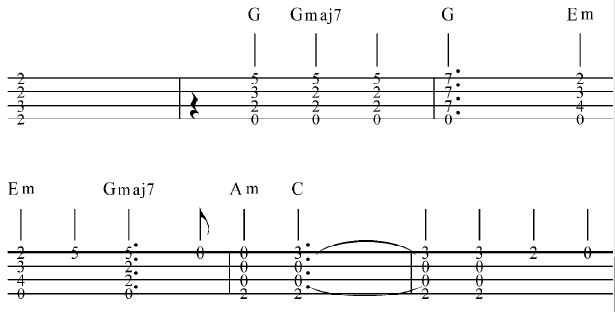
I was so delighted one day when I discovered that by simply playing a G major chord on the ukulele the melody of FINLANDIA presented itself. I the discovered the very simple progression that allows it to be played to nicely on the ukulele. My arrangement of FINLANDIA is what is termed a Chord/Melody arrangement. That means that in most cases by simply down strumming the chord the melody rides on the top or first string. So the entire piece is played only with the thumb in a downward harp like rolling fashion. Using the harp like roll gives the ukulele a fuller sound and expands the character of the piece. It’s vitally important not to play this with a metronome. It should be played very freely with what we call a RUBATO style. Allows plenty of breathing room between the chords. Never rush this piece. Although the ukulele has little sustain allow the uke to sustain as physically capable of the instrument. To also aid in providing more sustain hold the chords down firmly. Don’t let up pressure on the strings prematurely as this will disconnect the strings from the frets and cause the sound to terminate instantly. Therefore, do not lift the fingers until the very last moment you wish to change the chord.
I have provided a full tablature arrangement of Sibelius and below are two small examples of the tablature.
EXAMPLE 1.
EXAMPLE 2.
Below is a comprehensive video tutorial of FINLANDIA that I did on You Tube awhile back.
Here is a very nice rendition of my arrangement of FINLANDIA done by one of my followers on You Tube.
Here is yet another nicely performed rendition of FINLANDIA
My wife, Collene and I performing FINLANDIA on the 2013 Ukulele cruise aboard the Golden Princess cruise ship
Complete tablature for my arrangement of FINLANDIA is contained in my large 92 page eBook SOLO UKULELE INSTRUMENTALS 2013 Enlarged edition. It sells for just $20.00 and can be purchased by paying through the paypal donate button on
my website: http://www.ukulelemikelynch.com Once purchased it will be emailed to you within the day.
FINLANDIA is now also contained in the newly released CHORD/MELODY Collection from UKULELE MIKE LYNCH. It also sells for just $20.00 and can be purchased through the paypal button on the Ukulele Mike website: http://www.ukulelemikelynch.com
HERE IS A YOU TUBE VIDEO DETAILING THE CONTENTS OF THE NEW “CHORD/MELODY COLLECTION”


Each of the Chord/Melody eBooks can be purchased separately for just $20.00 or all together at the new Combo “Trilogy” discount of just $50.00



All 4 of the Chord melody ebooks can be purchased at a combo QUARTET discount of $70

For information regarding any ukulele product please email: TheUkuleleMan2012@hotmail.com
El Condor Pasa – Arranged for Ukulele by UKULELE MIKE LYNCH . . . Contained in the Massive 52 song Chord/Melody eBook One

El Cóndor Pasa (pronounced: [el ˈkondoɾ ˈpasa], Spanish for “The Condor Passes”) is a song from the zarzuela El Cóndor Pasa by the Peruvian composer Daniel Alomía Robles, written in 1913 and based on traditional Andean folk tunes.
It is possibly the best-known Peruvian song worldwide due to a cover version by Simon & Garfunkel in 1970 on their Bridge over Troubled Water album. This cover version is called “El Condor Pasa (If I Could)”.
Paul Simon heard a version called “Paso Del Condor” by Jorge Milchberg, who was head of the group Urubamba (then known as Los Incas), who told Simon that the song was an 18th-century musical composition by an anonymous composer. Simon became interested in the song and composed new lyrics for the melody. The song appeared on Simon and Garfunkel’s 1970 album Bridge over Troubled Water and they used without permission the instrumental version of Los Incas as the basic-track. Simon became friendly with the group through this song and ended up touring with them and producing their first American album.
I’ve always been intrigued by the haunting melody of this piece and it was a regular part of my repertoire when I was in college and performing in local and regional coffee houses and hootenannys. My roommate, Tom Buser, and I regularly performed on college staged hootenannys which were a popular mainstay of the folk music revival of the 60’s and 70’s. I distinctly remember us performing at a local university hootenanny on a stage “in the round”. A few weeks later the late John Denver performed on that same stage. It was a very exciting and formative time for me as a musician.
One day while I was randomly strumming chords on my ukulele I began to form the progression for El Condor Pasa. In no time I was pleased to discover that the main melody line fit quite nicely on the first string entirely. So I came up with this arrangement that alternates between single note melody on the first string with chordal responses. Typically the flat pick is not used in ukulele playing but I just found it worked really well with this song to add a distinctively strong feeling to the single melody line.
Below are several small examples of the tablature notation for my arrangement of El Condor Pasa. Notice that the standard treble clef notation is on the upper stave. My thanks to great ukulele performer and songwriter Narciso Lobo (Seeso) for kindly doing the transcription of my arrangement.


Music for this arrangement of El Condor Pasa is available in both tablature and standard treble clef notation and is included in my Chord/Melody eBook ONE. It can be purchased by making a payment of $29.95 through the paypal button on my website: http://www.ukulelemikelynch.com Once purchased, it will be emailed to you within the day.

Full Table of Contents:
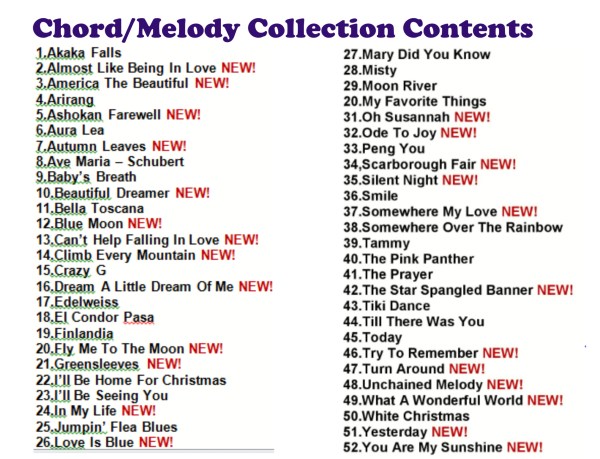
Each of the current 3 eBooks within the Chord/Melody series may be purchased separately or all together at a combined discount:

Questions regarding any Ukulele resource, please email: TheUkuleleMan2012@hotmail.com

“Plaisir d’amour” (literally “The pleasure of love”) is a classical French love song written in 1784 by Jean-Paul-Égide Martini (1741–1816); it took its text from a poem by Jean-Pierre Claris de Florian (1755–1794), which appears in his novel Célestine.
We learn from internet source Wikipedia that notable classical singers who have recorded Martini’s original song include Rosa Ponselle, Victoria de los Ángeles, Tito Schipa, Fritz Wunderlich, Elisabeth Schwarzkopf, Janet Baker, Inessa Galante, Yvonne Kenny and many others.
Notable interpretations of modern arrangements of the song include those of Karrin Allyson, Joan Baez, Brigitte Bardot, Vicki Brown, Charlotte Church, Marianne Faithfull, Nana Mouskouri and The Seekers;
One of the more unusual recordings is by Paul Robeson. Notable appearances in films include Irene Dunne in Love Affair; Montgomery Clift played the music on the piano and sang the song as well in The Heiress; the song’s music is featured in the opening of the 1955 movie We’re No Angels; Joely Richardson, as Marie Antoinette, sings it in the 2001 film The Affair of the Necklace; “Plaisir d’amour” is sung by a children’s choir in “The Breaking Point”, an episode of HBO’s 2001 World War II television miniseries Band of Brothers; the 1987 movie La Famiglia by Ettore Scola; the tune is heard repeatedly in the 1977 film March or Die. The melody was used for several songs with new lyrics, including “Can’t Help Falling in Love”, with Elvis Presley.
PERFORMANCE OF THIS ARRANGEMENT:
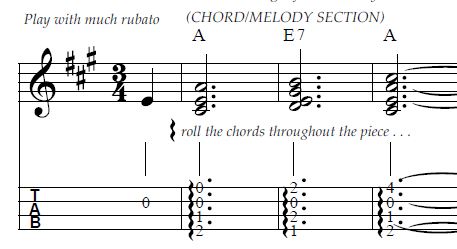
I have arranged this beautiful classic song into 3 distinct sections. The first section was arranged in a basic Chord/Melody version. Typically in this style, simply strumming the chord with the melody usually on the highest string allows for both accompaniment and melody to be played simultaneously. To give more richness, color and sustain to the strummed chords I recommend a slow rolling strum with the thumb.
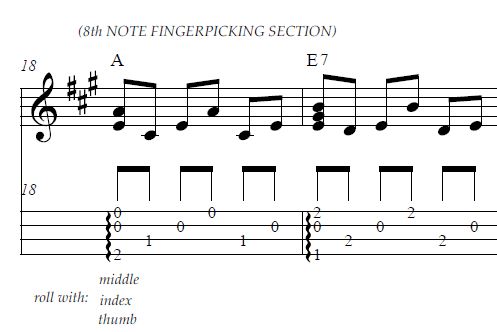
The 2nd section is a standard 8th note fingerpicking pattern. Middle finger or m plays the 1st string. Index finger or I plays the 2nd string. Thumb or p plays the 3rd and 4th strings. The melody can vary generally from first string to second string. On occasion the melody can be on the 3rd string, in which case it is played by the thumb.
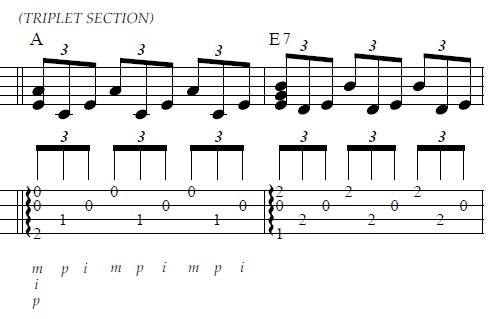
The 3rd section uses a triplet figure in 4/4 time exactly like the Bach/Gounod Ave Maria or such classics as Beethoven’s Moonlight Sonata.
Note that in most tablature arrangements but simply following the chord indications given above will most often set up the left hand fingers for the notes to be played. Often one only needs to add a finger or move a finger up and down to grab the notes needed for the melody.
Below is an example, however, when the arrangement calls for an alternate or inverted position for a standard chord. In this case the D major chord. It requires the technique of barring to achieve this. This is a very good reason why it’s important to acquire the skill of barring.
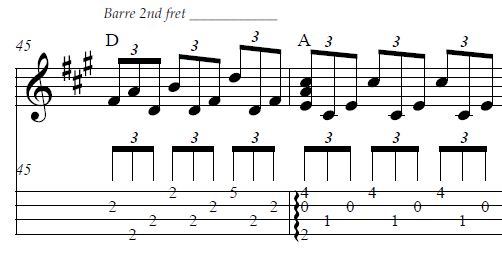
Tablature is available for purchase: $5.39 and can be purchased by paying through the paypal donate button on the Ukulele Mike website: http://www.ukulelemikelynch
Once purchased it will be emailed to you within the day.
By the way, a number of months ago I did a ukulele arrangement of the song Can’t Help Falling In Love by Elvis Presley which is based on Plaisir d’amour. Here is a VIMEO performance of this arrangement.
https://vimeo.com/45281449
Tablature for Can’t Help Falling In Love is also available for purchase: $5.39 and can be purchased by paying through the paypal donate button on my website: http://www.ukulelemikelynch.com
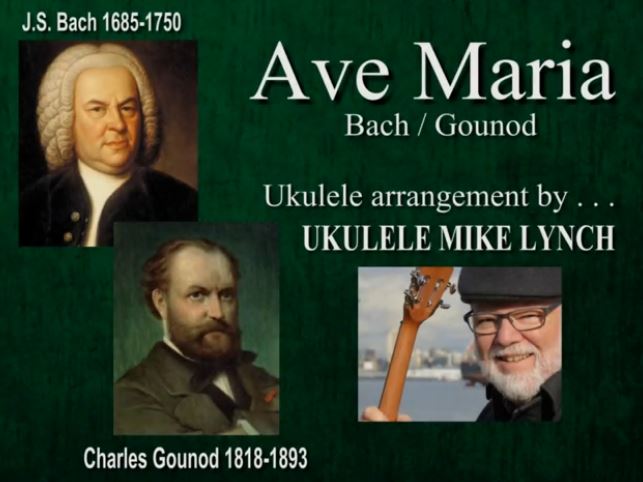
Ave Maria is a popular and much-recorded setting of the Latin text Ave Maria, originally published in 1853 as Méditation sur le Premier Prélude de Piano de S. Bach. The piece consists of a melody by the French Romantic composer Charles Gounod especially designed to be superimposed over the Prelude No. 1 in C major, BWV 846, from Book I of J.S. Bach’s The Well-Tempered Clavier, written some 137 years earlier.
Ukulele Mike Lynch has transposed this piece from the original Key of Cmaj to allow for a more practical fingering for standard GCEA ukulele tuning. By the way, this was arranged for standard High G Tuning. He’s broken away from the original 8th note figures that Bach utilized for his original Prelude in C maj and instead uses a rhythmic figure identical to Beethoven’s Moonlight Sonata. . . It’s in 4/4 time with 4 triplet 8th note figures in each measure. It’s a techniqhe that Ukulele Mike has chosen numerous times in such pieces as his Paris Nocturne Cherry Blossoms and in the French love song: Plaisir d’amour. Since the ukulele typically has very little sustain, by using this triplet figure it allows the chordal accompaniment to ring out longer and continue to sustain more consistently underneath the melody that rides on top. In most cases the Gounod melody is found on the first and second strings with just a few cases of the melody jumping over to the third or fourth string. Since this arrangement was writeen with a High G tuning the 4th string notes are crucial so don’t come off all that well with a Low G tuning. Sorry all of those you have ukes with Low G. . . That does bring up a point though, that it’s really important to consider having 2 ukes at hand. One with Low G, one with High G. Both tunings do have their strong points so having both at hand gives the player much more flexibility.
There are several right hand fingering patterns that are suggested in this arrangement.
p – Thumb
I – Index Finger
M – Middle Finger
Thumb plays 4th and 3rd strings
Index plays 2nd string
Middle finger plays 1st string
There are only a few minor times that this rule is broken in this piece.
So here are several of those fingerings used in this arrangement.
M P I M P I M P I M P I
M I P M I P M I P M I P
P I M P I M P I M P I M
This arrangement comes in both tablature as well as standard treble clef notation. Here is a small example from page one:

Here is a video performance by Ukulele Mike with voice over commentary:
https://vimeo.com/68666360
Tablature is available for purchase $5.39 by simply paying through the paypal donate button on the Ukulele Mike website: http://www.ukulelemikelynch.com Once purchased it will be emailed to you within the day.
Note: We also have available the UKULELE SOLO INSTRUMENTAL eBook 2013 Enlarged edition: $28.95 as well as several separate solo ukulele instrumentals: AKAKA FALLS, PLAISIR D’AMOUR available for purchase.
Fill in contact form below for feedback


 UKULELE MIKE LYNCH - All things UKULELE