PLEASE NOTE: My “UKULELE BASICS” DVD is currently available for purchase. . . For more information email me at mike@ukulelemikelynch.com
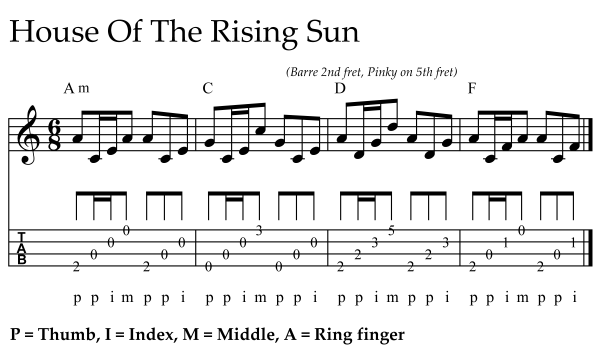
HOUSE OF THE RISING SUN - Picking Pattern in 6/8 time
I’ve had numerous responses and questions regarding my You Tube tutorial on “HOUSE OF THE RISING SUN”. In the process of interpreting this tun for the ukulele I dug down deep into my musical past when I was in college in the 60’s. I formed a small folk group at the time and were doing Peter Paul & Marry and Kingston Trio, Ian & Sylvia etc. etc. . . Along came Eric Burden and the Animals doing one of “OUR” folks songs. . . “HOUSE OF THE RISING SUN”. I remember being amazed that a rock group was doing a folk song but then this was a significant event in the birth of what soon became known as “Folk Rock” Many other groups were doing it as well. . . The Byrds, The Mamas & The Papas, The Lovin’ Spoonful and many others. . . it gave rise to a bit of grumbling and a slight revolution in the ranks, but eventually a good majority of the “folkies’ did come onboard. . . At any rate. . . The ANIMALS interpretation of HOUSE was thought pretty dang cool and all of us guitar pickers attempted to emulate that rolling 6/8 pattern that they did. . . Once we got that down we figured we were pretty cool and when we went on stage and opened up with that signature strum instantly everyone knew what song we were about to perform. . . It was GREAT!!!. . . Ok, so now how do we transfer that same feel to the ukulele. . . Acutally quite easy, even in spite of the fact that we have only 4 strings. So look above and you will see that I’ve notated the picking pattern. . . You will see the fingering notation given for the right hand as P I M A . . . That’s actually been around since the middle ages for string instrument players. It’s great because when you see PIMA you immediately know we are talking about the RIGHT HAND . . . Clearly, one of the most significant aspects of this pattern is that double thumb stroke. . . It takes a bit of practice to get that but once you do and it becomes automatic it will feel and sound very cool. . . So, have a listen to the video tutorial above and give a try to this classics 60’s remake of an old traditional american folk song. . . . “HAPPY STRUMMING” – UKULELE MIKE

PLEASE NOTE: My “UKULELE BASICS” DVD is currently available for purchase. . . For more information email me at mike@ukulelemikelynch.com
One day many years ago, upon leaving my music room and heading for the faculty lunchroom I met up with my principal in the school hall. I had in my hand my ever present uke. . . She said rather off handedly “Mike, did you know my grandfather invented the ukulele?” I stood there in silence for what seemed forever. . . In my mind I guess I always thought the ukulele just existed . . . not something that was invented and on top of that this lady was of portuguese desent not obviously “Hawaiian” (shows my total lack of knowledge about Hawaiian history). . . By the way her name was Mildred Nunes. . . So I responded. . . “Seriously? your grandfather invented the uke?” Yep, then she followed up with “do you know that I’m of portuguese ancestry?” Now, I knew she was born and raised in Hawaii but never really stopped to consider her ancestry. I said no. . . then she replied “well my grandfather came to Hawaii in the late 1800s and when he arrived he invented the ukulele”. . . I was dumbfounded, of course. I had no idea . . . I thought perhaps she’s just stretching the truth a bit? She didn’t elaborate on the story so upon arriving home I immediately went to do some research on the subject and discovered that sure enough one Manuel NUNES came from Portugal to the shores of Hawaii in the late 1800’s bringing with him a small 4 string guitar the Cavaquinho that was a traditional instrument of Portugal and that he not only played it but being a cabinet maker he could also build them. . . And from there it all started. . . Now in his day he would publicize himself as the “INVENTOR” of the ukulele. . . It was a great sales gimmick and worked, but in truth he didn’t REALLY invent it but he surely helped to popularize it . . . Making instruments for the Queen of Hawaii herself. . . In fact, once she played it all the islanders wanted one as well. Now, knowing the back story and seeing how I kinda fit into the legacy. . . teaching under Manuel Nunes’ granddaughter. . . It only seemed right that I should begin to introduce it to my students and eventually it became a core element in my music curriculum at the school. Since that day I’ve taught over 400 young people to play the uke and all because I took my uke to lunch.
AN ADDENDUM: Of course, over the years that number increased tremendously and while teaching there I got the inspiration to open up a YOU TUBE account. I uploaded various lessons initially just for my classroom music students. Little did I totally understand the unique power of the internet. Within a very short time my little classroom became a global classroom. Thank you, Mildred Nunes, for inspiring me and supporting my efforts to build the Ukulele program at our school.
“HAPPY STRUMMING”
Mike Lynch
Beginners Ukulele DVD combo pak available for purchase . . . Includes a full companion eBook. .
$30.00 plus $3.00 shipping in the US $7.00 shipping outside the US . Make payment through the paypal donate button on the Ukulele Mike website: http://www.ukulelemikelynch.com The companion book will be emailed to you within the date of purchase and your DVD will be shipped to you right away.
Questions regarding any Ukulele resource please email TheUkuleleMan2012@hotmail.com
FINGERPICKING – A Basic Lesson by “UKULELE MIKE”
PLEASE NOTE: My “UKULELE BASICS” DVD is currently available for purchase. . . For more information email me at mike@ukulelemikelynch.com
I’ve had SO many students online who have asked me how they can learn to fingerpick. Having basic fingerpicking skills allows a player to provide not only a great depth of styling to accompaniment for singing but also gives the student techniques that will allow them to play purely instrumental pieces. The ukulele belongs to that long lived family of instruments in which the guitar, the mandolin, the banjo etc. are all members and so we can go back many hundreds of years to draw on some wisdom regarding fingering technique and notation. Since we have numbers allocated to strings, frets and left hand fingers, players of stringed instruments going back to the Middle Ages have employed a “LETTER” method of denoting the fingers of the right hand. The fingers are labeled as PIMA. In other words, “P” represents the thumb, “I” represents the index finger, and so on. The letters derive from spanish words for the fingers. So just about everything with fingerpicking will name the fingers by the PIMA method. The pinky finger is not used much and therefore does not have a letter to go by. Players who do a lot of fingerpicking will often “culture” their nails, keeping them somewhat long, rounded, shaped, and smooth. . . But the fingernail is not necessary to do fingerpicking. Let’s start with what I call “MY RULE OF THUMB” . . . no pun intended ha ha ha. The thumb or “P” is allocated to the 4th and 3rd strings. . . The Index or “I” finger is allocated to the 2nd string and the Middle or “M” finger takes care of the 1st string. That’s my “RULE OF THUMB” stick to it or your fingers will be ALL OVER THE PLACE. Ok, so here is a new word: ARPEGGIO . . .Most musical terms are in Italian. . . Don’t ask me why. . . long story. . . Anyways. . . What one does when they fingerpick to accompany singing is to basically break up the chord into it’s separate notes in some sort of smooth, rolling fashion in time with the song. Imagine a harpist in the symphony orchestra. . . fingers gracefully rolling across the strings. . . breaking up the chord in time with the music. . . get it: ARPpeggio. . . HARPpeggio. . . that’s where the word derives from. So lets start with a VERY basic 4/4 ARPEGGIO. You can do this on open strings or select any chord you want. Place your thumb or “P” on the 4th string . . . Index or “I” finger on the 2nd string. Middle or “M” finger on the 1st string. . . now simply play “P” then “I” then “M” then “I” so the pattern looks like this PIMI
PIMIPIMI would complete an entire 4/4 measure . . . Now lets add one more element . . . The first “P” plays the 4th string . . . The second “P” plays the 3rd string. So now we have an alternating thumb . . . This gives the pattern much more interest. It will take some time and patience to acquire the “muscle memory” of your fingers to keep this pattern going without any interruptions. Keep the beats all even . . . In time you can work in some syncopation but not recommended in the beginning. Don’t attempt to do chord changes with this pattern until you’ve really developed the “muscle memory” in your right hand first. . . The key to doing that, of course, is DAILY repetitive practice. Nothing can substitutue for consistent practice. So there you have it . . . begin to enhance your playing with some fingerpicking technique and in future blogs I’ll be showing you some more patterns and combinations . . .
HAPPY STRUMMING
Mike Lynch
GIVING NEW LIFE TO A BASIC UKE STRUM – by “UKULELE MIKE”
PLEASE NOTE: My “UKULELE BASICS” DVD is currently available for purchase. . . For more information email me at mike@ukulelemikelynch.com
GIVING A SIMPLE UKE STRUM NEW LIFE from “UKULELE MIKE”
We have all used the simple strum of DOWN UP DOWN UP DOWN UP DOWN UP . . . right?
But listen to this. . . It’s boring and lifeless . . . It can’t be played in a heavy handed unmusical way if you want your playing to sound professional and compelling. So, how can we change that? How can we give the most basic uke strum of all a new lease on life?
HERE IS THE ANSWER!! First, try doing the strum in THIS fashion: down up DOWN up down up DOWN up Notice the DOWN strums in upper case? Those are called the back beats and they need to be accented. . . given more force. Another element to add to this would be to play the top strings (4th and 3rd) on the down beat and the bottom two (2nd and 1st) on the back or accented beat. Doing this “ENHANCED” strum is guaranteed to give your playing a more professional and compelling feel. It may take lots of daily practice to accomplish but I tell you it’s worth it. . . trust me. . . In future blogs I will talk about how we can combine strums in the same song. Another great way to give your playing more interest and keep your audience listening.
“HAPPY STRUMMING”
Mike Lynch
PLEASE NOTE: My “UKULELE BASICS” DVD is currently available for purchase. . . For more information email me at mike@ukulelemikelynch.com
PARIS NOCTURNE
CHERRY BLOSSOMS
RIVER OF DREAMS
Two summers ago I was taking a break from work and
spending some moments down at the local beach here in Edmonds. . . Bright sunny
day and the Olympic Mountains were resplendent across the sound.
My ever present uke was in my hands as I was randomly
strumming and picking some chords just to relax and let my mind be free. It’s during these moments that my most
creative thoughts come to me.
Working my fingers up and down the first string, idly
playing a comfortable melody that fit well under my fingers I began to discover
a tune that appealed to me. I
immediately repeated the melody over and over and soon a more developed line
began to form. (The genesis of a new
composition) . . . I often wonder if the great masters of the past wrote that
way. . . Ever considered how George Frideric Handel may have written his
Christmas classic JOY TO THE WORLD? . . . was he perhaps sitting at the harpsichord and just idly playing a
simple diatonic scale in reverse??? That
is, after all, the central theme of Joy To The World: C B A G F E D C.
Although I was here on the Pacific Coast of USA my mind
began to drift to far away Paris and the River Seine. . . A late evening walk
along the promenade near the Notre Dame cathedral. Voila!!! “PARIS NOCTURNE” was born:
During the process of composing I will try ideas. . .
include them, then decide later to remove them or modify them. Those that are not kept, however, seem to
stay with me for a long time. I file
them away for future reference. . . Months later after releasing “PARIS
NOCTURNE” I found myself in a similar
reflective moment and reached into that “file” and pulled out those ideas that didn’t
seem to work in “Nocturne”. . . In time. . . I think it took maybe a week . . . I
finished the last touches on “CHERRY BLOSSOMS” In composing “CHERRY BLOSSOMS” I consciously
tried to create a similar feeling to “PARIS NOCTURNE” I retained the same key. . . . Kept the melody mostly on the first string and of course kept the reflective feel . . . . you might say they became a sort of couplet.
Since my earliest days of classical piano study I’ve
always had a great love for the music of the French composer Eric Satie. He composed a trilogy of pieces for the piano
called The Gymnopedies. Soft, gentle,
almost lullaby like reflective pieces. I
could identify elements of my 2 pieces in the Gymnopedies so then I set out to
finish MY trilogy. . . I titled it the “DREAMSCAPE” TRILOGY. Once again I went back to my “files” for some
compositional elements. . . I drew them together with entirely new material and
created “RIVER OF DREAMS” http://www.youtube.com/watch?v=l3hg7Oll10Q
This is MY process as a composer and I think I share it
with many many other composers and songwriters.
It’s always a combination of inspiration mixed with some semblance of
structure and format. You try ideas. . . consider them. . . keep them or perhaps modify them or throw them out entirely. At the heart of it though the music always seems to come from somewhere deep within. It’s frankly a mystery to me how that
happens. . . There’s no way to explain it. Why, when I came to the beach to rest did I feel some need to create something new. I certainly never really set out to compose a trilogy.
. . In fact, I didn’t’ even set out to write a couplet of pieces . . . But . . .
undeniably the moment in which “PARIS NOCTURNE” was born on that warm summer day
at the beach so was the seed of the “DREAMSCAPE TRILOGY”
“HAPPY STRUMMING”
Mike Lynch
UKULELE MIKE does tutorials of 2 JIVE ACES hits
PLEASE NOTE: My “UKULELE BASICS” DVD is currently available for purchase. . . For more information email me at mike@ukulelemikelynch.com
You have perhaps seen and heard a couple of my You Tube video lessons that covered 2 songs that have been performed and recorded by UK’s Jive Aces. Ian Clarkson, trumpet and lead vocalist for the Jive Aces, has recently taken on the ukulele as a
central instrument in the ensemble and it really speaks to both the music of the Jive style plus the legacy of the ukulele.. . Typically the 2 would not have been combined. . . I’m speaking here of a 16 piece swing/jive band along with the charming, delightful, captivating little ukulele. . . But the Jive Aces have done that combo quite nicely.

In describing their music they say Jive is that music that resides somewhere between Big Band and the early rock style of
performers such as Bill Hailey and The Comets with such songs as Rock Around The Clock. The ukulele is a shoe in for
that kind of music. Just look at the wonderful tunes of the 20s and 30s done by such icons as Cliff “Ukulele Ike”
Edwards or the British Ukulele master George Formby. The uke fits with swing music like bread with butter or milk with cookies. The Jive Aces produced a music video for their cover of the well known Morecambe and Wise theme song Bring Me Sunshine in a Louis Prima jive style and put in on You Tube on March 17th. http://www.youtube.com/watch?v=oXvJ8UquYoo It got 50,000 views in the first week and at present I think it has over a million views. . . A concrete testament to the still vibrant popularity of that musical era and the current incredible popularity of the MIGHTY UKULELE!!!
I’ve done a tutorial lesson on Bring Me Sunshine which is on my MusicTeacher2010 You Tube channel. http://www.youtube.com/watch?v=1B8GqsXgw4Q I also did a tutorial on the song I Wanna Be Like You from Walt Disney’s Jungle Book http://www.youtube.com/watch?v=kmtt7qrVce8and It will be featured on the Jive Aces upcoming CD. Take a look at my videos of these two songs
and try them on your uke. I’m sure you’ll be delighted to learn them.
“HAPPY STRUMMING”
Mike Lynch
CHECK OUT THESE VIDEO TUTORIALS:
PLEASE NOTE: My “UKULELE BASICS” DVD is currently available for purchase. . . For more information email me at mike@ukulelemikelynch.com
This is my very first posting to my official BLOG site. . . It is my purpose here to share thoughts, tips, news, new music, video lessons, upcoming events. . . You name it. . . Anything and everything that crosses my path everyday in my constant pursuit of all things UKULELE!!! Stay tuned and please pass this blog link to all of your ukulele friends wherever they may be.
HAPPY STRUMMING
Mike Lynch
JAZZ UKULELE TUTORIALS by “UKULELE MIKE” LYNCH
PLEASE NOTE: My “UKULELE BASICS” DVD is currently available for purchase. . . For more information email me at mike@ukulelemikelynch.com
My background musically has been largely classically based. . . Classical piano from the age of 4. Majored in Music Composition in College and played mostly folk, classical, pop and worship music most of my life. Although I’ve always had a great love for Jazz recently I’ve actually begun to take up the study of Jazz as it applies to the ukulele. I figure at any age we can always expand our horizons and grow some more brain cells. . . God knows at my age, I need to build some more of those ha ha ha. . . Over this past year I’ve been struck by the work of Glen Rose and Kimo Hussey in regards to Ukulele Jazz performance. Their videos, books,CDs and instructional materials are outstanding. Inspired by these great teachers I’ve launched my new You Tube Ukulele Jazz Series on my MusicTeacher2010 channel. It’s my humble attempt intially to just open the doors for so many who have never had the good fortune of venturing into the Jazz structures and elements of the ukulele. I now have lessons 1 & 2 posted and will be doing more as the months roll on. Take a peek at lesson 1 to start with and treat your ears to these delicious new sounds. My Lesson #1 can be found at: http://www.youtube.com/watch?v=F9qn__22hSQ
WHAT SIZE UKULELE FOR BEGINNERS?
PLEASE NOTE: My “UKULELE BASICS” DVD is currently available for purchase. . . For more information email me at mike@ukulelemikelynch.com
I’ve had this question asked of me hundreds of times and honestly I can’t come up with a perfect answer. As many of us know there are several sizes of ukuleles. . . The smallest and most traditional size would, of course, be what we call the SOPRANO. Nowadays it is tuned GCEA with G being the 4th string or the nearest one to your chin. . . Now in past years it had several tunings. . . If you’ve ever browsed thru old sheet music collections in antique stores you may come across a tune from the 20s or 30s that says UKULELE CHORDS . . . You open it up and begin to play and you discover it doesnt sound in the same key as the piano accompaniment only to find that they dont have the uke tuned to GCEA but to some other tuning. . . Well nevertheless that tuning was intially intended for the soprano uke. THEN. . . along came a slightly bigger uke. . . the CONCERT . . . not a whole lot bigger but still bigger. . . Bigger sound, bigger body, somewhat deeper tone then the SOPRANO, perhaps longer neck . . . but. . . tuned the same as the SOPRANO. . . So, not to be outdone the manufacturers came out with a slightly larger model . . . the TENOR . . . Same tuning as the CONCERT and SOPRANO but oh SO much bigger and deeper and in fact most professional concert artists like Jake Shimabukuro and Lyle Ritz play the TENOR model. . . So there you have it . . . if you don’t mention the BARITONE!!!! Oh my . . . MUCH MUCH bigger and in fact almost feels and sounds like a small guitar. . . Different tuning though so we will keep the BARITONE for a later article. So. . . going back to that question. . . Which one to start one. . . Doesn’t really matter . . . but just be sure if you purchase any of them please dont settle for a $20 instrument. You will be sadly disappointed and truthfully it will NEVER really represent the skills you will be developing in just a very short period of time. I’ve had SO many students who have become frustrated with their inexpensive instruments. . . thinking it is THEY that are doing something wrong and not the instrument. I’ve seen so many delighted students who FINALLY advance to a higher quality instrument. It makes all the difference in the world. . . For me, I prefer the TENOR mostly because of my hand size, but I trully do play all of the size and enjoy them for what they are. . . . “HAPPY STRUMMING”
THE KEYPORT RAG an Original Ukulele Rag by UKULELE MIKE

PLEASE NOTE: My “UKULELE BASICS” DVD is currently available for purchase. . . For more information email me at mike@ukulelemikelynch.com

Spent a relaxing few days last week in a cottage overlooking Liberty Bay in the small town of Keyport, Washington USA. . . Population about 415 with a small established Naval base attached. While enjoying the tranquil nature of the town. . . Sitting on the deck watching boaters sail or kayak by, I was inspired to compose this fun little rag. Typically, most songs come to me on the spur of the moment while improvising or just lazily playing about on my uke or piano or guitar. Very soon the character of this piece really struck me and I knew instantly that it would become a full fledged tune. So off I went to begin developing the song. Ideas came left and right. . . too many at times, which is common for me and most composers, I think. By the evening I felt I had the song pretty much intact. . . WRONG!!! next morning I woke up and picked up my uke. . . strolled out onto the deck and began to play it again and VOILA!!! another entirely new B section came into existence. . . Where in the world did it come from? I asked myself. . . Why had I not thought of that yesterday? Well this is the world of songwriting . . . It happens so very often that certain ideas just dont become evident until a short or even long period of time elapses. I’ve often wondered if many of the classic standards we know and cherish today such as Over The Rainbow or I’ll Be Seeing You . . . Or Tonight You Belong To me would have been entirely different if the songwriters were given the liberty to re write say, a year or two later. . . Actually one example I can cite is MARIE by Irving Berlin. . . intially composed in the early 20th century. . . it was written as a waltz. . . Later in his life he decided to re write it as a 4/4 time fox trot . . Interesting . . . Anyways, hope you might take some time to give my KEYPORT RAG a listen. . . If you are a ukulele player there is also a notated tablature available for purchase. . . The You Tube link for this tune is: http://www.youtube.com/watch?v=-x3fbC8isyM
 UKULELE MIKE LYNCH - All things UKULELE